
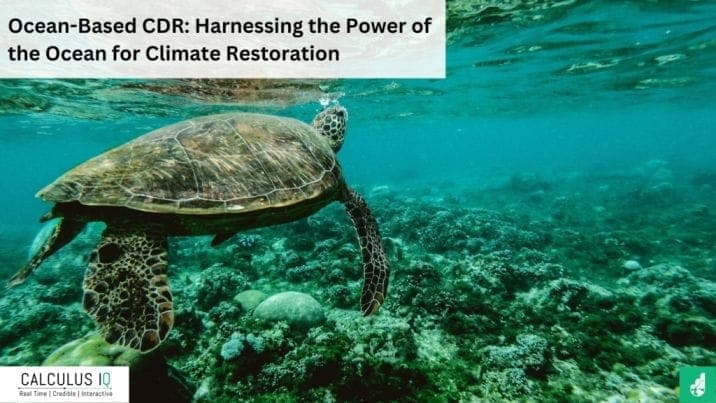
Introduction: Navigating the Ocean-Climate Interplay

The symbiotic relationship between the ocean and the climate, orchestrating the intricacies of weather patterns and global systems, is now at a critical juncture. Over the past 170 years, the accumulated emissions of greenhouse gases have set off a disruptive chain reaction, threatening the delicate balance of this intricate dance. Traditionally, climate mitigation efforts have primarily concentrated on reducing emissions at their source. However, as we confront the escalating challenges of a changing climate, the Intergovernmental Panel on Climate Change (IPCC) underscores the imperative for an additional dimension – large-scale Carbon Dioxide Removal (CDR).
In the context of climate change mitigation, the term CDR refers to the deliberate extraction of carbon dioxide from the atmosphere to limit the rise in global temperatures. This becomes increasingly crucial as the world grapples with the consequences of historical emissions. Herein lies the significance of ocean-based CDR, a burgeoning approach that offers unparalleled potential in comparison to terrestrial alternatives. The expansive reach of the ocean, covering 71% of the Earth's surface, becomes a vast canvas for innovative solutions capable of mitigating the impacts of climate change on a colossal scale.
The Ocean as a Climate Solution: Leveraging its Vast Carbon Reservoir
Various ocean-based approaches are currently under exploration, harnessing the inherent biological and chemical processes of the ocean to counteract the impacts of climate change.
Types of Ocean-Based Carbon Removal Methods:

Image 1: Approaches used for Carbon removal in Ocean (Source: WRI)
- Coastal Wetland Restoration:
- Description: This well-established method focuses on restoring coastal wetlands, emphasizing resilience and ecosystem benefits. The primary goal is to sequester carbon naturally within these ecosystems.
- Benefits: Enhances ecosystem health, supports biodiversity, and provides coastal protection.
- Alkalinity Enhancement:
- Description: Involves the addition of specific minerals to seawater, enabling increased absorption of atmospheric CO2 into the ocean. This process may also contribute to reducing ocean acidity.
- Benefits: Augments the ocean's natural ability to absorb carbon, potentially addressing ocean acidification concerns.
- Electrochemical Methods:
- Description: Utilizes electricity to mimic alkalinity enhancement or directly extracts CO2 from seawater for storage on land. Represents a technological approach to enhance carbon sequestration.
- Benefits: Offers a technological solution to accelerate carbon removal, especially in areas with limited natural processes.
- Artificial Downwelling:
- Description: Accelerates natural ocean currents that transport carbon-rich surface water into the deep ocean in polar regions.
- Benefits: Aims to enhance the ocean's natural carbon sink capacity, particularly in the Arctic and Antarctic.
- Seaweed Cultivation:
- Description: Involves the cultivation of seaweed, which can be later sunk to the deep ocean or seafloor, storing carbon within the biomass.
- Benefits: Utilizes marine plants for carbon sequestration, promoting sustainable seaweed farming practices.
- Ocean Fertilization:
- Description: Adds nutrients like iron to the ocean, stimulating phytoplankton growth. Phytoplankton absorbs CO2, converts it to biomass, and some sinks to the deep ocean, sequestering carbon.
- Benefits: Leverages the ocean's biological carbon pump to enhance carbon removal.
- Artificial Upwelling:
- Description: Aims to move deeper, nutrient-rich water to the ocean's surface, stimulating phytoplankton growth and enhancing the carbon sequestration process.
- Benefits: Promotes the growth of marine organisms that contribute to carbon removal.
These diverse approaches underscore the multifaceted nature of ocean-based carbon removal, reflecting a combination of natural processes and innovative technologies aimed at mitigating the impacts of climate change.
The Cost-Effectiveness Dilemma: Navigating Uncertainties in Ocean-Based Carbon Removal

Image 2: Berkeley Lab oceanographer measures how the ocean absorbs carbon dioxide from the atmosphere.
The exploration of ocean-based Carbon Dioxide Removal (CDR) methods brings forth a significant challenge concerning their cost-effectiveness. While the potential benefits are promising, the current landscape is marked by early developmental stages, presenting uncertainties in efficacy, scalability, and long-term impacts. Addressing the cost-effectiveness dilemma requires careful consideration of several key factors:
- Efficacy Concerns:
- Limited Field Testing: The majority of ocean-based CDR approaches lack extensive field testing, leaving uncertainties about their real-world effectiveness.
- Varied Methodologies: The diverse range of approaches, from coastal wetland restoration to biotic and abiotic methods, makes it challenging to gauge the overall efficacy without comprehensive testing.
- Scalability Challenges:
- Developmental Stage: Many ocean-based CDR technologies are still in their infancy, posing challenges in scaling up operations to meet the demands for substantial carbon removal.
- Infrastructure and Logistics: The scalability of these approaches depends on the development of robust infrastructure and logistical frameworks, adding complexity to the scaling process.
- Long-Term Impacts:
- Environmental Impact Assessment: The absence of extensive field testing makes it difficult to assess the long-term ecological consequences of implementing these technologies.
- Unforeseen Consequences: Lack of empirical data raises concerns about unforeseen impacts on marine ecosystems and biodiversity, potentially offsetting the long-term benefits.
- Investment Signals and Industry Interest:
- Growing Interest: Companies like Stripe and Shopify investing in ocean-based CDR ventures indicate a rising interest in these solutions.
- Need for Validation: Despite financial support, the lack of widespread field testing implies a need for further validation to justify long-term investments.
- Feasibility Challenges:
- Technological Viability: The feasibility of ocean-based CDR approaches is contingent on the successful development and deployment of innovative technologies, yet to be proven in practical applications.
- Regulatory Hurdles: Evolving regulatory frameworks add an additional layer of complexity, influencing the feasibility of large-scale deployment.
- Cost-Effectiveness Evaluation:
- Comparative Analysis: The lack of a comprehensive understanding of the comparative cost-effectiveness of different ocean-based CDR methods hinders informed decision-making.
- Economic Viability: Assessing the economic viability of these approaches requires rigorous testing and data collection to determine their efficiency over time.
Navigating the cost-effectiveness dilemma in ocean-based CDR necessitates addressing these challenges through increased research, robust field testing, and collaborative efforts. As the industry strives for clarity, resolving these uncertainties is crucial for ensuring the successful integration of ocean-based carbon removal into broader climate change mitigation strategies.
The Current State of Ocean-based Carbon Removal
Governments globally recognize the significance of Carbon Dioxide Removal (CDR) in their long-term climate strategies, with a specific focus on ocean-based solutions. Despite this recognition, the current state of ocean-based CDR presents challenges and uncertainties:
- Inclusion in Climate Strategies:
- Governments worldwide have incorporated ocean-based CDR into their climate action plans.
- Recognition of the ocean's role in sequestering carbon is evident in strategic initiatives aimed at mitigating climate change.
- Governance Challenges:
- Ocean-based CDR lacks a robust and comprehensive governance framework.
- Existing regulatory structures struggle to address the unique complexities associated with ocean CDR, creating regulatory gaps.
- The absence of a unified governance approach hampers effective oversight and coordination.
- Issues in High Seas Regulation:
- The regulatory difficulties are particularly pronounced in the high seas, where jurisdictional challenges complicate oversight.
- Governance frameworks designed for terrestrial environments often fall short when applied to the vast and challenging high seas.
- Surge in Investments:
- Investments in ocean-based CDR projects are on the rise, reflecting growing interest and confidence in the potential of these solutions.
- Financial support from various sources, including private companies and philanthropic entities, underscores the perceived importance of ocean-based CDR.
- Responsible Development Imperative:
- As investments surge, the emphasis on responsible development intensifies.
- Stakeholders recognize the need to address potential environmental and social risks associated with the deployment of ocean-based CDR technologies.
- The urgency to balance innovation with ethical and sustainable practices is increasingly acknowledged.
- Environmental and Social Considerations:
- The ecological impact of large-scale ocean-based CDR interventions raises concerns.
- Potential social consequences, particularly for communities dependent on marine ecosystems, necessitate careful evaluation and mitigation strategies.
- Call for Comprehensive Governance:
- Stakeholders, including environmental groups and scientists, advocate for the development of a comprehensive and adaptive governance framework tailored to the unique challenges of ocean-based CDR.
- A unified approach is seen as crucial for addressing regulatory gaps, ensuring transparency, and fostering international collaboration.
In summary, while ocean-based CDR holds promise, the current state reveals a need for urgent attention to governance issues. As investments increase, the imperative for responsible and sustainable development becomes a central focus, demanding a delicate balance between innovation and the preservation of environmental and social integrity.
Responsible Governance for Ocean Carbon Removal

Chart 1: Ocean Maritime Boundaries (Source WRI)
Responsible governance for ocean carbon removal demands a comprehensive and holistic approach, considering the entire lifecycle of projects. This involves meticulous attention to various aspects to ensure the ethical, sustainable, and equitable development of ocean-based carbon dioxide removal (CDR) solutions. Here's an elaboration on the key components:
- Lifecycle Approach: A thorough understanding of the project's entire lifecycle is essential. This encompasses the planning, implementation, and conclusion phases, emphasizing the need for responsible practices from inception to completion. It involves continuous evaluation, monitoring, and adaptation to evolving circumstances.
- Alignment with Sustainable Ocean Management Frameworks: Projects must align with established sustainable ocean management frameworks. This ensures that ocean-based CDR initiatives adhere to existing guidelines aimed at preserving the health and resilience of marine ecosystems. The alignment fosters harmony between CDR efforts and broader ocean conservation goals.
- Codes of Conduct: Implementation of explicit codes of conduct is crucial. These codes lay out the ethical principles, standards, and guidelines that govern the conduct of all involved parties. They serve as a moral compass, delineating acceptable practices, ensuring transparency, and promoting accountability throughout the project's lifecycle.
- Stakeholder Engagement: Involving a diverse range of stakeholders is paramount. This includes representatives from local communities, scientific communities, environmental organizations, and governmental bodies. Engaging stakeholders fosters inclusivity, considers diverse perspectives, and incorporates valuable insights into decision-making processes.
- International Code of Conduct: Given the global nature of ocean-based CDR projects, an international code of conduct is imperative. This overarching framework sets universal standards and guidelines applicable across borders. It addresses equity issues related to project benefits, outlines rules for intellectual property, and establishes mechanisms for fair benefit sharing.
- Equity Issues: The governance framework must explicitly address equity concerns. This involves ensuring fair distribution of project benefits, considering the impact on vulnerable communities, and preventing any undue concentration of advantages. Equity considerations extend to intellectual property rights and the fair commercialization of project outcomes.
- Intellectual Property: Clear rules regarding intellectual property are essential. This includes determining ownership of innovations and technologies developed during the project. Addressing intellectual property issues ensures that benefits derived from advancements are appropriately shared among project collaborators and stakeholders.
In essence, the responsible governance framework is a multifaceted system that combines ethical considerations, stakeholder inclusivity, and clear guidelines to navigate the complexities of ocean-based carbon removal initiatives. Developing and adhering to such a framework is fundamental to ensuring that these projects contribute positively to the global climate agenda without compromising the integrity of the ocean environment or marginalizing affected communities.
Conclusion: Moving Forward Responsibly
In the concluding segment, it is emphasized that the journey toward ocean-based carbon removal (CDR) demands a thoughtful and flexible strategy. This involves continual refinement based on insights gained from ongoing research and testing. A crucial element in this process is the infusion of additional research funding, acknowledging the complexities and uncertainties surrounding the development of ocean-based CDR solutions. The goal is to identify approaches that are not only viable but also carry minimal ecological and societal impacts.
Collaboration becomes a cornerstone as governments and stakeholders are urged to work in tandem. The establishment of governance frameworks is advocated, with a specific emphasis on formulating an international code of conduct for research trials. This regulatory framework aims to ensure responsible conduct, transparency, and inclusivity in developing and testing ocean-based CDR methods. Such collaboration and regulatory measures are deemed essential in navigating the uncharted waters of ocean carbon removal, providing a structured pathway for ethical and sustainable development.
The mention of initiating a process for exploring a new international framework underscores the need for a comprehensive, global approach to ocean-based CDR. This initiative lays the groundwork for the responsible deployment of large-scale solutions. The emphasis on "responsible development" encapsulates the core theme—recognizing the potential of ocean-based carbon removal while underscoring the importance of a cautious, ethical, and socially conscious approach.
In the final sentences, the urgent imperative of climate action is acknowledged. However, it is juxtaposed with the call for a meticulous consideration of environmental and social impacts. The concluding message stresses that the trajectory toward a sustainable and equitable future requires company's and investors' commitment. This commitment spans across the realms of research, governance, and ethical practices, forming the bedrock for a responsible and inclusive approach to ocean-based carbon removal.