
Project Finance · CDR · Same-Bank Prototype
Same Bank on Both Sides: The Charm-JPMorgan Prototype for Carbon Project Finance
JPMorgan's June 2026 combination of a USD 20M venture debt facility to Charm Industrial with a 61,500-tonne carbon removal offtake is the same bank on both sides of the trade. That is how project finance for engineered carbon removal begins to become underwritable.
The Deal That Read Like a Second Offtake But Was Not
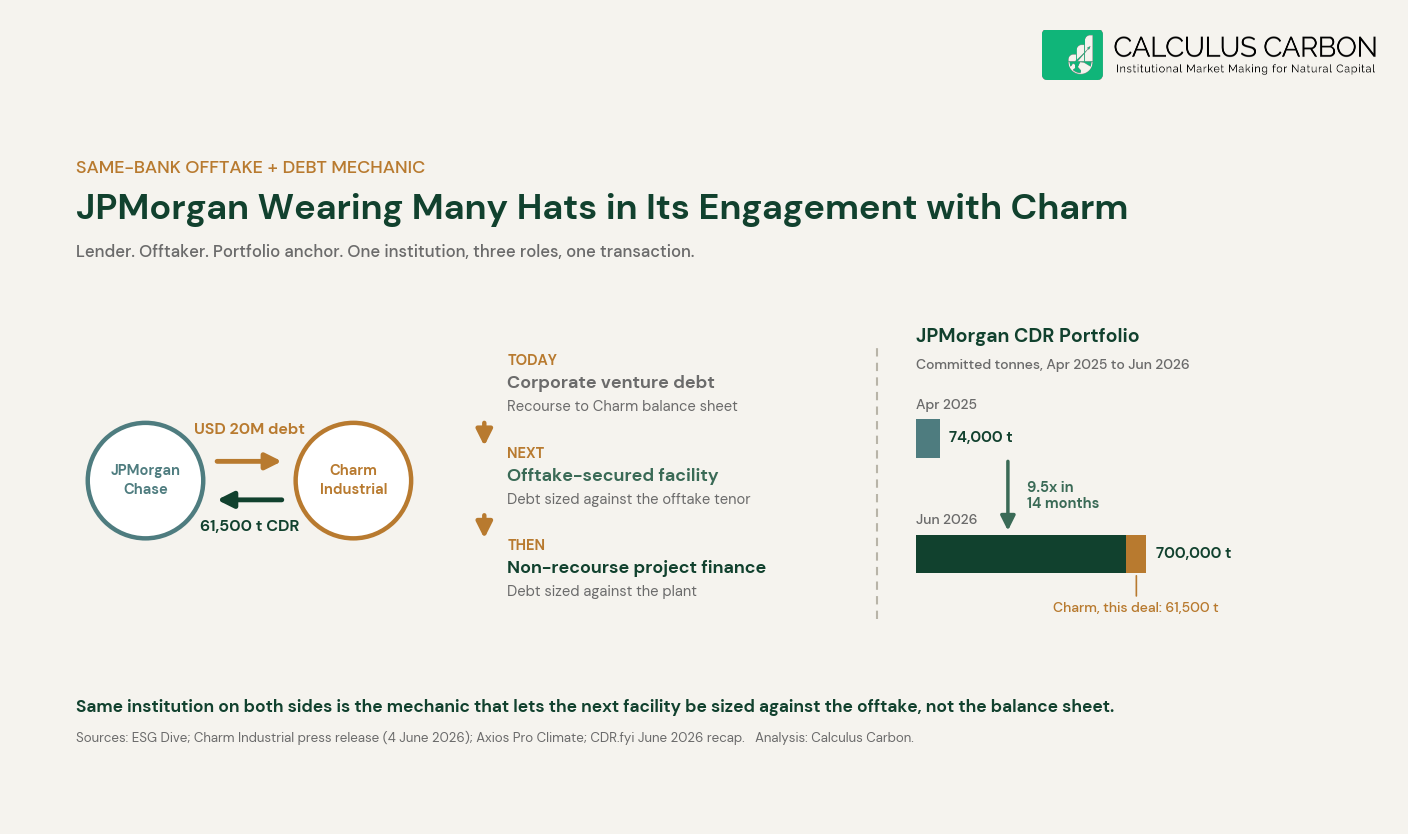
On 4 June 2026, JPMorgan Chase and Charm Industrial announced a combined transaction: a fresh 61,500-tonne bio-oil carbon removal offtake, and a USD 20M venture debt facility from the bank to the developer.1,2 The offtake brings the two counterparties to roughly 90,000 tonnes of contracted removals since their 2023 relationship began.2 The debt lands on Charm's corporate balance sheet, earmarked for the Fort Lupton, Colorado facility that runs the pyrolysis and injection lines.2,3
The headline read like a second offtake with a financing sweetener. Read again. The bank writing the cheque for the credits is the same bank writing the cheque for the equipment that produces the credits. That is not a sweetener. That is the same institution sitting on both sides of the trade, and it is how project finance for engineered carbon removal begins to become underwritable.
What the USD 20M Actually Is
Venture debt is not project finance yet. The USD 20M is corporate-level, recourse to Charm's balance sheet, priced against the enterprise not against a specific facility or a specific tonne.3 The proceeds are ring-fenced by use, not by security: expanding the Fort Lupton pyrolysis plant, adding injection capacity for the underground wells, and hiring pyrolysis operators to feed the throughput ramp.2
Project finance in the traditional sense requires a special purpose vehicle, a bankable revenue contract long enough to cover the debt tenor, insurance layers that absorb operating risk, and a non-recourse ring-fence so the sponsor's balance sheet is not the collateral. Charm's transaction has none of those items in the disclosed shape. The ingredient it does have is the one that unlocks all of them in the next iteration: a named investment-grade offtaker with a contracted tonnage schedule, sitting inside the same institution that provided the debt.
Why Same-Bank Matters
An offtake contract is a promise that a buyer will pay for units delivered. In every other project-finance context we underwrite, that promise gets tested against a third-party lender's credit committee. The lender asks: is the offtaker good for the money, is the tenor long enough, is the price fixed or floating, what happens on delivery shortfall. Each of those questions is a diligence step that costs weeks and can kill the financing.
With offtaker and lender inside the same institution, three of those steps collapse. The bank does not need to diligence its own creditworthiness. The tenor conversation happens once, not twice. The delivery-shortfall waterfall is drafted by one credit team, not negotiated across two. And because the bank knows precisely what it will pay per tonne under its own procurement contract, it can size the debt against that specific revenue stream with far tighter conviction than a third-party lender ever could.
This is not a full non-recourse project finance structure. It is the mechanism by which a full non-recourse project finance structure becomes buildable at a later stage. The prototype gets tested at USD 20M against a single-site expansion; the template gets written at USD 200M against a portfolio of sites once the counterparty relationship, the offtake performance data, and the credit history are in the file.
The Buyer That Built the Portfolio to Underwrite the Deal
JPMorgan's carbon dioxide removal portfolio was 74,000 tonnes as of April 2025.5 Twelve months later, in June 2026, it was 700,000 tonnes.4,5 That growth put the bank sixth on the CDR.fyi purchaser leaderboard.5 A buyer running that scale of contracted tonnage across bio-oil, direct air capture with geological storage, mineralisation and enhanced weathering has done the diligence work on each pathway several times over. By the time the bank writes debt against a Charm expansion, its procurement desk has already answered the questions that a first-time third-party lender would need eighteen months to answer.
That is the second half of why this transaction works. The offtake side is not new information for the lending side. The lending decision is not dependent on a fresh technical review of Charm's pyrolysis process, its injection well permitting, or its delivery history. Those questions were already answered when the offtake was signed, by procurement staff who report into the same institution. The credit committee inherits that dataroom.
What Charm Gets, in Plain Terms
Charm's expansion needs capex before it needs revenue. Pyrolysis capacity, injection well throughput, and biomass supply logistics all require capital months or years before the tonnes they enable are delivered and paid for. Equity capital is expensive at Charm's stage; delaying revenue on the offtake side is not an option because the offtake tonnages are what fill the plant.
The USD 20M gives Charm the timing bridge. Build the plant now with debt, deliver the tonnes later, pay down the debt from the offtake receivable. The offtake counterparty and the debt counterparty being the same institution means the bank can size its own facility against its own future receivable, with all the natural netting that implies. On a February 2026 note Charm flagged a roughly 900 percent capacity increase forecast against its Learnings from the Field trajectory; a 900 percent throughput ramp is not affordable off retained earnings.6
The Read for Institutional Capital
For allocators watching engineered carbon removal, the question was never whether the technology worked. The question was whether the revenue contract would be structured tightly enough to underwrite debt against it. Same-bank offtake and debt answers that question by removing the counterparty-diligence gap that has kept third-party lenders away from the space.
Three consequences follow, in order:
- The USD 20M is the prototype. The next transaction with the same counterparty pair, or a comparable pair, is likely to be larger and structured closer to a project finance shape. The debt piece becomes non-recourse to Charm and recourse only to the facility. The offtake gets used explicitly as the collateral against the debt.
- Other CDR developers with named investment-grade offtakers become financeable. If the JPMorgan credit committee has drawn a line at USD 20M against a 61,500-tonne offtake it wrote itself, that line becomes visible to other CDR developers who hold contracts with Frontier participants, Microsoft, Google or comparable buyers. The relevant question at the developer's next board meeting is whether the offtake counterparty also has a lending arm that will sit on both sides.
- The financing template scales before the technology does. Charm's throughput ramp is a multi-year plan. The financing structure that underwrote USD 20M today needs to underwrite the next several rounds of capex. The template of same-bank offtake and debt, or of tightly coordinated offtake plus lender syndicates, is what makes that ramp bankable rather than dilutive.
The debate for the next twelve months is not whether other banks will follow JPMorgan into the CDR portfolio build. Several already have; TD Bank signed a 44,000-tonne Charm offtake in February 2026 without a paired debt tranche.6 The debate is whether the paired offtake-plus-debt structure gets copied, and whether the second copy is written by a bank with a smaller carbon procurement book that still wants project-finance-style credit exposure to the sector.
The Prototype Question
For a Calculus Carbon capital advisory conversation, this is the transaction we point to when a senior counterparty asks how offtake-secured debt for carbon removal actually works. There is a single live example. It is USD 20M. The offtaker and the lender are the same institution. The proceeds fund a specific site with a specific tonnage schedule and a specific counterparty pair.
That is enough to start writing a term sheet against. Not enough to close one at scale yet. The template gets its second data point in the next quarter or the one after, and the price of a forward tonne moves accordingly.
The USD 20M is not the story. The template is. Once the same bank sits on both sides of an offtake and a debt facility, its own procurement obligation becomes the collateral behind its own credit exposure. That is how carbon project finance gets to scale, one bank at a time, one prototype at a time.
This piece extends the LinkedIn post scheduled 11 August 2026. Analysis by Neelesh Agrawal.
Sources
- [1] ESG Dive, JPMorgan signs carbon offtake, financing deal with Charm Industrial (4 June 2026). esgdive.com
- [2] Charm Industrial, JPMorgan Chase and Charm Industrial build on longstanding relationship (press release, 4 June 2026). charm-industrial.com
- [3] Axios Pro Climate Deals, Charm secures financing, offtake from JPMorganChase (4 June 2026). axios.com
- [4] Carbon Credits, JPMorgan backs carbon removal growth with new Charm Industrial deal (June 2026). carboncredits.com
- [5] CDR.fyi, Monthly recap June 2026. cdr.fyi
- [6] Biochar Today, JPMorgan Chase and Charm Industrial form multi-year financing and offtake agreement (June 2026). biochartoday.com