
Project Finance · Nature-Based Solutions · 17 August 2026
A Long-Term Buyer Does Not Remove Pre-Financing Risk. It Makes the Risk Visible.
Green Earth's Uganda Bulindi Verified Emission Reduction Purchase Agreement contracts USD 4.8M of future sales on a payment-on-delivery basis. The four-year gap between capex and first payment is where the project-finance question lives.
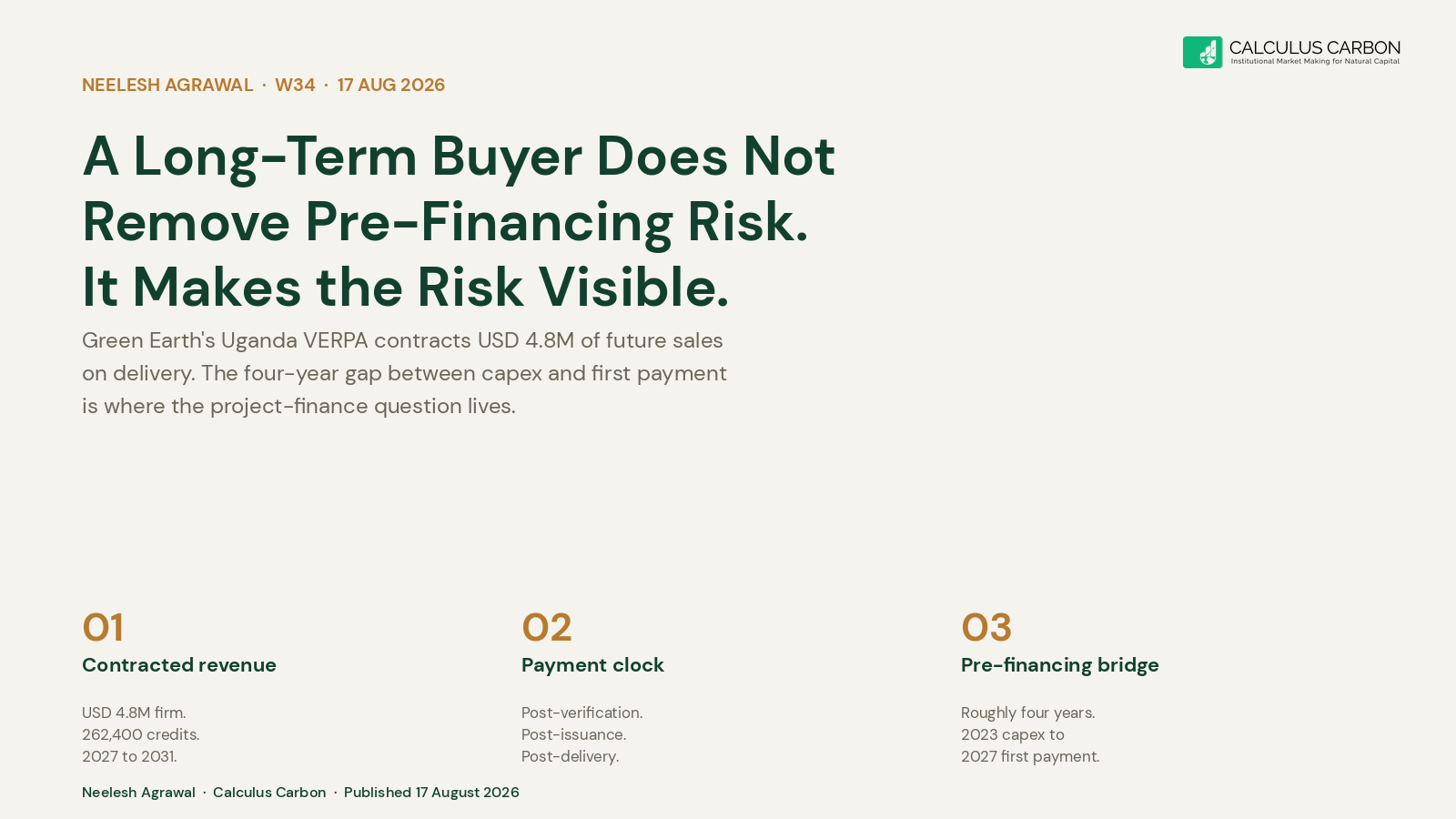
Green Earth's 11 August 2026 offtake agreement for its Bulindi Agroforestry and Chimpanzee Conservation Project in western Uganda is a textbook payment-on-delivery Verified Emission Reduction Purchase Agreement.1 Approximately USD 4.8M of future sales are contracted for the 2027 to 2031 delivery window, with a paid option that could take total contract value to approximately USD 16.3M through 2035.2 The buyer is a leading international energy company. The commercial headline is that Green Earth has locked in long-term demand for 262,400 verified credits, with an option covering a further 566,400. The project-finance headline is different. The payment clock in the contract, the fact that the buyer pays only after credits are independently verified, issued and delivered, leaves a multi-year window in which the developer has to fund planting, monitoring, and verification out of its own capital. That window is where the project-finance question lives.
Why Does a Long-Term Offtake Not Automatically Finance the Project?
The reflex read on a signed long-term offtake is that a project has been de-risked. In one sense it has. Demand risk, the question of whether a project will find a buyer for its future credits at all, is materially reduced when a named buyer with a multi-year commitment is on the contract. In a market where a large share of nature-based-solutions credits still trade opportunistically after issuance, a firm contracted forward volume is a real asset on the developer's balance sheet.
What a payment-on-delivery offtake does not do is put cash in the developer's account today. Under the Bulindi VERPA, the first deliveries are scheduled for 2027, and payment for those deliveries occurs only after Gold Standard verification, issuance to the buyer's account, and physical delivery of the credits.3 The developer, in the meantime, has to fund the entire capex of the project. Planting seasons across 22,700 hectares of intended reforestation, nursery expansion, farmer enrolment across the Hoima and Masindi districts, chimpanzee-corridor management, monitoring plots, and the audit expense of the first verification cycle all have to be paid for from another source. The offtake, at signing, contributes zero of that capital.
This is not a Green Earth specific feature. The United Nations Development Programme's transactions manual, drawn from Clean Development Mechanism deal experience, records that buyers strongly prefer the forward contract and pay-on-delivery model, whereby payments are made only after credits are fully validated, certified, registered and transferred. That leaves it to project developers to find ways to convert the financial commitment into financing for the project.7 Twenty years later, on a Gold Standard afforestation project in western Uganda, the same structural feature persists.
How Wide Is the Cash-Conversion Gap in the Bulindi VERPA?
The mechanical arithmetic on Bulindi is illustrative of the shape of the gap. Gold Standard registration was completed in March 2025.4 The first planting season was 2023, and by mid 2026 the developer had approximately 1,600 hectares planted.3 First issuance of verified credits is projected for 2027, encompassing all vintages accrued since project initiation. First payment, under the Bulindi VERPA, arrives on delivery of those verified credits into the buyer's registry account.
That is a period of roughly four years between the start of committed capex and the first tranche of contracted VERPA revenue. Across the firm contracted volume of 262,400 credits delivered between 2027 and 2031, the implied blended price sits around USD 18.3 per credit. Across the full 828,800 credits including the paid option through 2035, the blended price sits around USD 19.7 per credit, with the developer having received a USD 141,600 option premium at signing.2 The option premium is real cash today. The USD 4.8M is not. The USD 4.8M is a receivable dated 2027 to 2031, contingent on Gold Standard verification and physical delivery, and payable only after each of those events has occurred.
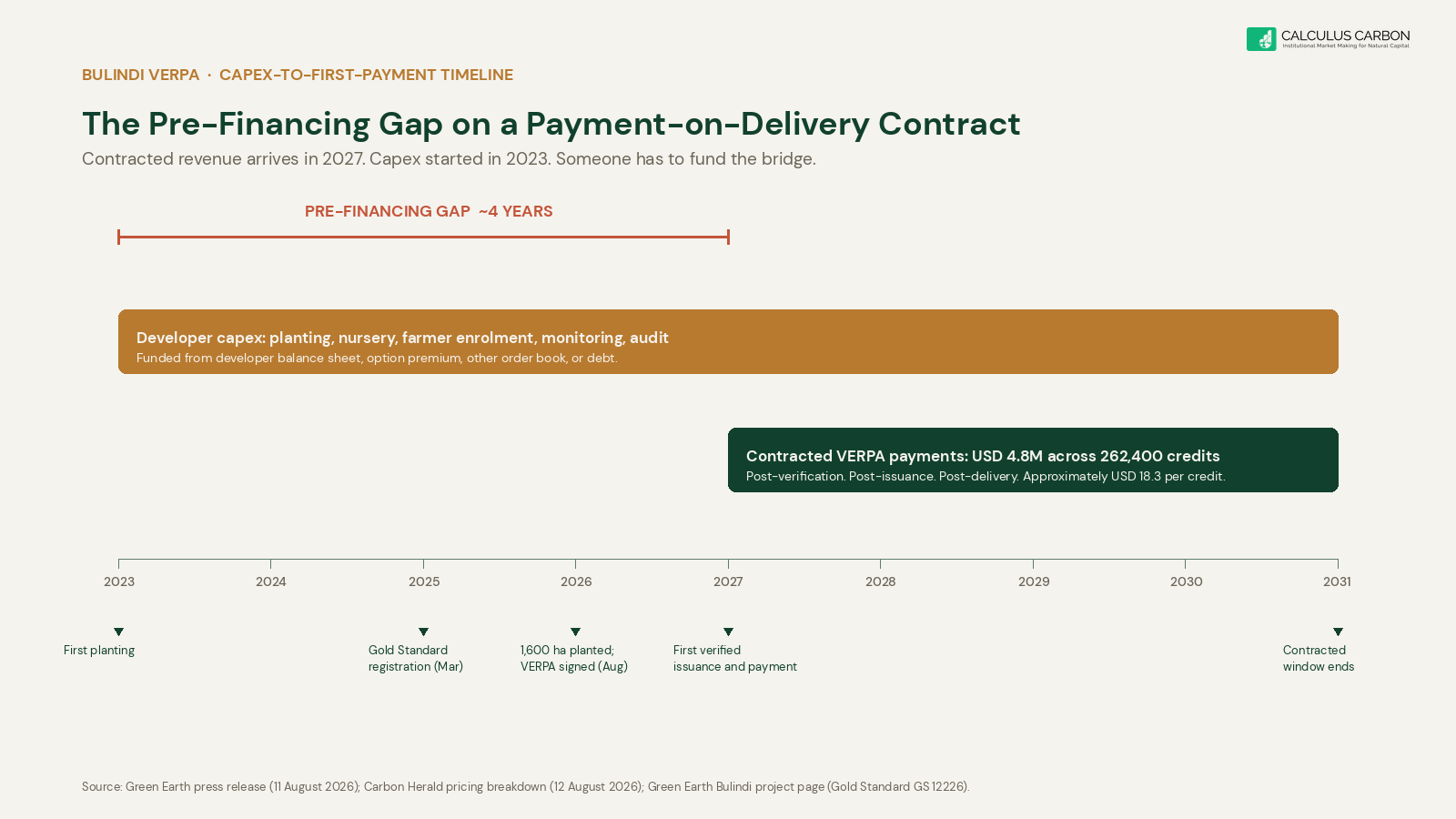
A useful way to see the gap is to place the receivable on a timeline. Capex on nursery seedlings, planting, farmer enrolment, monitoring and audit runs from 2023 to 2031. Contracted cash from this VERPA runs from 2027 to 2031. The area between the two lines is the pre-financing gap. That gap is not a risk that shows up in the headline announcement. It is the entire reason a payment-on-delivery contract is not, on its own, project finance.
What Kind of Capital Fills the Pre-Financing Gap?
There is a stack of instruments developers and their advisers turn to when the offtake is payment-on-delivery and the capex is upfront. The Trinity International practice note on carbon project financing sets out the two families clearly.5 On one side sit VERPAs and forward contracts in their pure form, under which the buyer commits to purchase but provides no upfront capital. On the other side sit prepayments, streaming arrangements, and offtake-backed debt, all of which convert some portion of the future contracted cash into cash today.
The prepayment structure advances a fraction of the total contract value at signing, often in exchange for a discount to the eventual delivery price. Financely Group's public term-sheet guidance for developer financing puts typical prepayment advance rates at 30 to 70 per cent of expected near-term issuances, with cash released against milestones such as validation, monitoring and verification.6 A streaming structure, more common in the metals and mining precedent that carbon finance is now borrowing from, advances capital upfront in exchange for a percentage of future issuances over a defined term, usually with a floor or collar on price. An offtake-backed debt structure, the closest analogue to conventional project finance, advances a portion of contracted deliveries against an assignment of the VERPA proceeds, priced at a benchmark plus a spread, with account control and a project SPV pledge as security.6
Each of these instruments requires the offtake to be strong enough to underwrite against. The named buyer has to be creditworthy. The contract has to define delivery, remedies and termination in a lender-legible way. The registry mechanics have to permit assignment of proceeds. And the verification schedule has to be sufficiently predictable that a lender can size a repayment profile against it. A well-drafted VERPA is a necessary condition for the pre-financing gap to be closed. It is not a sufficient one.
Where Does the Bulindi Deal Sit in Green Earth's Own Capital Picture?
The USD 4.8M contracted future revenue is additive to a Green Earth order book that stood at approximately EUR 41.5M at the end of June, and which after the Uganda agreement exceeds EUR 50M.2 The Uganda deal is roughly a 10 per cent addition to that book. Set against Bulindi's own lifetime, 10.1 million tonnes of CO2 across 22,700 hectares over a 41-year credit period,3 the contracted 262,400 credits represent roughly 20 per cent of the first five years of expected annual issuance, and the full 828,800 credits including options represent approximately 8 per cent of lifetime volume. That is meaningful commercial validation. It is not a claim on lifetime economics.
The point of putting the numbers side by side is not to grade the deal. It is that a headline of USD 16.3M read on its own is misread. Read alongside a EUR 41.5M order book, a 41-year project lifetime, and a payment-on-delivery cash profile, the deal is a firm forward commercial commitment that leaves the developer's near-term capital question fundamentally open. Whether Green Earth funds the next four years of Bulindi capex from equity, from other order book prepayments, from balance sheet cash raised on the Euronext Amsterdam listing, or from a lender against this VERPA is not visible in the headline. It is the question the next round of the developer's capital story will answer.
The Read for Institutional Capital
At Calculus Carbon, the project-finance question on a payment-on-delivery offtake is always the same. What is the gap between capex and first contracted payment, and who is funding that gap. A lender can support the bridge if the delivery evidence is strong, if the buyer commitment is legally clean, and if the assignment of proceeds is registrable.5 That is a specific, testable underwriting question, and it is different from the general market question of whether the project is a good project. The Bulindi VERPA is a good structural example of the distinction. It contracts long-term demand, it leaves the developer's four-year capex bridge visible, and it turns Green Earth's next capital conversation from a demand-side pitch into a financing conversation.
A long-term buyer does not remove pre-financing risk. It makes the risk visible.
This piece extends the LinkedIn post scheduled 20 August 2026. Analysis by Neelesh Agrawal, Calculus Carbon.
Sources
- [1] Green Earth press release, Verified Emission Reduction Purchase Agreement for Bulindi Agroforestry and Chimpanzee Conservation Project (11 August 2026). green.earth
- [2] Carbon Herald, contracted volume and pricing breakdown (12 August 2026). carbonherald.com
- [3] Green Earth Bulindi project page, Gold Standard GS 12226 (accessed 17 August 2026). green.earth
- [4] Green Earth Gold Standard validation release for Bulindi (2025). green.earth
- [5] Trinity International LLP, Mechanics of Pre-Purchasing Carbon Credits (2025). trinityllp.com
- [6] Financely Group, developer payout timing and offtake-backed debt terms (2025). financely-group.com
- [7] United Nations Development Programme, Structuring Transactions chapter, forward contract and pay-on-delivery mechanics. undp.org
- [8] ERCST paper, A Pre-Payment Model for ITMOs Under Article 6 (2025). ercst.org