
Durability · Project Finance · 18 August 2026
Insurance Over Buffer Pool Contributions: The Cashflow and Debt Service Test for Durability Risk
Verra’s durability pilot has approved two insurers to replace buffer pool contributions on nature-based projects. The headline is that reversal risk can now be priced by an underwriter rather than pooled across the register. The project finance question sits one layer deeper. It is whether the pricing, the renewal mechanics and the tenor of the cover align with when the project actually issues credits and when its debt schedule needs to be serviced.

The Structural Shift
Verra approved the first two insurance policies for use under its durability pilot in July 2026, CarbonPool and Kita, and the pilot is now live for AFOLU and geological storage projects that select the insurance-based approach to reversal risk.2 Under the pilot, an approved insurance policy can fully replace the buffer pool contribution that the AFOLU Non-Permanence Risk Tool would otherwise impose on the project.3 That contribution runs from ten per cent of issued credits at the low end to thirty per cent at the high end, and can move higher on high-risk categories.4 The pilot is a three-year process with a minimum three-year cover requirement for participating projects.5 The mechanic replaces a pooled, register-administered reversal instrument with an insurer-underwritten one. The register still cancels credits when a reversal occurs. The source of replacement credits shifts from the pool to the insurance policy.
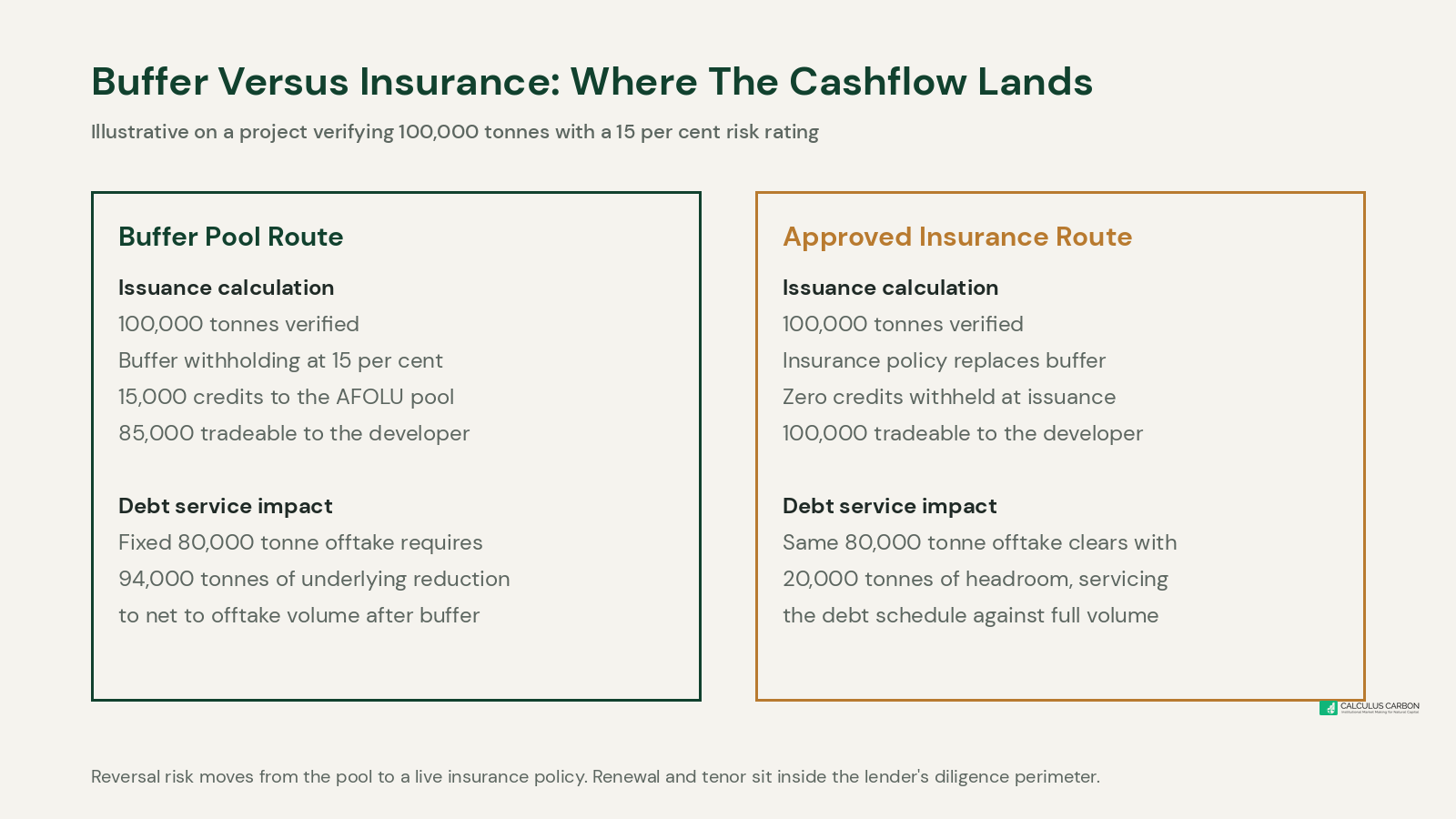
For a project finance underwriter, the buffer contribution has always sat on the debit side of the issuance calculation. A project verifying one hundred thousand tonnes of removals with a fifteen per cent risk-adjusted contribution issues eighty-five thousand credits into the developer’s account and deposits fifteen thousand into the AFOLU pooled buffer. That fifteen thousand is not tradeable, and it is not the developer’s to sell against an offtake obligation. On a portfolio with meaningful risk exposure, the sums involved run into seven to eight figures in foregone issuance value across a fund life. The insurance route is priced separately, at a fraction of that value on the annual premium line, but the two instruments do different things at different moments in the project’s cashflow curve.
Why This Matters For Debt Service
The moment the buffer contribution matters most is the moment a project has a fixed-volume offtake obligation and a debt schedule that assumes issuance clears the obligation with headroom. A buffer withholds credits at every issuance. A project that has contracted to deliver, say, eighty thousand tonnes into a three-year forward offtake, and that carries a fifteen per cent buffer requirement, must effectively sequester or reduce closer to ninety-four thousand tonnes to meet the eighty thousand tonne delivery net of buffer withholding. That is the developer’s operational reality. The lender’s reality is that any deviation on the sequestration side compresses the buffer-adjusted issuance below the offtake volume, and the debt service coverage the lender priced against evaporates before it ever touches the cash line.
Insurance changes the shape of this calculation. Under the pilot, if the project uses an approved insurance policy for a given vintage, the buffer withholding for that vintage is replaced entirely, and the issuance flows to the developer’s account net of any other deductions but without the pooled buffer haircut.4 The developer sells the full issued volume against the offtake. The lender’s debt service coverage is calculated against the full issued volume, subject to reversal risk being covered by the policy rather than the pool. In a lending package structured around senior-secured debt against future credit issuance, that headroom is the difference between a bankable structure and one that needs mezzanine or first-loss support to close.
The pricing separation matters here. By one industry estimate, insurance premia for reversal cover can be priced at a fraction of the buffer contribution’s opportunity cost, cheaper by a factor of five to ten annually against the value of the withheld credits.6 That number is a working estimate rather than a published rack rate, and the ratio will vary by project type, geography and risk profile. The direction, however, is the salient point. The insurer prices for its underwriting risk, not for the pool’s cross-subsidy across every project in the AFOLU registry.
Precision Pricing Versus Cross-Subsidy
The pooled buffer, by design, is a mutualised instrument. Every AFOLU project deposits a risk-adjusted percentage of its issuance into a single pool, and losses are cancelled from that pool when any project in the pool reverses.7 The pool cross-subsidises. A strong project, with secure tenure, low fire and pest exposure, well-documented monitoring and a professional operating team, contributes on the same schedule as a weaker project in the same category, and the pool socialises the loss when a weaker project reverses. That mutualisation is the pool’s structural feature and also its cost to the strong project.
An insurance policy prices project-specific risk. The insurer looks at the project’s tenure documentation, its natural hazard exposure, its monitoring stack, its operator’s track record, and it prices a premium that reflects that project’s risk profile rather than the pool’s. This is why the insurance route is more likely to be economically attractive to large portfolios of high-integrity, well-documented projects that would otherwise be paying a pool contribution calibrated to the pool’s weakest members. The corollary is that weaker projects, or projects with thinner documentation, may find that the insurer’s individual risk pricing is closer to the mutualised pool rate or higher. The pilot is not a universal cashflow unlock. It is a pricing separation that helps the projects that can already demonstrate strong integrity, and probably does not help the projects that could not.
Where The Tenor Gap Sits
The structural question the pilot leaves open for project finance is tenor. The pilot’s minimum cover requirement is three years, and it is likely to match the pilot’s own three-year window for most participants.5 But in many AFOLU categories, first issuance typically lands around year five, after the project has completed its initial monitoring cycle and its verification. On an ARR project, the biomass has to grow before the sequestration can be measured. On an IFM project, the avoided emissions have to be documented against a validated baseline. The cover starts running the clock the moment the policy is bound, which is at the pilot’s application phase, not at the first issuance. On a project where issuance lands at year five and the policy runs three years from year zero, the policy has expired before the project has produced anything the policy could have been asked to cover.
The renewal question sits inside this gap. Verra requires eligible insurance products to be renewable, but the renewal itself sits between the insurer and the insured, not on the register. If the policy is not renewed, the pilot rules require the project to return to the buffer pool, and Verra retrospectively cancels credits from the developer’s account equivalent to the buffer contribution the project would have deposited during the insured period.5 The developer, having sold the insured-period issuance to a buyer under an offtake, is now short on the register, and the debt service the lender priced against is retrospectively compressed. The insurer’s exit is the developer’s balance sheet event.
This is the shape of the tenor risk that project finance underwriting has to handle. A three-year policy is compatible with a project that has already issued and is monetising a stock of vintages under offtake. It is much harder to compatible with a project pre-issuance, or with a project whose offtake tenor runs seven to ten years against a policy tenor of three, unless the policy is written with a stapled renewal commitment that runs the full offtake tenor at pre-agreed pricing. Some of the insurance products approved so far are three-year policies with an option to renew at then-current pricing.4 That is a real product, and it is not the same product as a seven-year committed cover.
The Read For Project Finance Structuring
The specific project finance work sits at the junction of the offtake and the policy. Two structural moves make the pilot bankable for lending against future issuance.
The first is to align the policy tenor with the offtake tenor at the point of policy binding, not at the point of first issuance. This means a project pre-issuance underwrites the offtake and the cover together, and the insurer prices a committed multi-year policy against the same book the offtake priced. The policy runs from year one, covers a nominal exposure that grows as issuance grows, and steps into the offtake’s replacement clause when a reversal occurs. This is close to how syndicated project finance already handles political risk insurance against a long-dated offtake. The instrument exists. The pricing has to be negotiated on a project-by-project basis and the insurer has to be comfortable underwriting the pre-issuance risk profile, which most insurance products approved under the pilot are not yet structured to do at length.
The second is to build a mezzanine layer that sits behind the policy for the years after policy expiry. If the project runs a three-year initial policy with renewal at market, the mezzanine underwrites the renewal risk. If the policy renews at expected pricing, the mezzanine is not called and the senior debt service is uninterrupted. If the policy fails to renew or renews at pricing that breaks the project’s economics, the mezzanine steps in to fund the buffer contribution the project would then owe. This is the more capital-intensive route, and it is more expensive on the weighted-average cost of capital, but it is the route that most closely matches the current shape of the pilot’s approved products.
What Sits Behind These Two Moves
Both moves require the underwriting side of the project finance stack to see the insurance policy as a co-security instrument rather than a compliance instrument. The buffer contribution the pool takes was never a security instrument for the lender. It sat on the register and reduced issuance. The lender priced around it. The insurance policy, by contrast, sits on the developer’s side of the register, and its terms, its renewal clause, its exclusions, its trigger definition and its counterparty credit are all now inside the lender’s diligence perimeter. This is a shift in what the credit team has to read. It moves the reversal risk from a fixed haircut on issuance to a live policy document with clauses that require the same underwriting discipline as an offtake or a political risk cover.
The projects most likely to clear this bar first are large portfolios of compliance-grade credits with strong documentation and an offtake counterparty who is credit-rated. That population is a smaller subset of the AFOLU universe than the pilot’s headline suggests, and it is the same subset that is most active in the current wave of contracted forward offtakes into commodity trading houses, DFIs and corporates with net zero commitments. The pilot’s pricing separation is likely to compound the advantage those projects already have, and the tenor problem is soluble on those projects because the offtake counterparty has an interest in structuring the cover to run the full tenor.
The Read For Institutional Capital
Calculus Carbon specialises in bridging the gap between capex and first payment on nature-based projects, mobilising project finance from a variety of institutional pools of capital including commodity desks, hedge funds, banks, traders and DFIs. Verra’s durability pilot changes what sits on the developer’s side of the register during the years the debt is drawn and being serviced. It replaces a haircut on issuance with a live insurance policy that the lender has to underwrite alongside the offtake. On the projects where the policy can be structured to run the offtake tenor at committed pricing, the pilot is a cashflow unlock, and the debt structure prices tighter because the buffer haircut no longer compresses the service coverage. On the projects where the policy runs three years against a longer offtake, the pilot is a re-pricing of tenor risk into a mezzanine layer, not a removal of it. Either read is useful. Neither read is a headline about buffer pools going away.
The pilot is a pricing tool, not a durability tool. What it prices is the ability of a specific project to bear reversal risk on its own balance sheet, with an insurer standing behind that risk for a defined tenor. Whether it unlocks project finance depends on whether the tenor of the policy matches the tenor of the debt.
This piece pairs with a Calculus Carbon LinkedIn short-form scheduled for W34.
Sources
- [1] Verra, Verra to pilot innovative approaches to addressing durability. verra.org
- [2] Verra, Verra approves insurance policies for use under durability pilot. verra.org
- [3] Verra, Durability pilot frequently asked questions. verra.org
- [4] CarbonPool, Insurance for Verra’s durability pilot. carbonpool.earth
- [5] Sustainacraft, Verra durability pilot introduction of insurance to replace buffer pool. sustainacraft.com
- [6] Sylvera, Carbon credit insurance primer. sylvera.com
- [7] Verra, Agriculture, Forestry and Land Use programme area of focus. verra.org