
Project Finance · Article 6.2 · Vietnam · Singapore
A Legal Route Is Not a Revenue Contract. What Vietnam's Resolution 235/NQ-CP Actually Delivers.
Vietnam's Resolution 235/NQ-CP approves the Article 6.2 implementation agreement with Singapore. The bilateral route is open. The project rules that make it financeable are still pending.
Vietnam's Resolution 235/NQ-CP, approved on 14 August 2026, ratifies the implementation agreement between the Governments of Viet Nam and Singapore on the implementation of Article 6 of the Paris Agreement.1,2 The agreement itself was signed in Singapore on 16 September 2025; the resolution is the domestic legal step that gives the framework binding effect on the Vietnamese side.3 That is a real, dated, verifiable event. The commercial reflex to that headline is that a corridor has opened between a Global South supply market and a named sovereign buyer, and that the projects sitting inside Vietnam's Article 6 pipeline just became financeable. That reflex overstates what has actually been delivered. What Resolution 235/NQ-CP delivers is a country-to-country legal route. What a project needs to reach a financeable revenue contract is separate, and by the terms of the agreement itself, still pending.
What Did Resolution 235/NQ-CP Actually Authorise?
Read at face value, the resolution is narrow and precise. It approves the government-to-government implementation agreement. It gives Vietnam's central-government machinery the legal basis to instruct line ministries, project participants and downstream registries to act inside that framework. It confirms that Vietnamese organisations and businesses may develop greenhouse gas emission-reduction projects, generate internationally transferred mitigation outcomes, and transfer those outcomes to Singapore in a form that Singapore's National Environment Agency will accept against its International Carbon Credit Framework.2,4
Read structurally, the resolution answers a specific question. Is there a lawful pathway for a Vietnam-hosted mitigation activity to be authorised, issued, and moved cross-border into a compliance regime that treats it as a fungible credit? On 14 August 2026 the answer became yes. Before that date it was closer to an in-principle intent letter than a domestic legal instrument.
What the resolution does not do is set the project-level rulebook that a lender or an offtaker needs to underwrite the project revenue. That work sits inside the annexes to the implementation agreement itself, and inside the domestic guidance Vietnam's Ministry of Agriculture and Environment will issue against them.3
Where Is the Rulebook Actually Written Down?
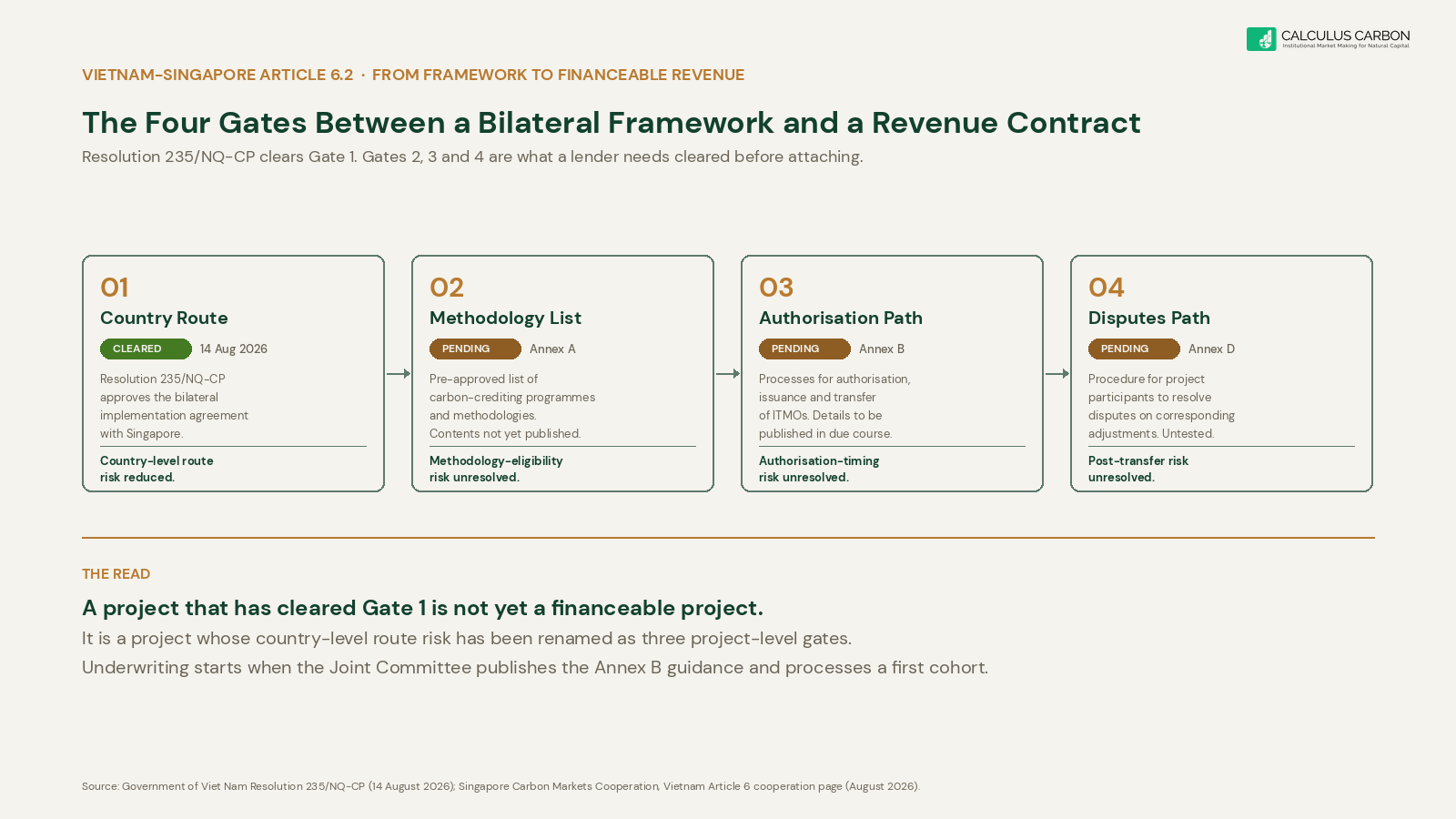
The implementation agreement carries four annexes. Annex A is a pre-approved list of carbon-crediting programmes and methodologies. Annex B sets out the processes for the authorisation of mitigation activities and the issuance and transfer of ITMOs. Annex C is the terms of reference of the Joint Committee co-chaired by the Director (Carbon Planning Division) at Singapore's National Environment Agency and the Director General (Department of Climate Change) at Vietnam's Ministry of Agriculture and Environment. Annex D is the disputes-resolution procedure between project participants and Vietnam on the application of corresponding adjustments.3
The presence of an Annex B is not the same as the presence of a published Annex B rulebook. Singapore's Vietnam cooperation page states, in unambiguous terms, that more details of the processes to seek Article 6 authorisation of the mitigation activities and the mitigation outcomes, including required documents at each stage, will be published in due course.3 That single sentence carries the full weight of what is still open. Which line ministry receives the authorisation application. What the documentary evidence pack looks like at each of the three gates: mitigation-activity authorisation, mitigation-outcome authorisation, and ITMO issuance. How long each gate takes. Which pre-approved methodology on Annex A applies to a given project type. What the appeal path is if a project participant is refused authorisation.
A project developer holding a Verra ARR project in central Vietnam knows, today, that the bilateral route now legally exists. It does not know, today, exactly which document its diligence file needs to include for the mitigation-activity authorisation letter, or how the timing of that authorisation lines up with a Verra crediting-period start. The Joint Committee is the body that will operationalise Annex B, and its first published minutes will carry more useful information than the resolution itself.
Why Does This Distinction Matter for Underwriting?
A project revenue contract is a contract that a senior lender can attach to. That means, at a minimum, three things. The credits must exist as a legal object recognised by a named buyer. The revenue timing must be predictable enough to build a debt-service schedule. The gating documents needed to move from project inception to first revenue must be identified, with an estimable time and cost to obtain each of them. Resolution 235/NQ-CP fixes the first of those three. It does not yet fix the second or the third.
That is where the underwriting question actually sits. Project-eligibility risk, the risk that a specific project fails to obtain mitigation-activity authorisation in a form that its offtaker will pay against, is what a Vietnam-hosted Article 6 project has to price today. That risk has not been eliminated by the resolution. It has been renamed. Before 14 August 2026 it was country-level route risk, the risk that a bilateral framework did not exist and might never take domestic legal effect. After 14 August 2026 it is process-level authorisation risk, the risk that the project's specific paperwork does not clear the Annex B gates on a timeline a lender can rely on.
For a debt provider, this is a live pricing question, not a theoretical one. A senior debt facility with a first-repayment date tied to first ITMO issuance is exposed to whatever Annex B eventually says about the elapsed time between authorisation application and issuance.6 A pre-payment facility, of the kind ERCST has documented for Article 6.2 supply, is exposed to whatever Annex D says about disputes resolution if a corresponding-adjustment claim is challenged after ITMOs have already changed hands.7
What Has Been Derisked Versus What Has Not?
The honest read is that the resolution moves the underwriting question up the stack rather than off the table. It de-risks the top layer. A project developer, a buyer coalition, or a trading desk arranging offtake can now write commercial paper on the assumption that Vietnam is a live Article 6 counterparty for Singapore. The bilateral risk that the entire structure collapses because the sending country cannot execute a corresponding adjustment is meaningfully reduced.
The layers below that remain exposed. Methodology-eligibility risk is unresolved until Annex A is treated as a live, published, updatable list rather than a placeholder.5 Authorisation-timing risk is unresolved until Annex B guidance is issued and the Joint Committee has processed a first cohort of authorisation applications. Post-transfer risk, the risk that a corresponding adjustment claim is challenged after ITMOs are already in the buyer's registry, is unresolved until Annex D dispute cases begin to test the mechanism in practice.
None of these are reasons to sit out the Vietnam pipeline. They are reasons to price the pipeline against three separate underwriting gates rather than one composite country signal. A project that has cleared the country-level gate is not yet a financeable project. A project that has cleared the country-level gate and has an in-principle authorisation letter from Vietnam's Ministry of Agriculture and Environment for its specific mitigation activity is on a different footing. A project that has cleared the country-level gate, has an in-principle authorisation letter, and has a matching Annex A methodology already published is on a materially different footing again.
How Does This Compare With Other Bilateral Routes That Have Gone Further?
Singapore has been the most active buyer country on the Article 6.2 side, and the Vietnam cooperation is not the only implementation agreement in the queue. The Singapore National Climate Change Secretariat maintains the international collaboration inventory.4 The point that matters for a project developer is not the number of countries on that inventory. The point that matters is which of those countries has actually seen a first mitigation-activity authorisation application land on a line ministry's desk, and which has not.
That is where a live pipeline signal is worth more than a headline count. A Vietnam project developer whose file is being read by an agribusiness allocator right now can ask a specific question. Has Vietnam's Ministry of Agriculture and Environment yet issued any project-specific authorisation letter under any bilateral framework? If the answer is no, the developer's file is queueing behind the entire Annex B rollout, and the Joint Committee's first cohort of decisions will set the timeline for every project in that queue. If the answer is yes, the developer can point to a precedent and price its own file against how long that precedent took.
The general read applies across host countries. Ghana, Rwanda, Papua New Guinea and Peru have all been named in successive bilateral tranches. Each of those routes has the same two-gate structure. The bilateral route becomes legal. The project rulebook is written afterwards. Nothing in Article 6.2 architecture inverts that sequence.
The Read for Institutional Capital
For institutional allocators, the takeaway from Resolution 235/NQ-CP is not that Vietnam is now a financeable market. The takeaway is that Vietnam is now a legally live counterparty for one specific buyer sovereign, with three project-level gates still to open before a specific project generates a specific revenue receipt on a specific date. The correct diligence sequence for a Vietnam-hosted Article 6 project today is to treat the resolution as the country gate cleared, and to price the residual gates individually. Where an allocator's mandate can tolerate authorisation-timing risk in the underwriting case, this is a moment to lean in on Vietnamese supply, ahead of the Joint Committee's first decisions. Where the mandate cannot, the correct read is to watch for the first published Annex B guidance and the first cohort of authorisation letters, and to hold the file at pipeline stage until then.
A legal route is not a revenue contract. Underwriting starts when the project rules are clear.
This piece extends the LinkedIn post scheduled 25 August 2026. Analysis by Neelesh Agrawal.
Sources
- [1] Government of Viet Nam, Resolution 235/NQ-CP, 14 August 2026. vanban.chinhphu.vn
- [2] Government News (VGP), Govt approves Viet Nam-Singapore carbon credit agreement, 19 August 2026. en.baochinhphu.vn
- [3] Singapore Carbon Markets Cooperation, Vietnam Article 6 cooperation page. carbonmarkets-cooperation.gov.sg
- [4] Singapore National Climate Change Secretariat, International Collaboration. nccs.gov.sg
- [5] Singapore Carbon Markets Cooperation, Overall Eligibility List. carbonmarkets-cooperation.gov.sg
- [6] Trinity International LLP, Carbon offsetting through project financing: the mechanics of pre-purchasing carbon credits (2025). trinityllp.com
- [7] ERCST, A Pre-Payment Model for ITMOs under Article 6 (2025). ercst.org