
CORSIA · Aviation Compliance · Project Finance
Commodity Trading Houses As Compliance Intermediaries: How Their Positions Reprice Developer Risk In CORSIA
Marex, Econetix and Ecoeye are taking three different positions in the CORSIA compliance stack. Each one reprices a specific risk that used to sit on the developer.
The Structural Shift
CORSIA's first compliance phase has pulled commodity trading houses into a role their desks already know how to price. Airlines in participating states now carry a legally mandated obligation to purchase and cancel CORSIA Eligible Emissions Units against their emissions over the 2019 baseline, with the first retirement deadline set for 31 January 2028.10 That legal mandate does what voluntary demand never did. It converts a discretionary buyer into a contracted buyer, and it lets the desk price the transaction against three questions it has answered on many other physical commodities: forward price, counterparty credit and delivery guarantee.
The list of firms taking positions in CORSIA supply is now public through IATA's Supporting Alliance, which counts Marex-related infrastructure, Ecoeye, Econetix, Gunvor and Vitol among its carbon-market stakeholders.1 Three of these firms illustrate the range of positions on offer. Marex sits between developers and airlines as a full-service intermediary. Econetix sells forward supply from LoA-covered African portfolios to distribution partners. Ecoeye holds an inventory position against Korean airline demand. Each position reprices a different risk that used to sit on the developer's balance sheet, and each has a different implication for how a project finance underwriter should think about the developer's cashflow curve.
Why The Compliance Framing Changes Underwriting
Voluntary carbon transactions have always required the desk to price two risks at once. The first is delivery risk on the credit itself, which turns on the developer's ability to sequester, verify, tag and transfer the units into the buyer's registry account against a defined vintage. The second is demand risk on the buyer's willingness to pay when delivery lands. On the voluntary side, that willingness has been contingent on corporate net-zero narratives, on the buyer's board, on scope-3 accounting rules that could move under it, and on the reputational cost of retiring a credit whose provenance is later contested. Airlines under CORSIA sit inside a different demand curve. The offsetting requirement is set by the state and communicated by the aviation authority. Non-compliance is a regulatory event, not a reputational one. The desk pricing the forward is now pricing against a legally mandated take-off, not a discretionary one.
This changes what the credit team has to underwrite. Delivery risk is unchanged in kind, but it is now the residual risk after buyer-side demand risk has been removed. The forward price, the counterparty credit line and the delivery guarantee are the three variables the desk has to reconcile against the developer's project curve, and the desk has practice reconciling those three variables across LNG, refined products, freight and other physical commodities. What is new is that carbon has landed on the same underwriting workbench.
The Intermediary Position: Marex
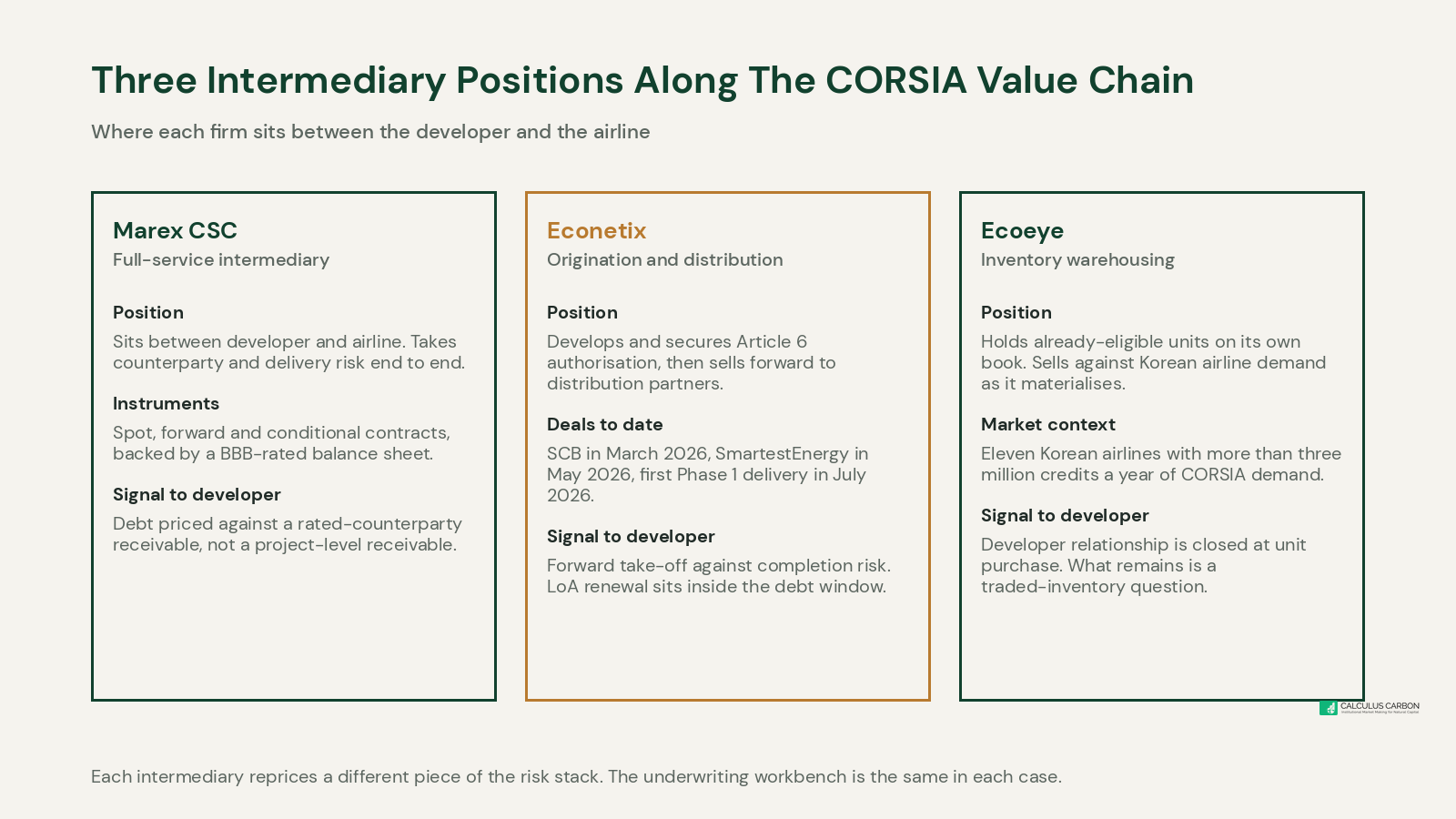
Marex's CSC Commodities division sits between developers with small balance sheets and short track records on one side, and airlines and other obligated entities on the other. The Marex offer to procurement teams is a range of contract structures, including spot, forward and conditional purchases, backed by Marex Financial's BBB-rated balance sheet.2,3 Marex's own procurement guidance highlights that CORSIA-eligible units require a Corresponding Adjustment from the host country, typically evidenced by a Letter of Authorisation, and that eligibility criteria interact with issuance date, methodology and registry.2 That is the eligibility perimeter the desk manages between the developer's issuance schedule and the airline's retirement deadline.
The Marex position takes on both developer counterparty risk and delivery risk end to end. When Marex commits to a forward delivery against an airline retirement schedule, it is committing that its developer pipeline will produce and transfer the credits by the delivery window, with the necessary CA in place, or that it will source the shortfall from elsewhere in its book. That commitment prices a specific piece of financing into the developer relationship. The developer receives some combination of pre-payment against the forward, arranged insurance against reversal or non-delivery, and a delivery guarantee from Marex to the airline.4 In exchange, Marex takes a spread against the eventual retirement price and a claim on the developer's issuance calendar. The developer trades margin for tenor, and the desk absorbs the plumbing between the LoA process, the registry transfer and the airline's compliance window.
For a project finance underwriter reading this structure, the useful move is to see the Marex forward as a shadow offtake with a differently priced tenor. The airline is the ultimate obligated buyer, but the underwriter's counterparty on the offtake is Marex, and Marex's BBB balance sheet does the work of turning what would otherwise be a project-level receivable into a rated-counterparty receivable. That has direct consequences for the debt service coverage ratio the underwriter can price. It also has consequences for the covenants the underwriter needs to run against the developer, because the developer's operational obligation to produce and transfer credits on the promised schedule is now inside the desk's contractual perimeter rather than the buyer's.
The Distribution Position: Econetix
Econetix has taken a different position. Its first CORSIA supply agreement was signed with SCB Environmental Markets, part of SCB Group, on 5 March 2026, covering Verra-registered credits from a Gold Standard project in the Democratic Republic of Congo.5 It followed that in May 2026 with a multi-million dollar forward supply agreement with SmartestEnergy, a subsidiary of Japan's Marubeni Group.6 In July 2026 it completed its first delivery of Phase 1-tagged CORSIA volume against a million-dollar offtake with an unnamed commodity trading house.7 On 5 August 2026 it secured a Letter of Authorisation from Rwanda's Designated National Authority for up to 1,766,234 tonnes from the Likano-developed Rwandan Improved Cookstove Project, of which the majority of vintages fall within the CORSIA first compliance phase eligibility window.8
Econetix's role in each of those transactions is closer to the origination and distribution end of the chain than to the balance-sheet warehousing end. It develops carbon projects under recognised standards, secures Article 6 authorisation from host governments, and then contracts forward supply to distribution partners who in turn sell into aviation buyers. The distribution partner takes market risk on the eventual airline retirement price. Econetix takes completion risk, in the sense that it must deliver against the forward contract on the tagged vintages by the delivery window, with the LoA in place and the corresponding adjustment applied by the host country. The counterparty on the forward is the distribution partner, not the airline.
The completion risk on this structure sits on Econetix and by extension on Likano, its Rwandan project partner, and on the developer relationships in the DRC and elsewhere. If a project is delayed on verification, if the LoA is subject to renewal risk in the host country, or if the corresponding adjustment is contested by the host country's National Determined Contribution accounting, the developer or the developer-plus-Econetix layer bears the delivery shortfall, subject to whatever recourse the forward gives to the distribution partner. That is a familiar structure to a commodity desk. It resembles a producer forward on a physical delivery where the producer takes production and quality risk and the distribution layer takes price risk to the ultimate buyer. What is different is the LoA layer, which is a sovereign action, and which is not fully within the developer's control.
For an underwriter looking at Econetix-style deals, the useful move is to price the LoA renewal window against the offtake tenor and against the debt tenor. The Rwandan LoA covers emission reductions between 1 September 2022 and 31 August 2027, and it is renewable once.8 If the underwriter is financing the developer against issuance that runs into 2028 or beyond, then the renewal event sits inside the debt period, and the underwriter has to model what happens if the LoA is not renewed on the original terms. The debt structure has to accommodate that renewal risk either through a mezzanine layer that funds the gap, or through a covenant that accelerates on non-renewal, or through insurance if a policy is available on that specific sovereign risk.
The Warehousing Position: Ecoeye
Ecoeye's position is closer to inventory. It holds already-eligible CORSIA units on its own balance sheet and sells against airline demand as it materialises. That is a warehousing model, and the risk profile is different again. The market it addresses is well-defined. According to Korea Investment and Securities, quoted by S&P Global Platts on 16 July 2026, there are eleven airlines in South Korea with CORSIA obligations, with annual credit demand estimated to exceed three million credits, and roughly eighty per cent of that demand concentrated in Korean Air and Asiana Airlines.9 Korean airlines are procuring through Korea Investment and Securities to mitigate counterparty risk, and their credit preference is driven primarily by price.9
The Ecoeye trade is therefore not a forward against a specific airline retirement date. It is an inventory position taken in advance of a defined national demand pool, with the airlines choosing between competing warehousing providers when they retire. Ecoeye already carries CORSIA Phase 1 label from Verra on projects including its Uzbekistan methane leakage reduction activity, and it is a signatory to the IATA Supporting Alliance for CORSIA supply.1 The company's balance sheet takes inventory risk and buyer-concentration risk. If Korean airline demand shifts to a competing supplier on price, the units Ecoeye already owns are still eligible but they lose the buyer premium they were bought against.
For an underwriter, the Ecoeye position is closer to a traded-inventory position than to a project finance transaction. The developer relationship has already been completed at the point Ecoeye took ownership of the units. What is left is a working-capital line against the warehoused inventory, and the price at which that inventory eventually clears against airline demand. This is a shorter-tenor question than the Marex or Econetix cases, and it does not require the underwriter to price the LoA cycle, the verification cycle or the developer's counterparty credit. It requires the underwriter to price a specific buyer-concentration profile and the price path of a compliance credit into a defined retirement window.
What The Three Positions Have In Common
The three positions differ in where the risk sits and in how much developer risk the intermediary is willing to hold. What they have in common is that all three convert a fragmented developer-and-buyer market into a set of transactions the underwriter can actually price. Before compliance demand landed, the developer's forward was a promise to sequester carbon against a voluntary demand curve that could move under it. After compliance demand landed, and after Marex, Econetix, Ecoeye and their peers took intermediation positions between the developer and the airline, the developer's forward is now a promise to sequester against a rated-counterparty receivable with a delivery guarantee or against a distribution partner with a forward take-off or against an inventory book with a defined buyer pool.
That is what makes carbon underwriteable at commodity-desk quality. The developer's underlying risk has not gone away. Delivery is still delivery. The LoA is still sovereign. The verification cycle is still slow. What has changed is that a specific class of counterparty is now willing to absorb some of that risk between the developer and the airline, and to price it explicitly.
The Read For Institutional Capital
For institutional capital pooling into nature-based projects, the presence of commodity trading houses in the compliance stack is a signal about how much of the developer's risk can now be pushed one layer up the chain, and at what price. Calculus Carbon works on debt and mezzanine transactions against pre-issuance developer cashflows, bridging the gap between capex and first payment. The Marex, Econetix and Ecoeye positions each change what is possible on that gap. A developer with a Marex-style shadow offtake carries the intermediary's balance sheet inside its receivable, and can price its debt tighter. A developer with an Econetix-style distribution partner has a forward take-off against completion risk, but the LoA renewal sits inside its debt window. A developer already warehoused into an Ecoeye-style inventory position no longer has a project finance question in front of it. The underwriting workbench is the same in each case. The variable that changes is which specific piece of risk the intermediary has priced away from the developer, and at what cost to the developer's margin.
That is the read a project finance underwriter should carry into the current wave of contracted forward offtakes with commodity desks, DFIs and corporate net-zero programmes. How much of the developer's own risk the desk is willing to hold now separates one intermediary from another, and it separates one bankable structure from another.
The intermediary position is the risk-repricing layer. That is where the developer's next dollar of debt is set.
This piece extends the LinkedIn short-form scheduled 27 August 2026 by the Calculus Carbon page. Analysis by the Calculus Carbon Capital Markets Desk.
Sources
- [1] IATA press release, "States and Supporting Partners Join IATA's Alliance to Expand CORSIA Carbon Credit Supply", 23 June 2026. iata.org
- [2] Marex, "Sustainable aviation: how to build a procurement strategy for CORSIA", 7 October 2025. marex.com
- [3] IATA Partners Directory, CSC Commodities entry. iata.org
- [4] Marex, "Managing risk in procuring CORSIA Eligible Emission Units", 29 August 2025. marex.com
- [5] Carbon Herald, "Econetix Inaugural CORSIA Deal Channels Carbon Finance To Africa", 5 March 2026. carbonherald.com
- [6] Carbon Herald, "Econetix And SmartestEnergy Partner On CORSIA Carbon Credits", 22 May 2026. carbonherald.com
- [7] Carbon Herald, "Econetix Closes Million-Dollar CORSIA Deal As Airlines Race To Secure Eligible Credits", 17 July 2026. carbonherald.com
- [8] Econetix press release, "Likano and Econetix Secure Letter of Authorization for CORSIA-Eligible Carbon Credits in Rwanda", 5 August 2026. econetix.net
- [9] S&P Global Platts, "South Korean airlines target price-driven intermediary CORSIA procurement: KIS", 16 July 2026. spglobal.com
- [10] ICAO, "CORSIA Eligible Emissions Units", October 2025 list. icao.int