
Project Finance · Blended Finance · 2 September 2026
The First-Loss Layer Is Where NbS Blended Finance Is Being Repriced
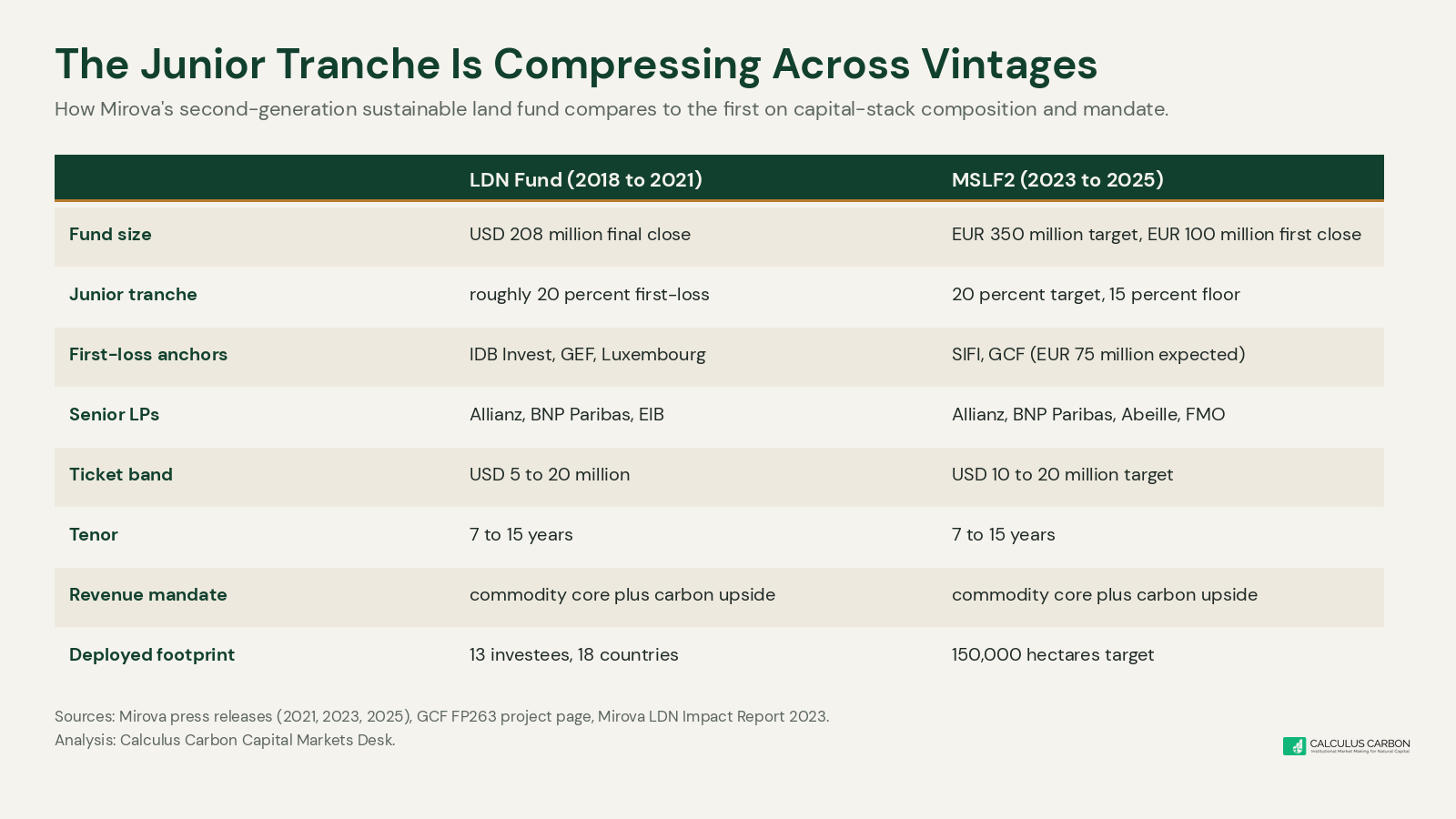
Mirova’s Sustainable Land Fund 2 is targeting a 20 percent junior equity tranche with a 15 percent floor, down from the Land Degradation Neutrality Fund’s roughly 20 percent first-loss layer, with guidance that the next vintage should compress further. The compression, not the fund size, is where institutional capital should be reading the pricing signal for second-generation NbS blended vehicles.
Thesis
Mirova’s second-generation sustainable land fund is being marketed on a claim that changes how project-finance underwriters should price the asset class. The manager is telling the market that sustainable land management is de-risking, and it is putting a smaller first-loss tranche in the capital stack to prove it. The Land Degradation Neutrality Fund closed in March 2021 with roughly 20 percent of the stack in junior equity from public and philanthropic anchors.1 The Mirova Sustainable Land Fund 2 is targeting a 20 percent junior tranche at first close, with a stated floor of 15 percent, and the manager’s own guidance is that the successor vintage should ultimately carry less.2,4 The read for institutional capital sits inside that compression, not on the headline size.
What Actually Changed Between the Two Vintages
The Land Degradation Neutrality Fund, promoted by the United Nations Convention to Combat Desertification and managed by Mirova, reached its final close in March 2021 at more than USD 208 million, against an original target of USD 300 million.1 Over the following two years the fund built a portfolio of 13 sustainable land management investments in agroforestry, planted forestry and agro-ecological transition across Latin America, Africa and Asia. Ticket sizes ran between USD 5 million and USD 20 million per investment, with tenors of seven to fifteen years, split between mezzanine debt and equity.8,10 The portfolio was completed in December 2023 with three final commitments into Koa Impact in Ghana, Pamoja in Kenya and Tanzania, and Terrasos in Colombia.10
The capital stack of the first vintage was built on a heavy public and philanthropic base. Public first-loss anchors included the Inter-American Development Bank, the Global Environment Facility and the Government of Luxembourg, alongside the European Investment Bank at senior level with a USD 45 million commercial ticket.1,9 Private senior investors ended up carrying more than 60 percent of the final capital, including Allianz France, BNP Paribas Cardif and BPCE Vie.1 Sizing the first-loss layer at final close, roughly 20 to 30 percent of the target stack was reserved for junior capital at fund design; the actual junior share at the smaller final close sat toward the lower end of that range.9
The successor fund, the Mirova Sustainable Land Fund 2, was announced at COP28 in December 2023 with a target size of EUR 350 million and reached its first close in February 2025 at approximately EUR 100 million.2,5 The Green Climate Fund approved MSLF2 as project FP263 in January 2025 with an equity commitment of USD 80.85 million and a grant tranche of USD 5.78 million, and Mirova has since said that EUR 75 million of Green Climate Fund support is expected to be signed by the end of the year.4,5,12 FMO added a USD 10 million approved commitment in mid-2025, and Proparco is lined up behind it.6,7 Senior investors already on the register include Abeille Assurances, Allianz France and BNP Paribas Cardif, with the SDG Impact Finance Initiative in the catalytic first-junior seat.5
Why the Junior Tranche Compression Is the Real Signal
The headline size of MSLF2 is not what the market should be reading. The headline is that the successor is targeting a smaller junior share of the stack, with a stated floor, and that the manager’s aspiration is for the next vintage to compress the junior share further. In blended finance mechanics, a compressed first-loss layer means one of two things. Either the underlying asset class is being repriced by senior capital as less risky, so less concessional cushion is required to pull it in, or the senior capital is being pulled in at a lower spread to compensate. In both readings, the concessional layer is doing less work to make the same trade close.
The evidence points to the first reading. The LDN Fund exited its investment period with an intact portfolio, primary-source impact reporting on 350,000 hectares under sustainable land management, and senior investor participation that sustained a 60-plus percent private share of the final capital.10 Mirova and the Green Climate Fund have framed MSLF2 explicitly as a follow-on strategy in which the asset class is maturing and the market is more familiar with commodity-plus-carbon investee cash flows.4,11 A first-loss layer that shrinks from roughly one-fifth of the target stack toward a 15 percent floor is a manager telling public capital and philanthropic capital that they are no longer being asked to underwrite the whole tail. That is a structural repricing, not a marketing line.
For institutional underwriters, the practical consequence is that senior tranches in the second-generation NbS fund vintage are being asked to price more of the risk on their own book. The senior spread should sit closer to comparable emerging-market long-dated agricultural or forestry debt than to a fully concessional-cushioned structure. On a comparable seven to ten year tenor with a mezzanine debt weight in the investee-level capital stack, that spread band is where the pricing conversation opens.
Who Is Bearing the Cost, and When
The compressed first-loss layer redistributes economic exposure across three groups. The public and philanthropic anchors keep the residual tail risk on the fund but now sit against a smaller pool, so their per-dollar exposure to each senior underwrite is lower. Their catalytic function is preserved, but the concessional-to-commercial ratio has narrowed. The senior LPs pick up more of the intermediate risk band that the concessional layer previously absorbed, and this is where the pricing discipline lands. Development finance institutions such as FMO and Proparco sit in the middle, catalytic but with a return expectation that is closer to a commercial LP than a concessional donor.6,7
The investee-level economics tell a related story. MSLF2 is structured, as LDN was, mainly through debt financing with equity participation where the asset requires it.4,10 Tenors are long, seven to fifteen years, matching commodity-crop cycles and forestry planting-to-yield curves. Ticket sizes are in the USD 10 million to USD 20 million range on average, with a target of 150,000 hectares under sustainable land management for a EUR 350 million fund, roughly 430 hectares per million euros invested.2,4 That density is a real underwriting parameter. A fund pursuing 430 hectares per million is buying operating exposure to a productive commodity land base, not underwriting a speculative reforestation curve.
Carbon as Bounded Upside, Not the Core Revenue
The MSLF2 mandate codifies a stance that Calculus Carbon has been advocating in project-finance dialogues with senior investors. Investees must derive the majority of their revenues from the sale of agricultural and forestry products such as cocoa, coffee, nuts, timber and citrus. Carbon credit sales, where the projects generate them, sit as additional revenue on top of a commodity core.2,4 The manager is explicitly not underwriting carbon-credit revenue as the primary cash flow. Growing demand for sustainably sourced, certified commodities is written into the fund thesis as the mechanism that improves the economics of the investee businesses.4
For an allocator, that structural stance materially changes the underwriting question. In a fund where carbon is the primary revenue, project cash flow depends on registry credit quality, offtake pricing and issuance timing, all of which sit inside the voluntary carbon market’s own volatility band. In a fund where commodity revenue is the core and carbon is bounded upside, cash flow depends on commodity offtake, grower economics and certified supply premiums, with carbon credit sales acting as a return enhancer rather than a return dependency. Underwriting concentrates on commodity supply-chain diligence, price and volume risk on the core product, and grower-level operational risk. Carbon credit issuance becomes an upside line item, not a make-or-break line item. That is a fundamentally different diligence file.
Why This Read Matters for Comparable NbS Blended Vintages
The Mirova compression is not an isolated data point. The same de-risking curve is visible across the second and third-generation cohort of NbS-first blended vehicles. Livelihoods Carbon Funds have moved through three vintages with a similar arc, ADM Capital’s Asia Climate-Smart Landscape Fund is being marketed at a larger scale than its predecessors, and a growing cohort of Latin America agroforestry funds is being structured with a lower concessional cushion than early-2020s vintages. Each of these funds sits on a commodity-plus-carbon investee mandate and is engineered to attract commercial senior capital that would not have participated in a first-generation blended vehicle.
Two observations follow. First, the pricing question for the senior debt or senior equity in the second-generation cohort should look more like a conventional emerging-market long-dated agricultural or forestry debt spread than like a fully concessional structure. The comparables set is shifting. Second, the vintage-over-vintage compression rate is itself a signal. A manager that can move the junior share from roughly one-fifth of a first vintage to a 15 percent floor and guide toward further compression on a third vintage is delivering the asset class into institutional territory. A manager that keeps the junior share flat vintage-over-vintage is telling the market the asset class has not moved.
What This Means for Underwriting a Second-Generation NbS Fund
The Calculus Carbon read for underwriters looking at MSLF2, or any comparable second-generation blended NbS vehicle, sits on four questions. First, what is the junior share of the target stack at first close, and what is the stated floor. Second, what is the concessional-to-commercial ratio at each closing, and how has it moved since the previous vintage. Third, what is the investee-level revenue mix mandated by the fund rules, and where does carbon credit revenue sit in that mix. Fourth, what is the target hectare-per-million ratio, tenor and ticket-size band, and how do those parameters compare to the senior LP’s own book of comparable long-dated commodity or forestry debt.
A fund that answers those four questions with a compressed junior share, a codified commodity-core investee mandate, tenors that match the underlying crop or forestry cycle, and ticket sizing that reflects real operating exposure to a productive land base is a fund that has been engineered for institutional capital. A fund that answers them with a heavy junior layer, a carbon-first investee mandate, and tenors that do not match the underlying cash flow is still in the pilot-phase blended finance category, and should be priced accordingly.
The Read for Institutional Capital
The first-loss layer is where the pricing of NbS blended finance is being decided this cycle. A junior tranche moving from roughly one-fifth of the stack to a 15 percent floor across successive vintages is a manager telling institutional capital that the asset class is repriceable. The senior LP question is no longer whether to participate; it is what spread to demand on a book that sits closer to comparable emerging-market long-dated commodity and forestry debt than to a fully concessional structure. Underwriting concentrates on the commodity core, on the tenor match to the cash flow cycle, and on the operating exposure per million invested. Carbon revenue sits as bounded upside on top of that core, not as the underwriting question. Second-generation NbS blended vehicles are being engineered to pull commercial senior capital in at a spread that reflects the maturity of the asset class, and the junior tranche compression is the receipt.
The pricing conversation for the next Calculus Carbon-underwritten NbS transaction should open with the junior share, not the fund size. The position of the first-loss layer, and its direction of travel, is the tell on how the market is pricing the risk.
This piece pairs with a Saurabh Anand LinkedIn short-form scheduled for W36.
Sources
- [1] Mirova, LDN Fund exceeds USD 200M for its final close, 29 June 2021. mirova.com
- [2] Mirova, targets EUR 350 million for new strategy dedicated to sustainable land management, 5 December 2023. mirova.com
- [3] Mirova, blended finance coalition for MSLF2 press release, 2025. mirova.com
- [4] Green Climate Fund, FP263: Mirova Sustainable Land Fund 2 project page. greenclimate.fund
- [5] Mirova, welcomes new investors to its flagship sustainable land use strategy, 29 October 2025. mirova.com
- [6] FMO, Project detail: Mirova Sustainable Land Fund 2. fmo.nl
- [7] Africa Private Equity News, FMO invests in Mirova Sustainable Land Fund 2, 31 July 2025. africaprivateequitynews.com
- [8] Green Finance Institute, Mirova Land Degradation Neutrality Fund case study. greenfinanceinstitute.com
- [9] Global Donor Platform for Rural Development, Blended finance in action: LDN Fund structure. donorplatform.org
- [10] Mirova, LDN Fund 2023 Impact Report. mirova.com
- [11] World Bank, Blended Finance for Landscape Restoration: From LDN to MSLF2 session paper, 8th Forum. worldbank.org
- [12] Green Climate Fund, GCF approves USD 686 million for climate action, 21 February 2025. greenclimate.fund