
Project Finance · Article 6.2 · 8 September 2026
Article 6.2 Just Got a Senior Debt Facility. The Offtake Is the Collateral.
Africa Go Green’s USD 10.7M senior debt facility to BioLite in Zambia, secured on a Swiss compliance offtake and wrapped by a specialist carbon-insurance market, is the cleanest project-finance receipt Article 6.2 has produced. It is a template the next round of Global South carbon transactions will be judged against.
Thesis
Africa Go Green’s USD 10.7M senior debt facility to BioLite in Zambia is the cleanest project-finance receipt Article 6.2 has produced. The facility funds the purchase and distribution of at least 163,500 improved cookstoves.1 Repayment comes from a Mitigation Outcomes Purchase Agreement with Switzerland’s KliK Foundation, signed under the Zambia-Switzerland Article 6.2 bilateral, whose first activity was authorised on 25 June 2026.2 The MOPA is not a footnote to the loan. It is the loan’s collateral.
Grants, equity and upfront credit pre-purchases have carried the cookstove project category for a decade. Compliance demand, from KliK under Article 6.2 and increasingly from CORSIA-eligible buyers, is what has finally opened cookstove projects to project finance at senior-debt terms. A climate-focused debt fund lends senior, on commercial terms, and gets repaid from a long-dated compliance offtake with a sovereign-backed counterparty. That is the shift the project category has been waiting for.
What Actually Sits Inside the Structure
Africa Go Green (AGG), managed by Cygnum Capital, is the lender. AGG is a KfW-established senior debt fund with committed capital of USD 232M and ticket sizes up to USD 18M with tenors capped at ten years, backed by the German Federal Ministry for Economic Cooperation and Development, the African Development Bank, IFC, Nordic Development Fund, British International Investment, Calvert Impact Capital and DEG.3 That set of names has priced credit risk in African infrastructure for a decade, and the diligence template travels.
The borrower is BioLite. The special-purpose vehicle is BioLite Carbon SPV 2. The activity is the deployment of at least 163,500 Dura Stove wood-burning improved cookstoves, which the KliK authorisation notes reduce fuel use and emissions by approximately 65 percent for end users against traditional cooking baselines.2 Distribution runs through local partners inside Zambia.
The offtake is a MOPA between BioLite and the KliK Foundation for the ITMOs generated by the activity. KliK is Switzerland’s compliance carbon foundation, funded by fossil-fuel importers under the Swiss CO2 Act, and buys these credits to meet Switzerland’s Paris Agreement target. The bilateral implementing agreement between Zambia and Switzerland, signed at the Belém climate conference in November 2025, is what makes the transferred credits count against Switzerland’s target and off Zambia’s ledger. The BioLite authorisation is the first authorised Article 6.2 activity between the two countries.2
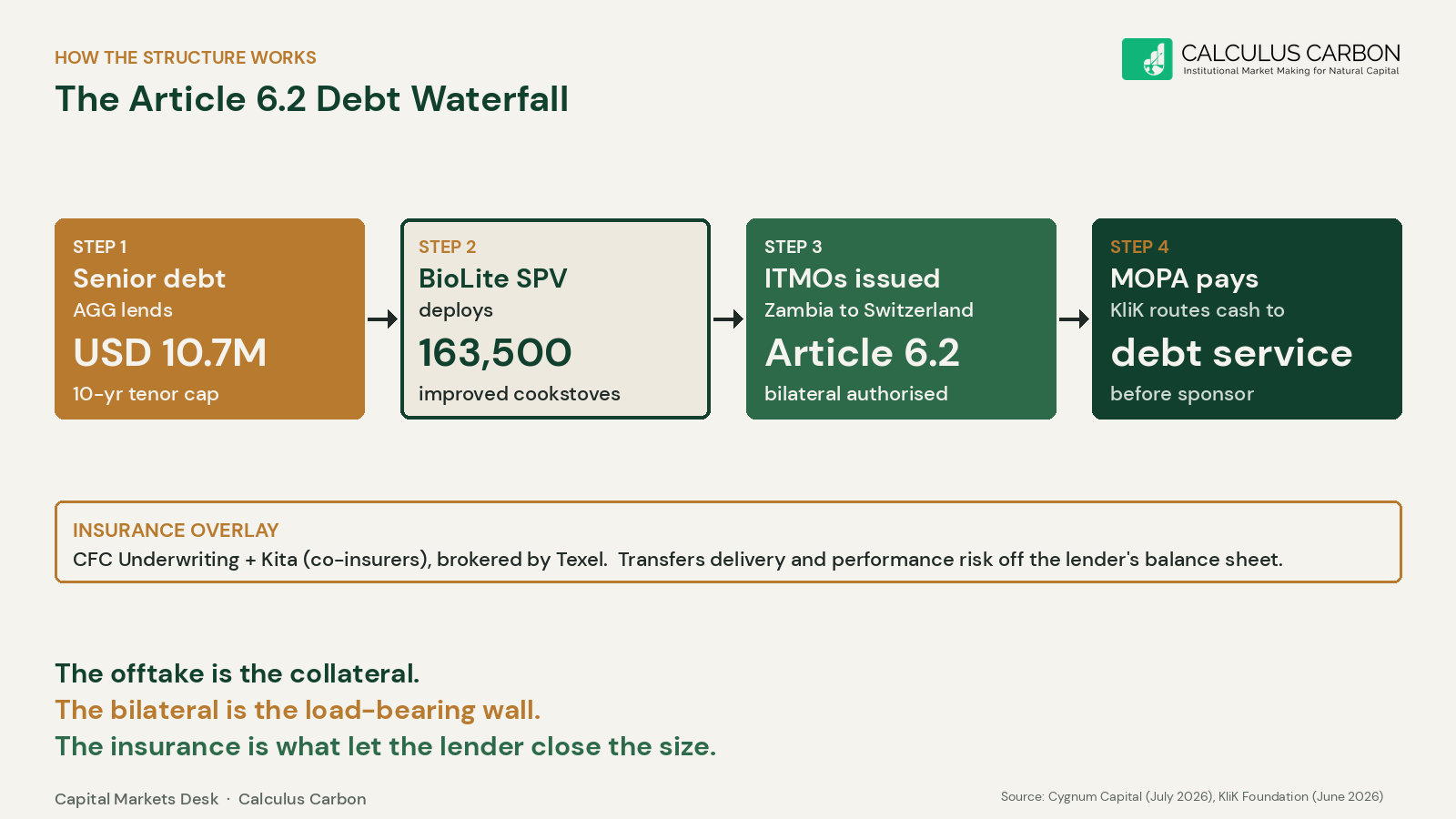
A carbon insurance wrap sits above the credit exposure. CFC Underwriting and Kita are the underwriters, brokered by Texel.1,4 The wrap transfers a slice of the delivery and performance risk off the lender’s balance sheet and lets AGG size the facility on the offtake cash flow rather than on a full-recourse view of BioLite as a corporate borrower.
Why the Offtake Is the Collateral, Not a Revenue Line
The instinct on a first read is to see the MOPA as a revenue contract that helps the borrower service the debt. That framing understates what has happened here. In a conventional project-finance structure, the lender is repaid from an asset that can be foreclosed on if the borrower defaults. In an Article 6.2 cookstove structure, the physical asset is 163,500 stoves in kitchens across Zambia. That is not a foreclosable balance sheet. The only asset that can be pledged, ring-fenced and directed to the lender in a default scenario is the future cash flow from the offtake. The lender’s security interest is over the ITMO stream and the KliK receivables it produces.
That is why the counterparty on the other side of the MOPA matters more than the sticker price on the credits. KliK is not a voluntary buyer. It is a Swiss compliance foundation with a statutory reason to buy these credits and a sovereign framework, under Article 6.2, that ratifies each transfer. A default on the underlying loan does not extinguish the offtake; the security package can be structured so that MOPA proceeds are routed to the lender’s account before they touch the borrower’s balance sheet. That is what ‘offtake as collateral’ actually means when the offtake is compliance-authorised. It converts a receivables stream into a foreclosable claim.
Who Bears the Cost, and When
The cash-flow order in this deal explains why senior debt priced. At origination, AGG advances the USD 10.7M facility. Those proceeds fund the SPV’s purchase of stoves from BioLite’s manufacturing operation and cover distribution, monitoring and issuance costs. Households receive the Dura Stove at a subsidised price, with the subsidy funded, over time, by the ITMO revenues that come back to the SPV once the credits are issued and transferred.
The insurance layer sits above this cash flow to protect the lender against slippage in delivery volumes and performance metrics. The premium is paid by the SPV out of the facility, which increases the total funding requirement modestly but is the reason AGG can size the loan on the offtake cash flow rather than requiring BioLite to post a corporate guarantee that would consume the sponsor’s balance-sheet capacity.
Once ITMOs start issuing, KliK pays for them under the MOPA. Those payments flow into the SPV’s collection account and are used, in a defined waterfall, to service AGG’s senior debt on schedule, fund the operating and monitoring costs of the activity, and route residual cash to BioLite as the sponsor. A senior lender at commercial rates gets repaid first out of every credit KliK buys, over a tenor consistent with AGG’s ten-year cap. Without a compliance offtake and an insurance layer, a lender could not see a repayment path that survived a delivery hiccup or a slower-than-planned issuance schedule. With both, the cash flow lands in a bankable shape.
Why the Bilateral Authorisation Layer Is the Load-Bearing Wall
The Zambia-Switzerland bilateral, signed on 16 November 2025 and now producing authorised activities under Article 6.2, is doing more work in this structure than a casual reader would give it credit for. An Article 6.2 authorisation letter, jointly issued by the host and buyer countries, is what turns a project’s emission reductions into ITMOs that count against the buyer’s Nationally Determined Contribution and are removed from the host’s own accounting via a corresponding adjustment. Without that letter, a KliK MOPA would still exist, but the credits would sit in a different regulatory class with a different price, a different buyer universe and a different balance-sheet treatment. The bilateral is what allows KliK to pay a compliance-market price for a compliance-eligible instrument.
The compliance status also changes the credit analysis. AGG is not underwriting the price risk of a voluntary market segment prone to reputational events. It is underwriting the credit of a Swiss compliance foundation, in a bilateral framework backed by two sovereign counterparties, over a defined tenor. That is a materially different exposure to price when the offtake is set by a voluntary buyer whose willingness to pay can move with a magazine article. The second Zambia-Switzerland activity, Emerging Cooking Solutions’ Modern Energy Cooking Zambia, was authorised on 17 August 2026.5 Two authorised activities in under two months on the same bilateral is a rate of throughput that reads more like a functional pipeline than a pilot. A one-off transaction does not build a market. A cadence does.
Why This Structure Was Not Available Twelve Months Ago
Three enabling pieces had to be in place before AGG could underwrite a senior debt facility against this cash flow. The first is the bilateral implementing agreement itself, signed at Belém in November 2025. Until that agreement existed, the ITMO transfer path from Zambia to Switzerland was legally unresolved.
The second is Zambia’s domestic institutional infrastructure. The Zambia Green Economy and Climate Change Act was enacted in 2024, the Zambia National Carbon Registry was launched on 7 August 2026, and the Carbon Market Regulations providing the operating rules for project authorisation and carbon-credit trading were promulgated in 2026.6 Without that stack, a lender cannot underwrite the security package because the registry entries that give the ITMOs their legal identity would not exist domestically.
The third is the maturing insurance market for carbon-credit delivery. CFC Underwriting and Kita, with Texel as broker, are the specialist market that has built products against carbon-project performance risk over the last two years. Two years ago, an AGG-sized lender would have had to hold that risk on its own balance sheet or pass on the transaction. Today the risk is transferable at an accepting price. The BioLite facility is what happens when those three pieces line up on the same deal.
What Comparable NbS Deals Now Have to Answer
The template is portable to any Global South project category where a bilateral authorisation is in place and a sovereign-backed compliance buyer sits on the other side. Ghana-Switzerland already has an authorised cookstove activity from 2024. Vietnam-Singapore has an implementation agreement ratified in August 2026. Thailand-Switzerland, Senegal-Switzerland, Peru-Switzerland and several others sit in various stages of the same architecture. For ARR and mangrove restoration, tenor and delivery schedules differ, but the underlying test is identical: is there a compliance-authorised offtake with a counterparty a lender would take credit exposure to, over a tenor a senior lender can price. If yes, senior debt is on the table. If no, the deal stays in the grant, blended-finance or forward-purchase quadrant.
Two questions decide whether a comparable transaction can access the same capital pool. First, is the offtake compliance-authorised or voluntary. A voluntary offtake with an investment-grade corporate can still support debt, but it prices differently and typically needs a shorter tenor or a heavier equity layer. A compliance-authorised offtake, in this bilateral form, is the closer analogue to a utility power purchase agreement that already prices bank debt in the renewable-energy sector. Second, is there an insurance market willing to take delivery and performance risk at a workable price. That market exists for cookstoves and improved-fuel activities. It is thinner for newer methodologies with longer verification cycles, and in those categories the lender is asked to hold more risk itself, and the deal either gets smaller or moves off senior debt.
The Read for Institutional Capital
Article 6.2 has been described for two years as a market that will one day carry institutional capital. The BioLite facility is what one day looks like when it arrives. A DFI-anchored senior debt fund lending USD 10.7M on commercial terms, with tenor consistent with a ten-year cap, secured on a compliance-authorised offtake to a Swiss sovereign-backed foundation, wrapped by a specialist insurance market. The offtake is the collateral. The bilateral is the load-bearing wall. The insurance is what let the lender close the size. The next round of Article 6.2 transactions will be judged against this template, not against the grant-and-equity structures that preceded it. Sponsors that can point to a compliance-authorised offtake and an insurance-wrapped delivery layer will access senior debt at commercial rates. Those that cannot will remain in the concessional and equity stack.
Compliance demand is what turns a carbon receivable into a bankable one.
This piece pairs with a Neelesh Agrawal LinkedIn short-form scheduled for W37.
Sources
- [1] Cygnum Capital, Africa Go Green backs BioLite’s clean-cooking rollout in Zambia under Article 6.2 of the Paris Agreement, July 2026. cygnumcapital.com
- [2] KliK Foundation, BioLite Improved Cookstoves Activity Zambia authorised, 25 June 2026. klik.ch
- [3] Africa Go Green Fund, About and portfolio. agg-fund.com
- [4] Africa Sustainability Matters, Africa Go Green and BioLite pioneer Article 6.2 carbon finance model to scale clean cooking in Zambia. africasustainabilitymatters.com
- [5] KliK Foundation, Modern Energy Cooking Zambia authorised, 17 August 2026. klik.ch
- [6] Africa Private Equity News, Africa Go Green Fund invests in BioLite Zambia SPV (context on Zambia National Carbon Registry launch and Green Economy and Climate Change Act 2024). africaprivateequitynews.com