
Project Finance · Carbon Removal · 8 September 2026
Before A Bank Underwrites Carbon Removal, It Buys It. The US Bank Carba Offtake Is A Diligence Move.
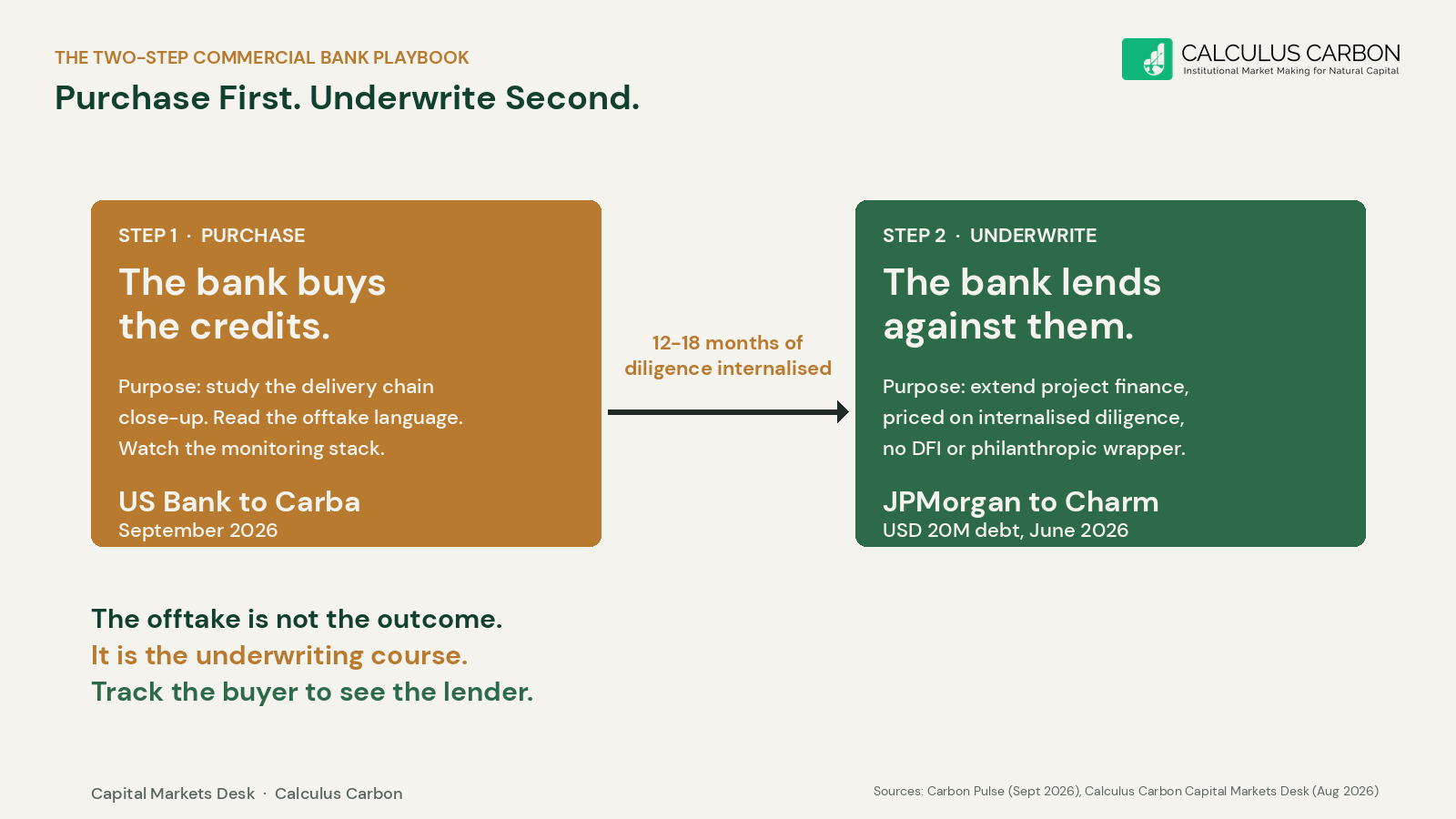
US Bank’s first carbon removal offtake, with Minnesota biochar developer Carba, is not a scale-up story. It is a learning move that mirrors the pattern JPMorgan used before it wrote debt to Charm. Carbon removal is following a two-step commercial-bank playbook: purchase first, underwrite second.
Thesis
US Bank’s first carbon removal offtake, signed with Minnesota-based biochar developer Carba, is not a scale-up story. On its own, the ticket is a small offtake for a young technology. In substance, it is a learning move: the bank is buying credits to understand how a removal project is originated, monitored, verified and delivered, so that when a project-finance opportunity in the same category lands on its underwriting desk in twelve or eighteen months, the desk is not asking first-principles questions. This is the pattern JPMorgan Chase used before it extended venture debt to Charm Industrial in June 2026. Carbon removal is following a two-step commercial-bank playbook: purchase first, underwrite second.
Two Deals, One Sequence
On the offtake side, US Bank has agreed to purchase carbon removal credits from Carba’s Minnesota biochar operation. Ariel Meyerstein, Head of Sustainability at US Bank, framed the transaction as a way for the institution to understand an emerging climate solution, rather than as an attempt to offset emissions at scale or to trade the credits on a secondary market.1 The offtake sits alongside Carba’s existing five-year, 44,000-tonne agreement with Microsoft, retiring credits from 2025, which was co-financed by climate-specialist debt provider Structure Climate.2,3 The signal on the credit-buyer side is not the ticket size. It is that a systemically important US commercial bank has bought the same technology Microsoft is buying, from the same developer Structure Climate has already lent against.
On the debt side, the reference precedent is JPMorgan’s June 2026 combination of an offtake and a venture debt facility with Charm Industrial. The desk covered that transaction in early August, and the mechanics matter for what follows: after roughly two and a half years of purchasing credits from the same developer, and building institutional familiarity with the pyrolysis-and-injection process, the bank wrote a USD 20M facility onto the developer’s balance sheet, earmarked for the Fort Lupton facility that produces the credits the bank continues to buy.9 The chronology is the point. The purchases were the prerequisite for the debt.
Why The Purchase Is The Prerequisite
There is a structural reason commercial banks do not underwrite project finance on a technology they have not previously bought. Project finance depends on delivery. A senior lender writes a facility against the cash flow the project generates when it delivers the product. In a carbon removal context, the product is a tonne verified by an independent methodology, issued under a registry protocol and transferred to a named buyer under an offtake contract. Every step in that chain sits on assumptions the lender needs to hold with confidence: how the feedstock is sourced, how the pyrolysis or storage process is monitored, how the methodology handles baselines and leakage, how the registry handles issuance timing, how the buyer treats non-delivery, what happens to the credits if the project misses its schedule.
A bank that has already been a buyer of the same credits has priced each of those assumptions inside its own procurement contract. It has read the offtake language. It has seen the delivery schedule slip or hold. It has understood how the developer responds when monitoring flags a shortfall. That accumulated familiarity is not a soft asset. It is the underwriting model that eventually lets a credit officer sign off on a project finance facility priced at commercial terms rather than at a punitive spread.
The US Bank purchase, then, is not a philanthropic gesture or a marketing move. It is the front end of an underwriting curve. The bank is buying informational capital.
What The Rest Of The Market Looks Like
Biochar and other carbon dioxide removal categories have moved from experimental purchases to a genuine market in the last twelve months. Q2 2026 non-Microsoft buyers committed 2.1 million tonnes of carbon dioxide removal, a 136 percent increase on the same quarter a year earlier, across 14 deals, seven of which came from first-time buyers.4 Excluding the three large Bio-CCS transactions, biochar accounted for 86 percent of Q2 volumes and surpassed one million tonnes contracted for the third time in five quarters.4 The demand curve has clearly moved.
Named project-finance transactions have not moved at the same pace. The desk can point to three data points in the biochar category, each with a distinct route.
Oxbury Bank, described as the UK’s only bank focused on the rural economy, extended a GBP 1M loan to Cornwall-based developer Restord in May 2026. The transaction was executed through the Green Finance Institute’s CDR Catalyst, launched on 13 May 2026 to seed the first-of-its-kind commercial loan to a UK biochar developer. The facility funds a project that removes approximately 2,000 tonnes of CO2 each year and is backed by a pre-purchase agreement from Terraset, with a partnership structure involving The Green Waste Company alongside.6 The pattern here is a small commercial bank with a rural-economy mandate, an equity partner sitting underneath the loan, and a policy-backed catalyst absorbing part of the origination cost.
Carba’s own USD 40M facility with Structure Climate is the second data point. Structure Climate is not a commercial bank; it is a specialist climate-debt provider, and the loan lands against a specific offtake portfolio anchored by Microsoft.3 A climate-specialist lender writing against a named investment-grade offtake looks like project finance, but the lender’s whole balance sheet is scoped to the sector. A generalist commercial bank does not carry that scope.
Exomad Green in Bolivia is the third data point, and its status matters. IDB Invest has disclosed a project up to USD 120M for Exomad’s biochar production, structured as an A/B loan jointly arranged with Deutsche Bank AG, at a six-year tenor including a grace period.7,8 The IDB Invest disclosure shows a syndicated envelope of USD 100M with USD 30M of direct IDB Invest financing. The project’s disclosure status is “Hold”, meaning the transaction has been signalled but not yet closed.7 Even at this stage, the structure is instructive: the deal reads as a DFI-anchored A/B loan with a commercial-bank partner, backstopped by DFI credit enhancement and long-term offtakes, rather than as a stand-alone commercial project-finance facility.
Three data points, three different routes. A rural-economy bank via a policy catalyst. A specialist climate-debt provider. A DFI-anchored A/B loan with a commercial-bank partner. The one route that has not yet appeared at scale is the pure commercial-bank project-finance facility on a stand-alone basis. That is the route US Bank is quietly preparing for.
Why This Is A Distinct Move From The DFI Or Philanthropic Route
The Restord and Exomad transactions closed, or are on the verge of closing, because a policy body or a DFI is absorbing a share of the origination and credit risk that a commercial bank would otherwise carry. The Green Finance Institute’s CDR Catalyst is explicitly a market-building instrument. IDB Invest is explicitly a development finance institution. That risk-sharing is the reason the loans exist at those tenors and pricing. But it is also the reason the same instrument cannot yet be extended to the next hundred biochar projects without the same enhancement layer at each step.
The US Bank purchase sits outside that architecture. It is a straight commercial procurement transaction on the bank’s own balance sheet, not a facility supported by a public or philanthropic backstop. If, twelve or eighteen months from now, the bank extends a project-finance facility to Carba or to a comparable developer, that facility will not need a DFI wrapper. It will be underwritten on the same delivery diligence the bank has spent this period internalising. That is a materially different capital pool from the one that has funded biochar to date.
The Charm-JPMorgan facility is the closest illustration of what that looks like when it lands. JPMorgan is one of the largest commercial banks in the world. Its debt to Charm was not written with a DFI guarantee or a philanthropic first-loss layer. It was written on the back of two-and-a-half years of institutional familiarity with the counterparty and the technology.9 That familiarity was built on the offtake side of the transaction, over a period long enough for the underwriting desk to internalise how the delivery worked.
What The Sequence Implies For Developers
For a carbon removal developer, the sequence has a specific implication. Selling to a commercial bank early is not a revenue event. It is the front end of a debt conversation that may not surface for another year. The value of that first purchase, from a capital-formation perspective, is the diligence the bank runs during procurement: the questions the bank’s credit officers ask about feedstock security, the interrogation of the monitoring stack, the review of the methodology, the assessment of the buyer diversity. Each of those interrogations is dress rehearsal for the underwriting model the bank will use if it later moves to a debt position.
That is why the identity of the buyer matters more than the ticket. A one-off philanthropic buyer teaches the developer nothing about how a project-finance lender will read the deal. A commercial-bank buyer with a sustainability mandate does teach that, whether or not the eventual debt materialises. Developers that receive a first-time commercial-bank offtake should treat it as a signal to invest in the diligence infrastructure the bank will require when the debt conversation begins: a data room, a monitoring stack that produces auditable output, and an offtake book with enough diversification to support a debt facility that sits above any single buyer.
What It Implies For Institutional Capital
There is a broader read for allocators. Non-Microsoft demand for carbon dioxide removal, on the ClimeFi data, is now the majority of the market by transaction count.4 The offtake side is diversifying faster than the debt side is deepening. That mismatch will not resolve on its own. It will resolve as commercial banks that have spent a year or two on the buyer side of the market move to the lender side, one deal at a time, following the same two-step sequence JPMorgan has already walked.
Institutional allocators looking at CDR funds, or at direct co-investment in developer platforms, should read the first-time commercial-bank offtakes as leading indicators. Every named US bank, European bank or global bank that signs its first CDR purchase in the next two quarters is a debt underwriter in training. The developers those banks buy from, the technologies they select and the offtake terms they use are the shape of the commercial project-finance stack when it arrives.
The Read For Institutional Capital
Commercial-bank project finance for carbon removal is not being blocked by an absence of demand. It is being paced by the length of time each bank needs to build internal underwriting capacity, and that time is being spent on the buyer side of the market. The US Bank offtake with Carba is the visible surface of a diligence process that will decide, over the next twelve to eighteen months, whether that bank is comfortable extending a project-finance facility to a carbon removal developer. Allocators tracking the sector should read first-time commercial-bank offtakes not as marketing headlines but as capital-formation signals. The two-step sequence, purchase before debt, is now the operating pattern institutional capital will follow into carbon removal.
Track the buyer to see the lender.
This piece pairs with a Calculus Carbon LinkedIn company short-form scheduled for W37.
Sources
- [1] Carbon Pulse, US Bank signs first carbon removal offtake with Carba, September 2026. carbon-pulse.com
- [2] Carba, Announces 5-Year Carbon Removal Credit Purchase Agreement with Microsoft, 24 April 2025. carba.com
- [3] Reversing Climate Change podcast episode 346, How Structure Climate Financed Carba’s Biochar Offtake Agreement with Microsoft. reversingclimatechange podcast
- [4] Carbon Herald, ClimeFi Q2 2026 report shows new CDR buyers making strides, July 2026. carbonherald.com
- [5] CDR.fyi, CDR monthly recap June 2026. cdr.fyi
- [6] Green Finance Institute, GFI’s CDR Catalyst launches, unlocking GBP 1M in financing in first-of-its-kind British biochar deal, May 2026. greenfinanceinstitute.com
- [7] IDB Invest, Exomad Biochar Production Bolivia project disclosure, June 2026. idbinvest.org
- [8] LatinFinance, Exomad seeks financing for biochar expansion, 7 June 2026. latinfinance.com
- [9] Calculus Carbon Capital Markets Desk, Same Bank on Both Sides: The Charm-JPMorgan Prototype for Carbon Project Finance, 10 August 2026. calculuscarbon.com