
Development Finance · Blended Capital · 15 September 2026
Investor-Level Guarantees Are Unlocking European DFI Capital Into Global South Nature Funds
The EFSD+ Carbon Sinks facility, a EUR 366 million European Union guarantee vehicle launched in October 2024, sits at the limited-partner ticket level rather than on the fund’s balance sheet. Six fund-level LP commitments have moved through it. Four landed inside a seven-week window in March-May 2026. The design point is where in the capital stack the guarantee sits.
The Design Point
Impact Fund Denmark announced a USD 20M limited-partner commitment to the SA Impact Forestry Fund II at COP30 in November 2025, funding the conversion of Paraguayan cattle pasture into commercial forestry with sustainable land-use outcomes.2,3 The European Union guarantee behind that commitment was formally confirmed in August 2026.1 The instrument that sits behind it is worth reading carefully, because the design point is not the size of the guarantee itself, which is EUR 366 million across the full facility.10 The design point is where in the capital stack the guarantee sits. It sits at the investor’s decision to write the LP ticket, not on the fund manager’s balance sheet, and that placement is what is unlocking European development-finance-institution capital into Global South nature-based-solutions funds at a pace that would not otherwise clear each institution’s individual risk committee. In the six months to August 2026, six fund-level LP tickets have signed under the same instrument. Four of them landed inside a seven-week window in March, April, and May 2026.1 The pattern is now observable, and the mechanic is portable.
Why This Instrument Matters
The vehicle carrying the guarantee is called the EDFI Carbon Sinks programme. It is managed by EDFI Management Company, the fund-of-funds arm of the Association of European Development Finance Institutions, on behalf of the European Union. The programme sits inside the European Fund for Sustainable Development Plus, which is the European Union’s flagship blended-finance vehicle for development-finance guarantees to non-EU geographies. Carbon Sinks was capitalised at EUR 366 million in October 2024, and its stated mandate is to de-risk European development-finance-institution capital going into pooled forestry funds and carbon-sink funds operating across the Global South.10 The design covers both fund-level limited-partner tickets and direct equity into operating companies, but the observable data over the past two years is that the fund-level ticket is where the instrument is repeating fastest.
The reason to walk through the plumbing carefully is that the instrument does something specific that a fund-level guarantee cannot do. A fund-level guarantee covers reversals on the fund’s exposure. It reads as a first-loss layer sitting inside the fund vehicle itself, and it is the instrument most limited partners are familiar with from blended-finance junior tranches. A fund-level guarantee makes the fund look safer to every limited partner in aggregate. It does not, however, change the individual investment decision each limited partner has to make. The EDFI Carbon Sinks programme is different. It sits at the investor level, meaning the guarantee is attached to a specific limited partner’s specific decision to write a specific LP ticket into a specific fund.4,5 The commitment being de-risked is the LP’s, not the manager’s.
Where the Guarantee Sits in the Capital Stack
The distinction between an investor-level and a fund-level guarantee is where most of the design work happens. On a fund-level guarantee, the guarantor absorbs a portion of the fund’s aggregate loss. Every limited partner participating in the fund benefits pro-rata. The individual limited partner’s incentive to make a marginal commitment is only modestly moved, because the guarantee is diluted across the full fund’s capital base. On an investor-level guarantee, the guarantor absorbs a portion of the specific limited partner’s loss on the specific ticket the guarantee is written against. The individual limited partner’s incentive to make a marginal commitment is moved significantly, because the guarantee is concentrated on that limited partner’s line of exposure.
For a European development-finance institution such as Impact Fund Denmark, Deutsche Investitions- und Entwicklungsgesellschaft, Proparco, or Swedfund, the risk committee decision on a USD 20M commitment into a Global South nature fund is measured against the institution’s country limits, sector limits, single-manager limits, and internal loss provisioning. A pooled fund-level guarantee moves the fund’s headline loss estimate down, but does not change the risk committee’s line on the individual institution’s exposure. An investor-level guarantee written directly against the institution’s ticket does. It reduces the committed capital the institution has to provision against, releases pressure on internal single-manager and single-strategy limits, and lets the ticket clear at a size the risk committee would not have approved on the standalone credit view.
The Repeating Pattern
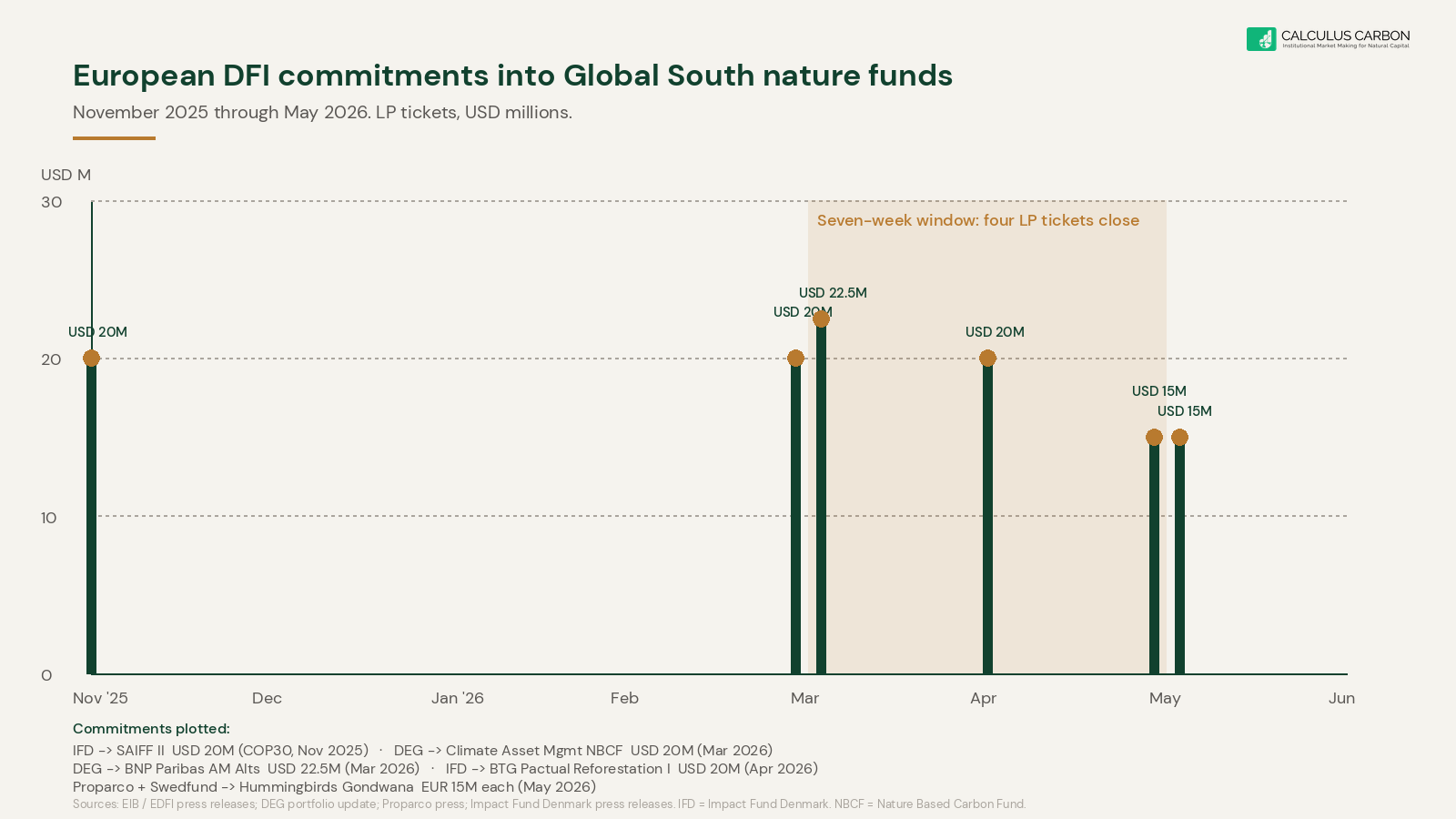
The observable pattern under the EDFI Carbon Sinks programme shows the design working the way the plumbing predicts. Impact Fund Denmark’s USD 20M commitment to the SA Impact Forestry Fund II, the Paraguayan reforestation vehicle also referenced as the Reforestation Fund I in EDFI Management Company communications, cleared under the Carbon Sinks guarantee.2,4 Deutsche Investitions- und Entwicklungsgesellschaft placed a USD 20M ticket into the Climate Asset Management Nature Based Carbon Fund under the same instrument.9 Deutsche Investitions- und Entwicklungsgesellschaft also placed a USD 22.5M ticket into the BNP Paribas Asset Management Alternatives natural capital and impact strategy.6 Impact Fund Denmark placed a further USD 20M ticket into the BTG Pactual Reforestation Fund I.4,5 Proparco and Swedfund each placed EUR 15M into Hummingbirds Gondwana.7,8 Six fund-level commitments, six institutional limited partners, six different fund managers, one shared guarantee mechanic sitting at the investor level.
Four of those six commitments landed inside a seven-week window from mid-March 2026 to early May 2026. The clustering is not a coincidence. Each institution’s risk committee had to see the mechanic clear at another peer institution before it would price the same mechanic into its own commitment. Once the first two commitments cleared and the guarantee’s operational architecture was public through EDFI Management Company’s own disclosures, the pattern accelerated. The remaining risk committees did not have to invent the read. They inherited it.
The same instrument has also backed direct equity into operating companies, including Mountain Hazelnuts in Bhutan and The New Forests Company in East Africa. The direct-equity path is repeating more slowly. The fund-level LP ticket is where the mechanic is proving out fastest, because the LP ticket carries a standardised diligence workflow that a risk committee can process against a manager’s private-placement memorandum, whereas direct equity into an operating company requires deeper single-name diligence and covenant negotiation.
Adjacent Instruments and Why the Placement Matters
The EDFI Carbon Sinks programme is worth reading against three adjacent instruments that a risk committee would consider as alternatives. A blended-finance junior tranche sits inside the fund vehicle and absorbs first losses on the pool. It changes the fund’s risk profile but not the marginal limited partner’s risk profile against its own book, and the pricing gets diluted across every subscriber. A political-risk insurance policy written at the project level protects a specific operating asset against a defined political-event trigger, and it is priced separately for each policy, but it does nothing to move a limited partner’s fund-level exposure. A Multilateral Investment Guarantee Agency guarantee at the sovereign level, or a similar Multilateral Investment Guarantee Agency-style breach-of-contract cover, protects the equity investor against sovereign action, and its logic is closest to the EDFI mechanic, but its perimeter is narrower and its diligence timeline is longer.
The EDFI Carbon Sinks placement is different because it is written explicitly at the limited partner’s investment decision, and it is capitalised as a facility rather than sold as a bilateral policy. That means a risk committee can price the instrument off the facility’s published mandate rather than negotiate the coverage terms line by line. The transaction cost of accessing the guarantee is materially lower than the transaction cost of arranging a bilateral instrument for each ticket, and it is the transaction-cost saving that lets the same institution commit through the same guarantee more than once in the same year.
The Read for Institutional Capital
For a European development-finance institution or an allocator with a European DFI-adjacent balance sheet that is looking to enter Global South nature-based-solutions funds, the EDFI Carbon Sinks placement is now the reference architecture. The instrument does not solve every constraint. It does not price the underlying carbon or the land-use outcome, and it does not shorten the manager’s diligence timeline. It does move the risk committee constraint that has historically held tickets under the internal size limit. Route the guarantee to the LP ticket, not the fund vehicle. Six commitments in six months, four in a seven-week window, is the observable pace of an instrument that has cleared its first operational cycle. The next fund vintages coming to market on the same architecture are worth reading closely.
The design point is not the guarantee’s size. It is the guarantee’s placement. Investor-level cover at the LP ticket is what has moved four European development-finance institutions into six Global South nature-based-solutions funds in six months, and the architecture is now portable.
This piece pairs with a Calculus Carbon company-page LinkedIn short-form scheduled for W38.
Sources
- [1] Carbon Pulse, EDFI Carbon Sinks programme confirms fund-level guarantees. carbon-pulse.com
- [2] Impact Fund Denmark, From cattle pasture to climate forest: Impact Fund Denmark launches new forest investment at COP30. impactfund.dk
- [3] IDB Invest, Silvipar: supporting development of the forestry industry in Paraguay. idbinvest.org
- [4] EDFI MC, Impact Fund Denmark’s investment in the Reforestation Fund I supported by EDFI Carbon Sinks. edfimc.eu
- [5] EDFI MC, EDFI Carbon Sinks programme to support DEG’s investment in the Reforestation Fund I. edfimc.eu
- [6] EDFI MC, EDFI Carbon Sinks supports DEG’s investment in BNPP AM Alts natural capital and impact strategy. edfimc.eu
- [7] EDFI MC, Proparco and Swedfund supported by EDFI Carbon Sinks in Hummingbirds Gondwana SAS. edfimc.eu
- [8] Proparco, Hummingbirds raises EUR 50M as Proparco, Swedfund and BII invest in nature-based solutions. proparco.fr
- [9] EDFI MC, Carbon Sinks programme supports DEG’s USD 20 million investment in Climate Asset Management’s Nature Based Carbon Fund. edfimc.eu
- [10] EDFI MC, EU and European DFIs launch a major new Global Gateway climate mitigation programme aiming at mobilising EUR 4 billion of forestry-sector and other nature-based climate investments. edfimc.eu