
Project Finance · Article 6.2 · Ghana · 17 September 2026
One Authorisation, Many Reports: Article 6.2 as a Recurring Sovereign Covenant
The Letter of Authorisation is a one-time gate at financial close. The corresponding adjustment is a sovereign covenant that repeats every biennial cycle for the full life of the loan. Transparency cadence, not the initial approval, is what will set the cost of capital for Article 6.2 debt over the next decade.
The Gate That Was Not the Real Test
Ghana authorised its first Article 6.2 transfer of 11,733 tonnes of Internationally Transferred Mitigation Outcomes to Switzerland in 2025, sourced from a cookstove project, and became one of only 11 developing-country programmes to have carried an authorised transaction across the finish line to date.2 The transfer sits inside a wider position of 12.7 million tonnes authorised by Ghana as of March 2026, representing 47 per cent of the country’s 24 million tonne Article budget over its current NDC period.2 Most institutional discussion of the transaction has anchored on the Letter of Authorisation as the sovereign-risk gate that unlocks Article 6.2 supply. The underwriting reality sits one layer down from that. The Letter of Authorisation is a one-time gate at financial close. The corresponding adjustment is a sovereign covenant that has to be honoured every biennial cycle for the full life of the loan.
What the Letter of Authorisation Actually Does
The Letter of Authorisation is a discrete administrative act. Ghana’s Carbon Market Office, operating under ACT 1124 of 2025 and the country’s Article 6 framework, issues a letter that authorises a specific project to transfer a specific tonnage of ITMOs to a specific participating Party.4 Once issued, the letter converts a domestic mitigation outcome into a unit that can legally cross a border for compliance use. From the lender’s perspective, this is the piece of paper that removes the largest single item of pre-close political risk and lets the transaction move from an uncontracted supply narrative to a contracted debt structure.
The Article 6.2 Reference Manual and Ghana’s own framework document then make clear what the Letter of Authorisation does not do.3,4 Authorisation is the point at which the tonnage enters the international register. It does not, in itself, complete the accounting move that allows the buyer to count the tonnage against a Nationally Determined Contribution obligation. That accounting move is the corresponding adjustment, and it is a separate, recurring, reporting-based act by the sovereign. Under Article 6.2 guidance, the transferring Party must add authorised and first-transferred ITMOs to its emissions balance and the acquiring Party must subtract used ITMOs, and both movements have to be published through a structured summary that forms part of each country’s Biennial Transparency Report.3
Every Two Years, For the Full Life of the Facility
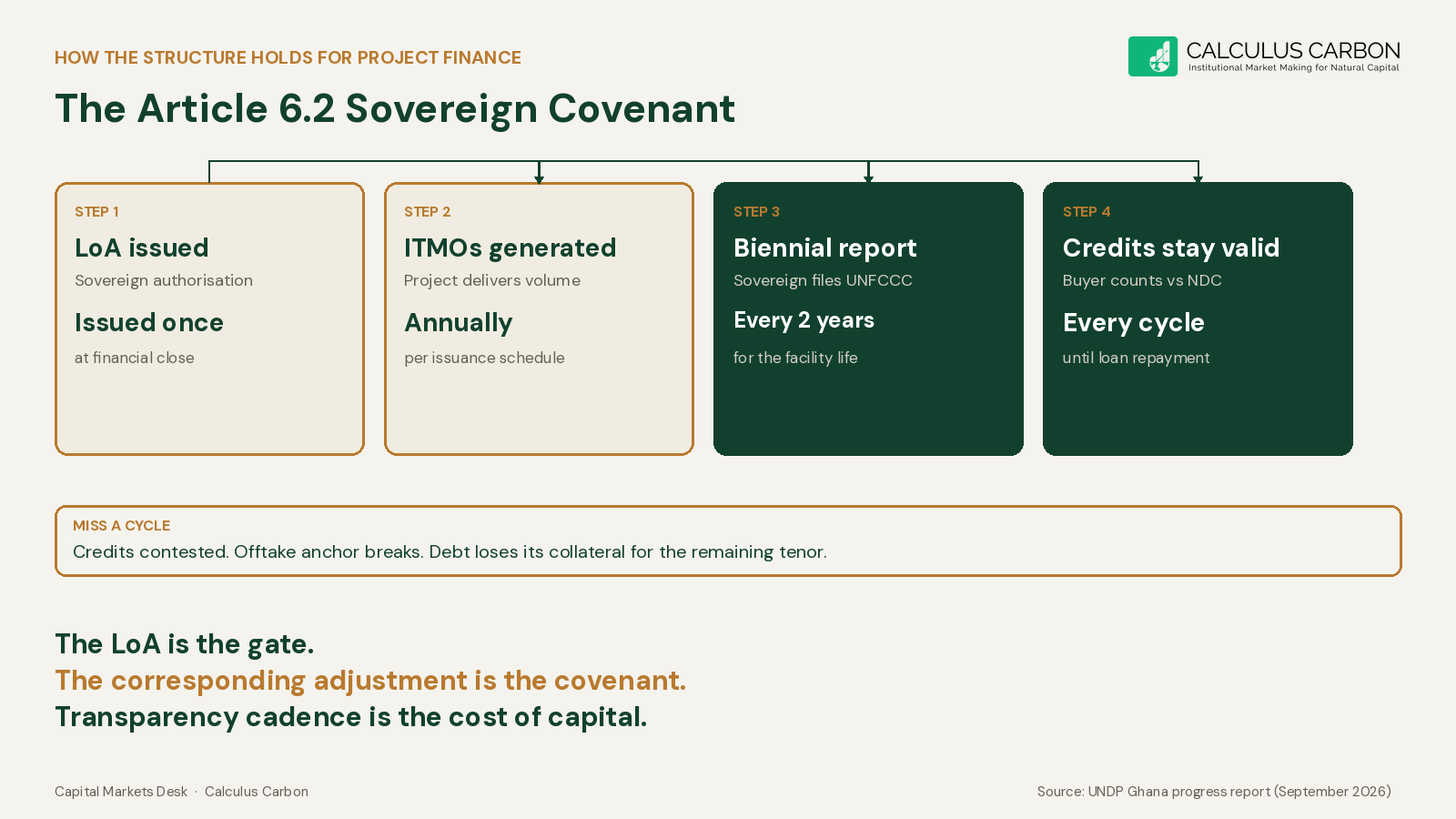
The reporting cadence is fixed. Under decision 18/CMA.1 and the associated common tabular format under decision 5/CMA.3, Biennial Transparency Reports are due by 31 December every two years.3,4 Ghana’s second Biennial Transparency Report, BTR2, is due by 31 December 2026, and the corresponding adjustment for the 2025 Swiss cookstove transfer is expected to be reported in that submission.2 Annual information under the Agreed Electronic Format is due by 15 April each year and feeds into the biennial submission.3 A ten-year construction-plus-offtake loan against a Ghanaian nature-based project is therefore not exposed to sovereign carbon-accounting risk once at close. It is exposed to it five times, at each successive biennial reporting cycle, until repayment.
The exposure is not theoretical. If a host country files a biennial report that is late, incomplete, or contested by the transparency review process, the ITMOs on the buyer’s balance sheet lose their status as fungible units against the buyer’s compliance obligation. In compliance markets that admit Article 6.2 units, either through CORSIA phase two, the Swiss CO2 Act obligation, or the growing set of bilateral arrangements, the counting mechanism at the buyer end depends on the transferring Party’s clean accounting at source. A break in that accounting at any point in the ten-year facility life is a break in the collateral that the debt provider originally underwrote.
The Credit Committee Question That Changes
The correct question inside the credit committee therefore shifts. It is not only whether the Letter of Authorisation is in the file at close. It is whether the host country has the institutional depth to file five successive Biennial Transparency Reports over the loan tenor without technical error, political interruption, or fiscal reprioritisation. That is a different diligence question than the one most Article 6.2 term sheets currently price. It sits somewhere between sovereign credit analysis and treaty-compliance analysis. Neither traditional infrastructure credit desks nor voluntary-market carbon desks have historically underwritten this specific piece of country risk with the seriousness it warrants for a ten-year facility.
The Verra Article 6.2 Corresponding Adjustments Reporting Tool, launched ahead of the December 2026 BTR window, is a useful signal here.5 Standards bodies are actively building infrastructure to help transferring Parties populate the structured summary correctly, precisely because the reporting mechanics are technically demanding and the consequence of a missed or malformed submission is material for units already sitting in buyer inventories. The market is aware that the corresponding-adjustment step is the pressure point. The tooling is arriving alongside a growing recognition that this step, not the Letter of Authorisation, is where Article 6.2 supply is either held together or lost.
Ghana as the Working Example
Ghana is one of the small set of Global South host countries that has done the primary institutional work to make the recurring covenant credible. ACT 1124 of 2025 enshrines the carbon market in domestic law. Sections 149 to 158 govern the market specifically.2 Ghana has submitted an Article 6.2 initial report to the UNFCCC and has committed to annex regular information on Article 6.2 transactions to its Biennial Transparency Reports no later than 31 December of the relevant year, consistent with the country’s own framework document and decision 18/CMA.1.4 Ghana was also one of only four Parties, alongside Guyana, Thailand and Vanuatu, that had submitted annual information using the draft Agreed Electronic Format by mid-2026. That institutional track record, more than the 12.7 million tonnes of authorised volume, is what makes the country’s carbon-revenue debt priceable at term.
The read is not that Ghana is the only host country capable of clearing the biennial reporting bar. Guyana, Thailand, Vanuatu, Zimbabwe and a handful of others are on comparable trajectories. The read is that the biennial reporting bar is the actual bar. A country can issue Letters of Authorisation quickly. Building the institutional capacity to file structured summaries under the Enhanced Transparency Framework every two years, on time, without material technical error, for the full life of a decade-long facility, is a different exercise entirely. The countries that build that capacity earlier will compound access to project finance over the next decade in a way that the countries that treat the Letter of Authorisation as the endpoint of the sovereign work will not.
The Read for Institutional Capital
For a debt provider pricing a facility against Article 6.2 carbon revenue, the correct front-page item on the credit memo is not the Letter of Authorisation. It is the host country’s rolling reporting cadence and the technical adequacy of its most recent Biennial Transparency Report. A ten-year facility against a Ghanaian, Guyanese or Thai project should be modelled with a cadence-risk overlay that recognises five successive biennial reporting events sitting inside the loan tenor. That overlay changes the spread, but it also creates a legitimate basis to price at term rather than to hold back for lack of a clean sovereign-risk frame. The overlay is priceable. The absence of the frame is what has kept much of the debt on the sidelines.
The wider point is that transparency cadence is emerging as the actual cost-of-capital variable for host-country carbon-revenue debt. Countries that report cleanly, on schedule, biennial cycle after biennial cycle, will attract senior debt at commercial rates. Countries that miss cycles, submit incomplete structured summaries, or allow the reporting apparatus to fall behind political transitions will price wider or fall out of the bankable set entirely. The compounding effect is real and it will show up in the pricing of the second and third generation of Article 6.2 facilities over the next five years. Ghana has taken the first step by moving eleven projects across the authorisation filter and enshrining the framework in primary legislation. The next ten years of reporting will decide whether it stays in the financeable set.
The Letter of Authorisation is the gate. The corresponding adjustment is the covenant. Transparency cadence, cycle after cycle, is the cost of capital for the next decade of Article 6.2 debt.
This piece pairs with a Neelesh Agrawal LinkedIn short-form scheduled for W38.
Sources
- [1] United Nations Development Programme (Ghana), Making the Carbon Market Work for All: Ghana’s 2025-2026 Progress, published 10 September 2026. undp.org
- [2] United Nations Framework Convention on Climate Change, Facilitative Multilateral Consideration of Progress, Ghana question-and-answer export, SB64 (2026). unfccc.int
- [3] United Nations Framework Convention on Climate Change, Article 6.2 Reference Manual. unfccc.int
- [4] Ghana Carbon Market Office (Environmental Protection Agency), Ghana’s Framework on International Carbon Markets and Non-Market Approaches. cmo.epa.gov.gh
- [5] Verra, Article 6.2 Corresponding Adjustments Reporting Tool. verra.org