
Project Finance · Nature Finance · Blended Capital · 28 September 2026
The Warehouse Comes Before The Fund: Reading Impact Earth’s Tropical Resilience Fund As A Project-Finance Sequence
Impact Earth has launched a Warehousing Facility to fund the first Tropical Resilience Fund investments before the fund closes. The headline is a USD 100M target. The financing event is the seeded portfolio that senior investors will be asked to underwrite.
The Read
Impact Earth announced on 24 September 2026 a Warehousing Facility for its Tropical Resilience Fund, a planned nature debt fund reported at USD 50M to 100M and aimed at Latin America and Southeast Asia.1 The natural read is that another nature fund is coming to market. We read it differently. The fund target does not finance anything yet. The warehouse does, because it puts the first loans on the books before the fund closes, and those loans become the evidence that senior investors will be asked to underwrite. The single learning for anyone raising or allocating to a nature debt fund is simple: a seeded portfolio is underwritten, a blind pool is only believed.
What Did Impact Earth Actually Launch On 24 September 2026?
Impact Earth, a UK-based impact investor and adviser, describes the Warehousing Facility as a dedicated holding vehicle that lets it deploy early catalytic capital and finance its first projects while the broader fund strategy takes shape for 2027.1 The first capital into the facility comes from the Restoration Seed Capital Facility, which the UN Environment Programme launched with the Frankfurt School of Finance and Management in October 2020, and from the Good Energies Foundation.1,6 The Global Innovation Lab for Climate Finance, Convergence Blended Finance and the International Climate Finance Accelerator supported the facility's development.1
Impact Earth's own framing is candid about the purpose. In its press release, the catalytic capital is meant to establish an initial portfolio and demonstrate the fund's approach in practice, “building the experience and evidence that will unlock further investment in TREF”.1 That sentence is the whole thesis. The facility is not there to make the fund bigger. It is there to make the fund investable.
What Does The Fund Look Like Once It Closes?
The Lab's 2025 profile sets out the destination. The Tropical Resilience Fund is a closed-ended mezzanine debt fund targeting a USD 100M final close, with a USD 30M first close, a 12-year term and two possible one-year extensions.2,3 The target return is a 10 percent net internal rate of return.2 The capital stack is split 70:30: a USD 70M senior tranche expected to come from institutional investors, development finance institutions and impact funds, sitting above a USD 30M junior, first-loss tranche expected to be anchored by philanthropies and governments.3 A guarantee facility may also be applied to the portfolio or to selected sectors.2
The lending toolkit is built for businesses whose cash arrives late or unevenly: revenue-based loans, convertible debt and bridge loans, with returns coming from loan repayments and equity conversions.3 Impact Earth's structuring terms of reference, dated 5 January 2026, add the portfolio shape: 18 to 22 investments at venture to early-growth stage, tickets of USD 0.5M to 10M, a Luxembourg vehicle run by an external alternative investment fund manager, and a regional split of at least 50 percent Latin America, at most 40 percent Southeast Asia and at most 10 percent other tropical regions.4
Why Does The Warehouse Matter More Than The Headline Target?
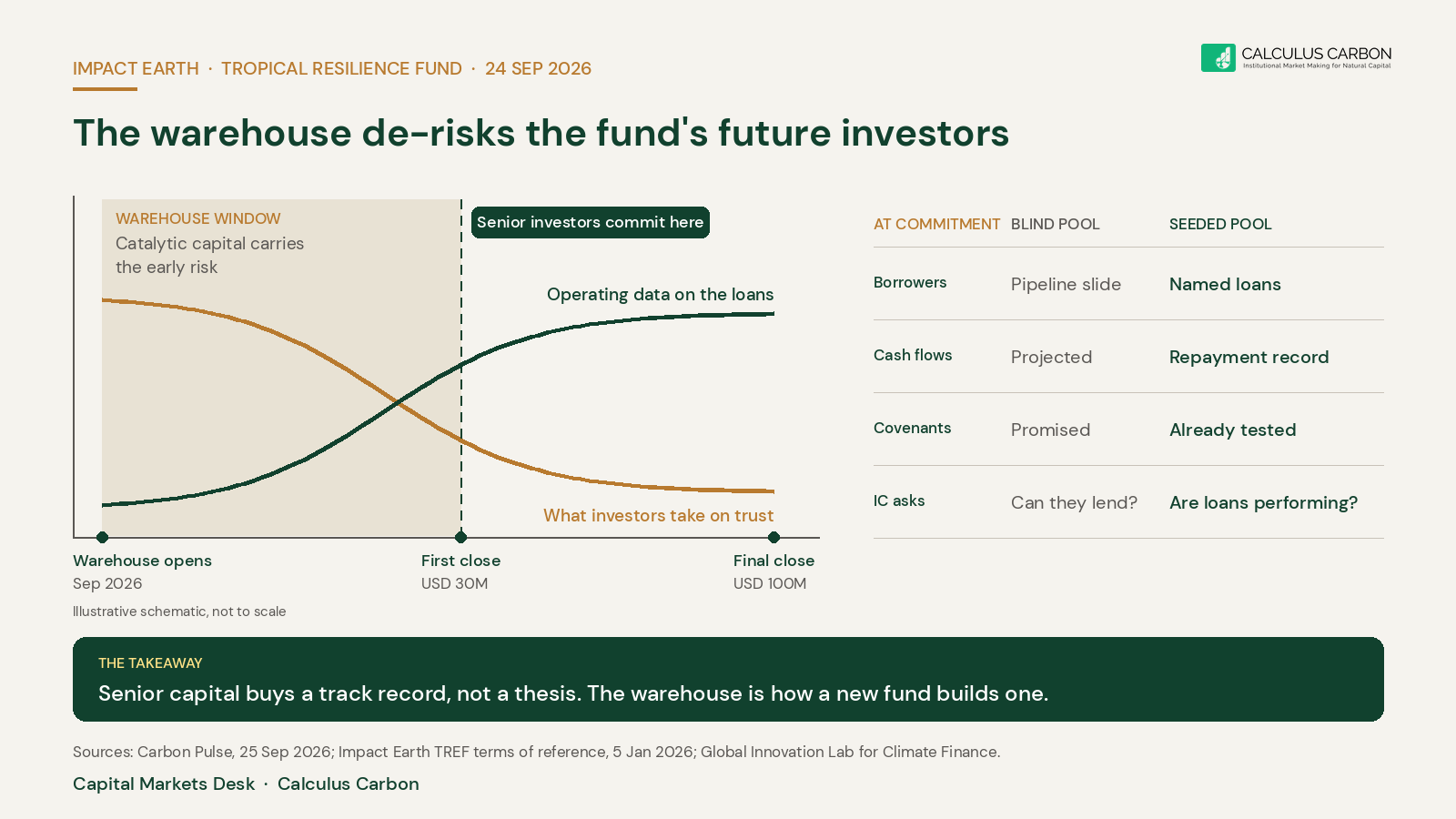
The same terms of reference contain the line that matters most for underwriting. Impact Earth asked advisers to structure “a warehousing facility to be merged into the fund at first close”.4,5 In plain terms, the loans made now are intended to transfer into the fund when it closes. The first investors into the fund would therefore not be buying a promise. They would be buying a book of existing loans with repayment history attached.
That distinction is well understood in mainstream private credit and securitisation, where a warehouse line funds assets before a vehicle is ready to hold them. It is still rare in nature finance, where most funds go to market as blind pools. A blind pool asks a pension fund or a development bank to trust a pipeline slide. A seeded pool lets the same investor look at actual borrowers, actual covenants and actual payment behaviour. The barriers the Lab lists for this segment are high perceived risk, long payback periods, high transaction costs and limited investor engagement at early and growth stages.3 Each of those is a diligence problem, and a live portfolio answers diligence problems better than any pitch book can.
Who Carries The Risk Before First Close?
The warehouse moves the hardest risk to the investors best placed to hold it. Before first close there is no senior tranche and no fee base, so the only money that can take the first projects is money that accepts it may be the evidence rather than the return. The Restoration Seed Capital Facility was built for exactly this role: seed capital and project-development support for fund managers, with partners required to bear at least 50 percent of eligible costs.6 Philanthropic capital such as the Good Energies Foundation sits in the same place in the queue.1
The facility's size, pricing and transfer terms have not been disclosed, so the terms of the handover are the open diligence question.1,4 Three points will decide whether the warehouse strengthens the fund or burdens it. The first is transfer price: whether warehoused loans move into the fund at cost, at a mark, or with any performance adjustment. The second is selection: whether the fund's investment committee, and not only the warehouse's funders, approves each loan that will later transfer. The third is concentration: whether the early book, likely weighted to the Brazilian Amazon given the Latin America minimum and the manager's history, still fits the regional limits once the fund is fully invested.4
What Evidence Does Impact Earth Already Bring?
The manager is not starting from zero. Its predecessor vehicle, the Amazon Biodiversity Fund, completed its investment period in 2025 after deploying R$250 million, about USD 48.7M, into 11 nature-based businesses in Brazil between 2020 and 2025.1 Carbon Pulse reports that those investments conserved 665,140 hectares and restored 2,180 hectares across carbon, agroforestry, regenerative production and bioeconomy businesses.1
That history helps, but it is not the same evidence. The new fund is a mezzanine debt fund across two continents with revenue-based and convertible instruments.3 Senior investors will want to see those specific instruments perform in those specific markets. The warehouse is how that track record gets created before the capital raise, rather than promised during it.
The Read For Institutional Capital
For senior investors in nature debt, the useful question is not how large a fund intends to become. It is how many of its first loans already exist, who funded them, and on what terms they transfer. A 70:30 senior and junior structure with a first-loss layer is a sound design on paper.3 A seeded book is what turns that design into something a credit committee can price.
In our own work on nature transactions, the same pattern repeats. Projects rarely fail diligence on the thesis. They stall on the absence of operating history: no repayment record, no evidence that revenue arrives on the schedule the model assumes, no proof that the manager enforces its covenants when a borrower slips. A warehouse that funds real loans ahead of close answers each of those gaps with data rather than argument. That is why we would weight the transfer terms and the early loan tape more heavily than the final-close target when assessing any fund built this way.
For catalytic funders, the lesson runs the other way. Money that funds a warehouse before first close does more work per dollar than money that joins the junior tranche after it, because it creates the track record that brings the senior tranche in. For developers in Latin America and Southeast Asia, the practical point is timing: the warehouse is open for business now, well before the fund's 2027 horizon.1
A fund target does not finance a pipeline. The first loans on the books do.
This piece pairs with a Neelesh Agrawal LinkedIn short-form scheduled for W40, Tuesday 29 September 2026, 13:30 IST.
Sources
- [1] Carbon Pulse, Nature fund launches early-capital investment facility, published 25 September 2026. carbon-pulse.com
- [2] Global Innovation Lab for Climate Finance, Tropical Resilience Fund (2025 Lab cycle). climatefinancelab.org
- [3] Global Innovation Lab for Climate Finance, Tropical Resilience Fund (TREF) overview. climatefinancelab.org
- [4] Impact Earth, Terms of Reference: Advisory Services on Fund Structuring for the Tropical Resilience Fund, dated 5 January 2026. acceleratingimpact.org
- [5] International Climate Finance Accelerator, Request for Proposal: Impact Earth Fund Structuring, posted 5 January 2026. icfa.lu
- [6] UN Environment Programme, New Restoration Seed Capital Facility launched to promote investment in forest landscape restoration, 27 October 2020. unep.org