
Project Finance · Biodiversity Finance · Repayment Source · 12 October 2026
Counted, Not Contracted: Reading The OECD’s Biodiversity Finance Estimate As A Lender
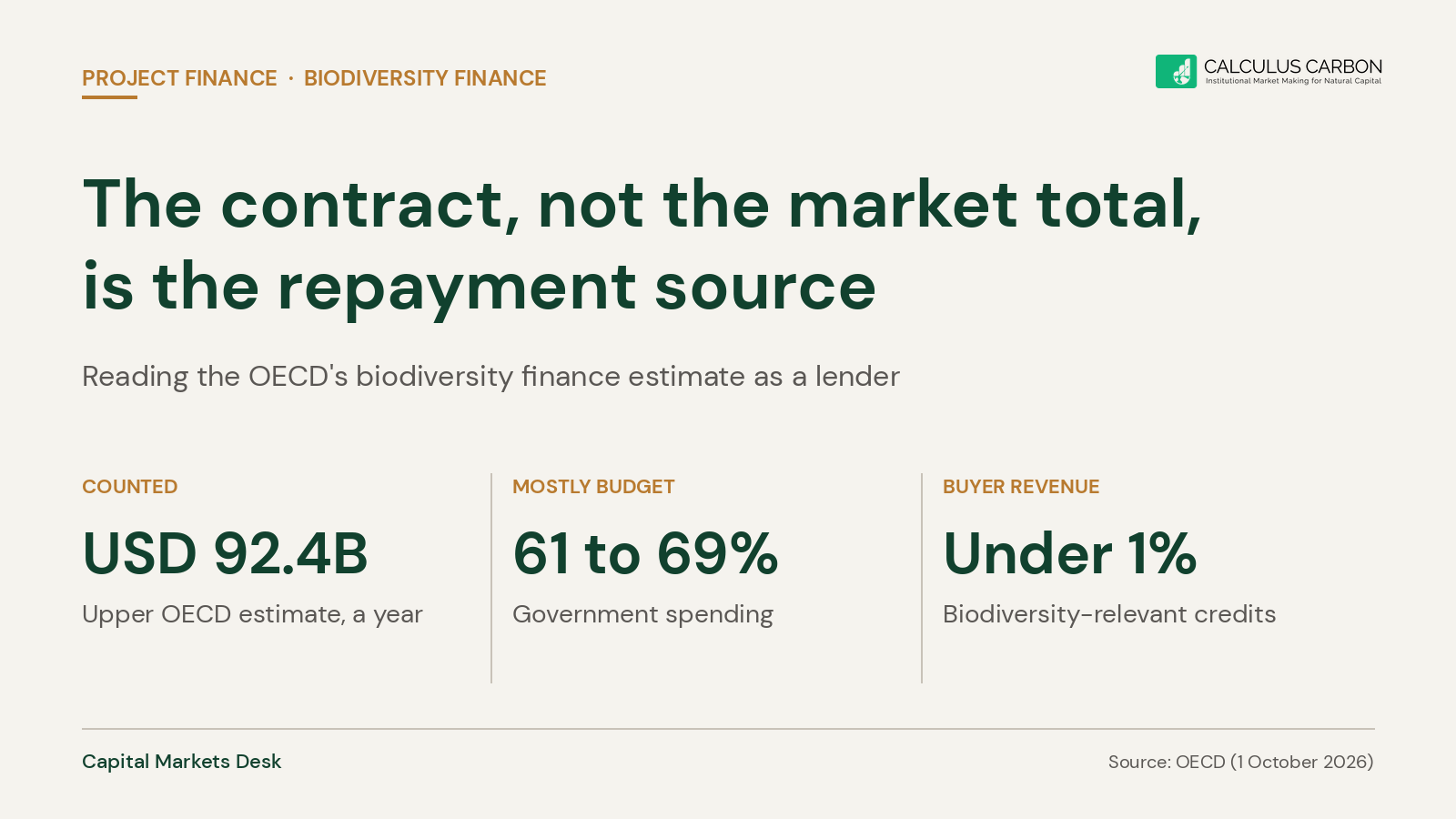
The OECD estimates that USD 74.9B to 92.4B a year now flows to biodiversity. Most of it is government spending, and the buyer revenue a lender could actually collect sits outside the total and is far smaller. For anyone financing a nature project, one point follows: the contract, not the market total, is the repayment source.
The Read
The Organisation for Economic Co-operation and Development (OECD) published on 1 October 2026 an all-source estimate of global biodiversity finance, at USD 74.9B to 92.4B a year on a 2023 to 2025 average.1,2 The easy read is that nature now has a large and growing pool of capital behind it. Our read, from the project finance seat, is narrower. The figure counts money spent and invested in a year, and most of it is government budget. A lender to a single nature project is looking for something else: dated, contracted receipts that can meet a debt schedule. The contract, not the market total, is the repayment source.
Is USD 92.4B A Pool A Lender Can Lend Against?
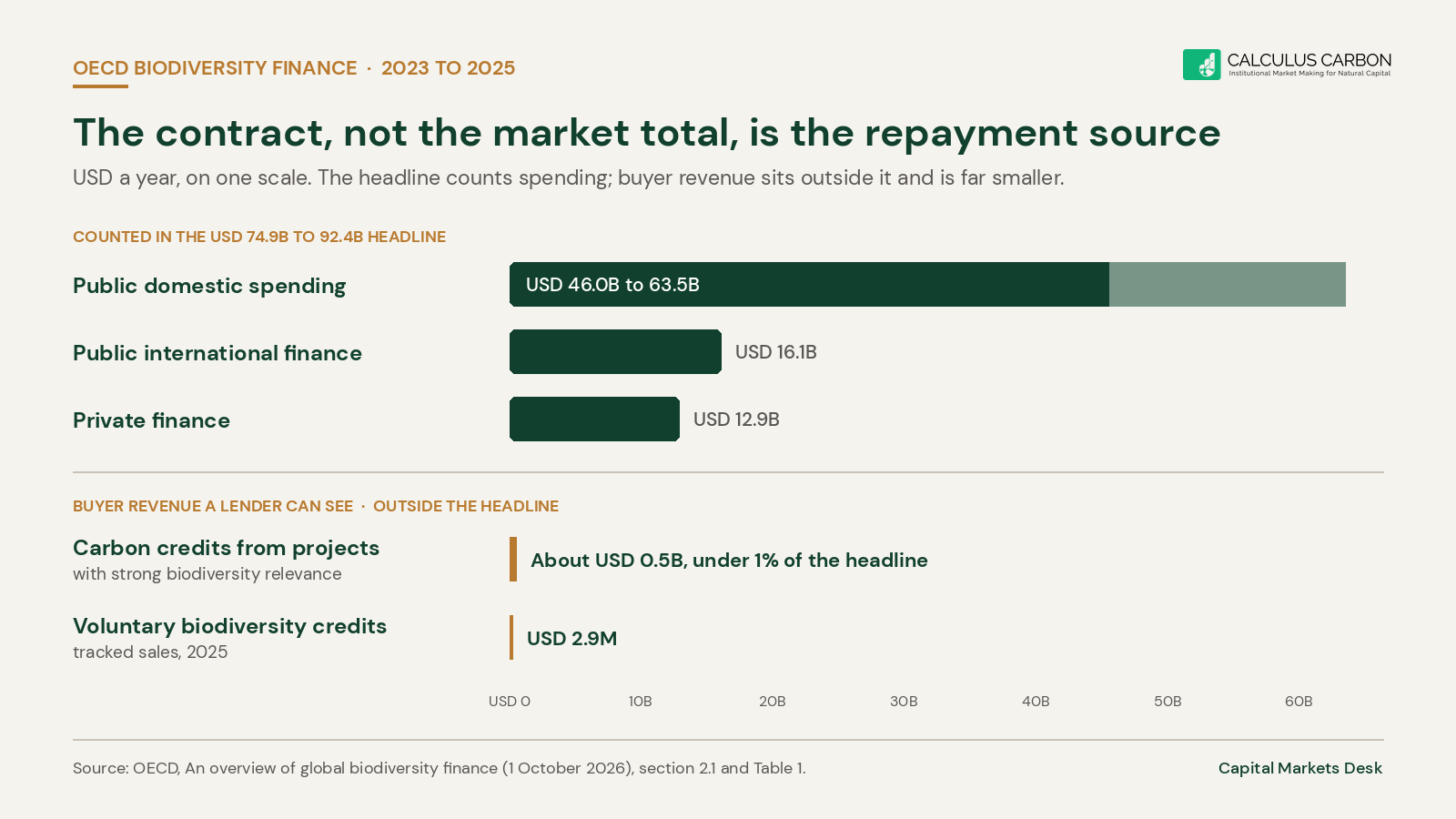
The headline is a flow total built from three blocks. Public domestic spending by 104 governments, covering 61 per cent of world output, contributes USD 46.0B to 63.5B a year. Public international finance, mostly development finance, adds USD 16.1B. Private finance adds USD 12.9B.2 The OECD puts domestic public spending at 61 to 69 per cent of the total, international public finance at 17 to 21 per cent and private finance at 14 to 17 per cent.2
The OECD is also careful about what the number is not. The range reflects methodological assumptions rather than statistical confidence, and the estimate does not assess the effectiveness or outcomes of what was financed.2 Bond issuance, fund assets, finance mobilised by development lenders and transactions in environmental markets are kept outside the total, because they measure different concepts or may be different stages of the same financing chain.2 That is a sound statistical choice. It also means the total is a measure of activity across a market, not a balance a lender can draw on.
Does Public Spending Repay A Project Loan?
Not on its own. The largest block in the estimate is annual government expenditure on biodiversity, as reported by countries.2 A budget line of that kind is voted each year, can be reallocated, and carries no obligation to any one project. A lender cannot place an annual appropriation in a cash flow model and call it revenue.
Public money does become a repayment source once it is written into a contract. A multi-year payment for ecosystem services agreement, or a payment tied to hectares maintained, gives the project a named payer, a price, a term and payment dates. At that point the same public money stops being part of a market total and becomes a receivable that can be tested against debt service. The step that matters for a lender is the conversion from budget to contract, not the size of the budget.
The terms of that contract then decide how much debt it can carry. Its term has to run at least as long as the loan, with room to spare for late delivery. Its price needs a clear basis, whether fixed, indexed or tied to verified outcomes, so that a lender can model it. A termination clause should pay out enough to clear the debt if the payer walks away, and the payer itself must carry a credit standing that a bank can rate. A short, cancellable grant agreement and a ten-year payment contract with a sovereign agency can carry the same headline amount and support very different loans.
Is The USD 12.9B Of Private Finance The Revenue Line?
It is easy to assume so, and it is the wrong way round. Of the USD 12.9B, about USD 9.8B a year is private investment that seeks a financial return alongside a biodiversity benefit, and it passed USD 14B in 2025.2 The remaining USD 3.1B is philanthropy and the private revenues of eight large non-governmental organisations focused on biodiversity.2
Investment seeking a return is capital going into projects, not cash coming out of them. In a project finance structure it sits beside the lender as equity or sits with the lender as debt, and both need repaying from the same project revenue. If it is counted as revenue, the problem is counted twice. The more private capital arrives, the more contracted revenue the sector needs to service it.
Can The Market Lines Outside The Total Carry Debt?
The closest thing in the report to buyer revenue sits in Table 1, outside the headline. The OECD estimates the value of retired credits from voluntary carbon market projects with strong biodiversity relevance at USD 488M to 540M a year on a 2023 to 2024 average, and describes it as an analytical estimate rather than observed spending on biodiversity.2 Sales of voluntary biodiversity credits tracked in the report were USD 2.9M in 2025 and USD 6M cumulatively from 2022 to 2025.2
Against the headline, the carbon credit figure is equal to less than one per cent of the total. On our arithmetic, the biodiversity credit market saw about USD 1 of tracked sales for every USD 26,000 to 32,000 counted in the headline. The other lines in the table are not revenue at all. Biodiversity-labelled funds held USD 1.6B, which the OECD notes is a stock of assets, not an annual flow. Bond issuance is allocated by listed use of proceeds, and one study the OECD cites found that only 3.7 per cent of proceeds from bonds listing biodiversity in 2021 and 2022 were finally allocated to biodiversity projects.2
Does The Project Finance Lens Change The Question?
It changes it completely. In project finance, the lender's recourse is limited primarily or entirely to the project assets, there is no revenue during construction, and the sole revenue stream is likely to sit under an offtake agreement.4 For a nature project, construction is the planting, protection or restoration phase, and the offtake is the contract with whoever pays for the outcome, whether a credit buyer, a corporate or a government agency.
A credit committee therefore reads the buyer contract before it reads any market statistic. It asks who the counterparty is and whether it can pay for the full term. It checks whether the payment dates fall after the first verified delivery and before each debt service date. It asks how much of scheduled debt service is covered by signed volume at an agreed price, as opposed to an assumed future market price. It then sizes the loan to the contracted receipts, carves out a grace period for the years before delivery, and holds a reserve account against a late or short delivery.
None of those answers can be read off a global flow total. A market of USD 92.4B can contain a project with no contracted buyer, and a market of a fraction of that size can contain a project with a ten-year contract that a bank will lend against.
Should The USD 200B Target Change How Lenders Read The Gap?
Target 19 of the Kunming-Montreal Global Biodiversity Framework calls for at least USD 200B a year for biodiversity from all sources by 2030.3 The OECD uses that figure as its benchmark, which leaves a shortfall of about USD 108B to 125B a year against its own estimate.2,3
As a flow gap, the natural response is a call for more spending and more investment. As a project finance gap, the response is different. Every additional dollar of investment needs a repayment source, so the binding constraint is the volume of long-term, contracted payments for nature outcomes. On the OECD's own complementary data, that volume is still measured in hundreds of millions, not tens of billions.2
The Read For Institutional Capital
The OECD has given the market its most complete count yet, and it is right to keep markets, bonds and fund assets outside the headline. Allocators and lenders should read the number as a measure of activity, not of debt capacity. The useful question in any nature financing is not how much money the sector has counted, but how much of a given project's revenue is signed, dated and payable by a counterparty that can be underwritten. Public budgets become bankable when they are written into multi-year payment contracts, and private capital becomes fundable when there is a buyer contract behind it.
For developers raising capital, the practical consequence is to lead with the contract file rather than the market sizing slide. A lender who sees the payer, the term, the price basis and the payment dates can size a loan in a week. A lender who sees only the market total has nothing to size.
The contract, not the market total, is the repayment source.
This piece pairs with a Neelesh Agrawal LinkedIn short-form scheduled for W42, Tuesday 13 October 2026, 20:30 IST.
Sources
- [1] OECD, An overview of global biodiversity finance, OECD Environment Policy Papers No. 51, publication page, 1 October 2026. oecd.org
- [2] OECD, An overview of global biodiversity finance, revised version, October 2026 (PDF): executive summary, section 2.1, section 2.4 and Table 1. oecd.org
- [3] Convention on Biological Diversity, Kunming-Montreal Global Biodiversity Framework, Target 19. cbd.int
- [4] World Bank PPP Resource Center, Project Finance: Key Concepts. ppp.worldbank.org