
Project Finance · Nature Restoration · First Capital · 14 October 2026
The Crowd Writes The First Cheque: How Retail Capital In Nature Projects Shapes What A Lender Asks For Later
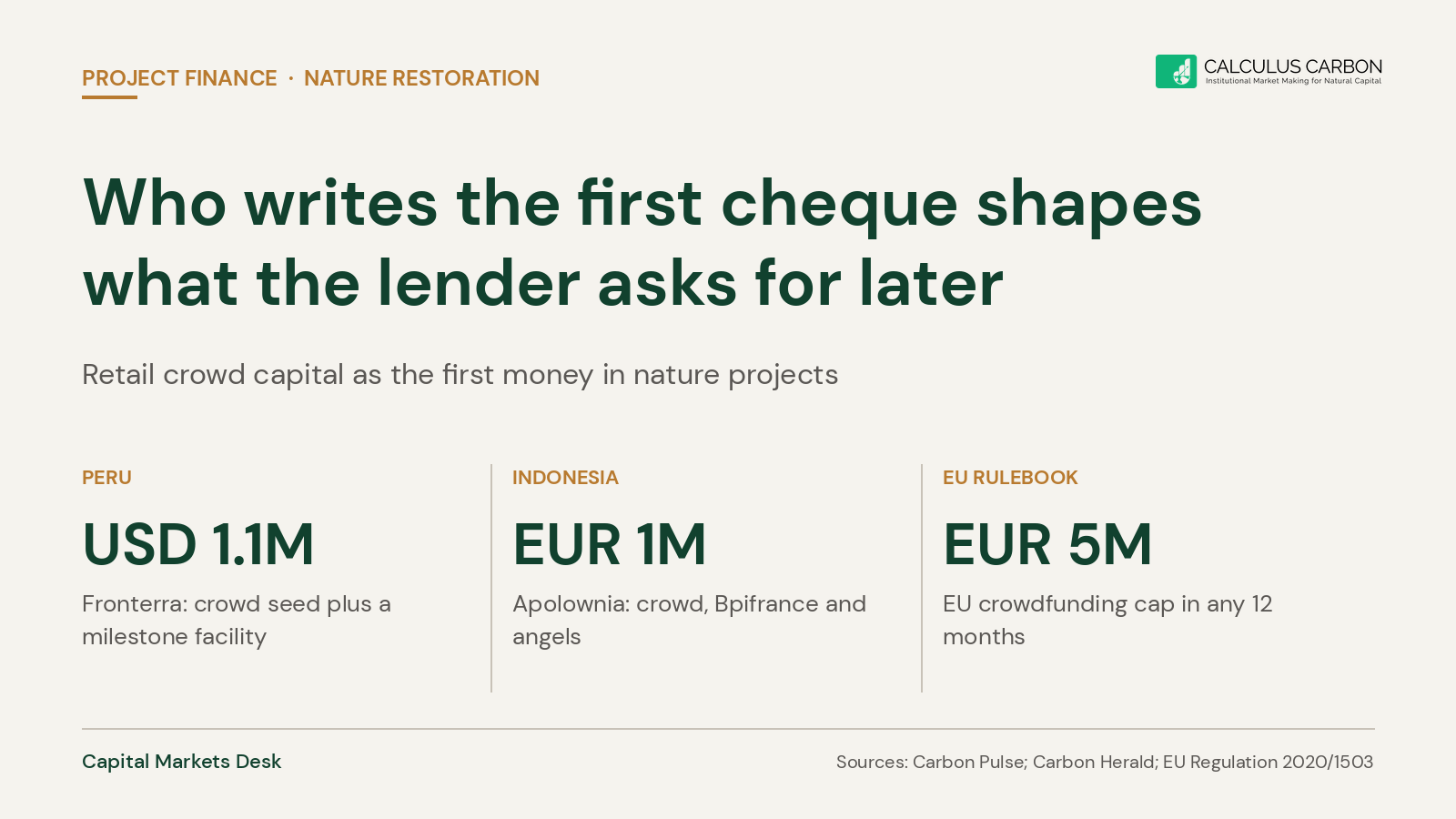
Two French developers raised seed capital this year from hundreds of retail investors to build restoration projects in Peru and Indonesia. That money carries the early risk a lender will not take. It also decides, years before any loan is signed, which questions the lender will ask about overruns, exits and control.
The Read
In nature project finance, the first cheque arrives before there is anything a lender or a buyer can price. That cheque carries the risk a lender will not, and in 2026 a growing share of it is being written by retail investors through crowdfunding platforms. Fronterra in Peru and Apolownia in Indonesia, both run from France, raised seed capital this year from hundreds of individuals alongside development finance and public bank money.1,4 The money is welcome and often decisive. The point that matters for later financing is narrower: who writes the first cheque shapes what the lender asks for later.
Is Retail Money Really Funding Nature Projects Now?
It is, in small amounts and in a growing number of deals. Fronterra, a Franco-Peruvian developer, announced in September 2026 a combined USD 1.1M package for four restoration and conservation projects. The package paired a seed equity round on the French impact platform Lita, in which more than 200 investors took part, with a zero-coupon project development facility from the Restoration Seed Capital Facility.1 The facility, backed by Germany and Luxembourg and run by the United Nations Environment Programme with the Frankfurt School of Finance and Management, can increase as milestones are met.1,2
Apolownia, a Paris-based developer of coastal restoration projects, closed a first seed round of EUR 1M in August 2026, with backing from hundreds of citizen investors on Lita, the French public bank Bpifrance and a group of business angels.4 Its flagship BlueRizon project targets more than 4,000 hectares of mangrove restoration on the north coast of Java.4
The route is niche but not new. Hummingbirds, a French developer, borrowed EUR 1.3M from 1,252 individuals on the Lendosphere platform in April 2024 for a reforestation project in Uganda, at 8.5 per cent a year with the principal due after three years.5 In Scotland, Highlands Rewilding raised GBP 1.2M from 757 crowdfunders as part of an equity round in 2022 and 2023, and in 2023 took a GBP 12M loan from the UK Infrastructure Bank.6
Does The Early Money Problem Justify A Niche Source?
It does, because the early stage of a nature project is the hardest stage to fund. Plan Vivo, which certifies community-led projects, reports that 64 per cent of its projects rely on grant funding to reach certification, and that preparing the core project design document can take one to two years and cost USD 100,000 to 250,000.7 None of that spending produces a credit, and none of it can be repaid from revenue that does not yet exist.
The Bridging the Disconnect report by The Art of Forests and HAMERKOP, launched at London Climate Action Week in June 2026, describes the same gap from the developer side.8 Developers interviewed for it say the first USD 2M to 3M is often harder to raise than a later USD 20M deal, and institutional investors often set minimum tickets of USD 5M to 30M.9 Retail crowd capital fills a slice of that missing middle. It is small enough to fit the ticket, patient enough to fund work before certification, and willing to take a risk a credit committee would decline.
Is Crowd Money Just Another Form Of Equity?
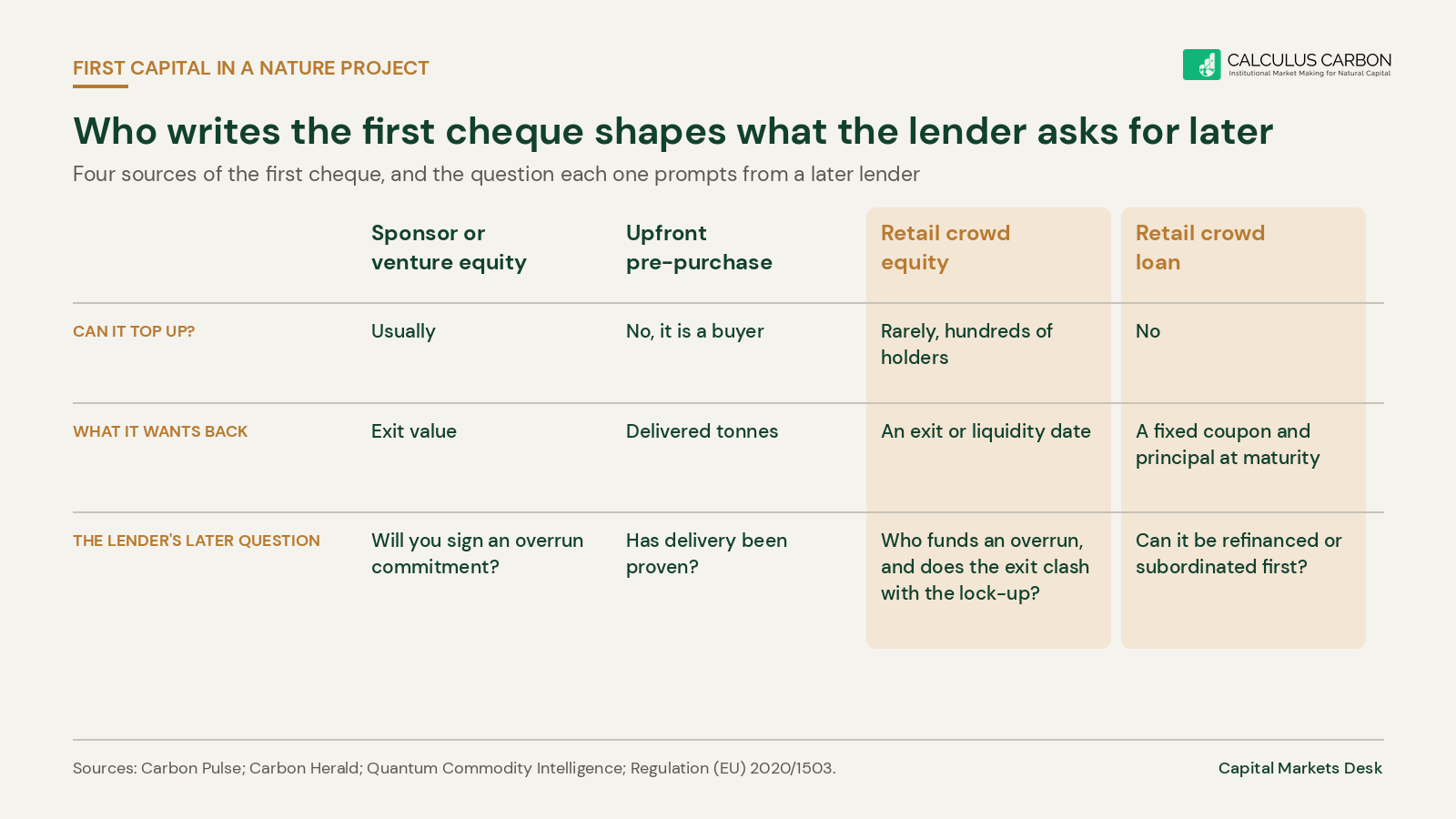
Not from a lender's seat. The first cheque in a nature project can come from four quite different places, and each one leaves a different mark on the later financing.
Sponsor or venture equity comes from a small number of professional holders who can usually be asked for more money if the project runs over budget. An upfront pre-purchase, of the kind Salesforce and Frontier use in carbon removal, brings a buyer who has already done diligence and wants delivery, not an exit. Retail crowd equity brings hundreds of small shareholders who cannot be counted on for follow-on capital and who invested expecting, at some point, a return of their money. Retail crowd lending, as in the Hummingbirds case, brings hundreds of creditors with a fixed coupon and a fixed maturity, often well before the project's credits are issued.5
All four carry early risk. The difference is what each holder needs from the project afterwards, and that is exactly what a senior lender reads when it is asked to lend.
Can A Crowd Fund A Cost Overrun?
This is the first question a project lender will ask, and in restoration it is not hypothetical. Trees fail, planting seasons slip and replanting costs money. In a conventional project finance structure the lender lends to a special purpose company whose only assets are the project, and its recourse is limited primarily or entirely to those assets and to any completion support the sponsors provide.12 The lender therefore wants to know who will fund an overrun before the project reaches steady revenue.
A dispersed retail shareholder base cannot give that comfort on its own. The usual answers are a committed anchor investor who signs a contingent equity commitment, a funded contingency reserve sized to a replanting scenario, or a development facility that steps up as milestones are met. Fronterra's package shows the last of these in practice: the Restoration Seed Capital Facility can increase over time as initial funding is used and agreed milestones are achieved.1 Its seed round was also anchored by a single natural capital investor, Christian del Valle, alongside the crowd.1 To a later lender, the anchor and the milestone facility matter more than the number of retail shareholders.
Does A Retail Exit Horizon Collide With A Loan?
It can. Project loans normally lock up distributions until debt service is covered, reserves are funded and agreed ratios are met, and they give the lender consent rights over any change of control of the borrower. A retail round marketed with an expected exit or liquidity event sits awkwardly beside those terms. If the crowd expects cash back in five to seven years, and the loan blocks dividends and sales for longer, either the investors or the lender will be disappointed.
Retail lending creates a sharper version of the same problem. A three-year bullet repayment, as in the Hummingbirds note, falls due before most reforestation projects issue meaningful volumes.5 A senior lender arriving later will want that debt refinanced, subordinated under an intercreditor agreement, or converted to equity before it lends.
The European rulebook also caps the role the crowd can play. Under the EU crowdfunding regulation, a project owner can raise no more than EUR 5M over 12 months through crowdfunding offers, and non-sophisticated investors receive an entry test, a loss simulation and a four-day reflection period.10,11 The crowd can be the first cheque. It cannot be the capital stack.
Does It Matter Where The Crowd Sits In The Group?
It matters more than any other single choice. Fronterra's founder has described a group with an investment holding company in France, a project development subsidiary in Peru and four project companies beneath it.3 In a structure of that kind, retail shareholders sit at the holding company, while future project debt can be raised in the individual project companies, each ring-fenced around its own land, contracts and credits.
That separation answers most of a lender's questions in advance. Change of control at the holding company can be handled with a consent covenant rather than a veto held by hundreds of shareholders. Distribution lock-ups apply to the project company, not to the crowd directly, and an exit for retail investors can happen at the holding level without disturbing the security package. Highlands Rewilding illustrates the sequence at small scale: bonds, then equity rounds that included crowdfunders, then an institutional loan.6
Is There A Test A Developer Can Run Before Opening A Crowd Round?
There is, and it is cheaper to run before the round than after it. The Capital Markets Desk reads a crowd round against five structural points, each of which a later lender will otherwise raise as a condition.
The first is an anchor: at least one investor with the capacity, and ideally a signed commitment, to fund a defined overrun. The second is placement: retail shareholders held at the holding company, with each project company free to grant security over its own assets. The third is the exit story: any expected liquidity date disclosed to retail investors should sit comfortably beyond the likely tenor of the project loan and its distribution lock-up. The fourth is retail debt: any crowd loan should mature after the first expected credit issuance, or carry terms that let it be subordinated or converted when senior debt arrives. The fifth is consent mechanics: a shareholder agreement with a representative, a drag-along right or a nominee structure, so that a change of control can be approved without polling hundreds of holders.
A round that clears all five points leaves the later lender with credit questions about the project itself, which is where the diligence belongs. A round that clears none of them leaves the lender with questions about the shareholders, which delay the loan and can price it higher.
The Read For Institutional Capital
Retail crowd capital is now a real, if small, source of first money for nature projects, and it fills a gap that grants and institutional funds leave open. For lenders and allocators, the useful question is not whether the crowd was involved, but whether the structure already answers three things: who funds an overrun, when the early investors expect to be paid, and where they sit relative to the project company. A crowd round with an anchor investor, a milestone facility and retail holders kept at the holding company is a cleaner starting point for project debt than a larger round with none of those features. The cheque carries the early risk; its shape decides the later term sheet.
The first cheque carries the risk a lender will not, but who writes it shapes what the lender asks for later.
This piece pairs with the Calculus Carbon LinkedIn company post for W42, drafted by Saurabh Anand (short-form companion post, 13 October 2026).
Sources
- [1] Carbon Pulse, Nature project developer secures cash to advance four Peru initiatives, 23 September 2026. carbon-pulse.com
- [2] Restoration Seed Capital Facility, New Partner Announcement: Fronterra, September 2026. restorationfacility.org
- [3] Juan Carlos Gonzalez Aybar, Fronterra founder, on the Lita seed round and group structure, LinkedIn, July 2026. linkedin.com
- [4] Carbon Herald, Apolownia Closes EUR 1M Seed Round To Scale Mangrove Restoration In Indonesia, 3 August 2026. carbonherald.com
- [5] Quantum Commodity Intelligence, French carbon developer borrows EUR 1.3m for Uganda ARR project, 10 April 2024. qcintel.com
- [6] Highlands Rewilding, Invest in taking nature recovery to scale. highlandsrewilding.co.uk
- [7] Plan Vivo, New research highlights opportunity to unlock early-stage finance, 2026. planvivo.org
- [8] The Art of Forests and HAMERKOP, Bridging the Disconnect, launched at London Climate Action Week, June 2026. theartofforests.org
- [9] NatureRe Capital, summary of Bridging the Disconnect, LinkedIn, June 2026. linkedin.com
- [10] Regulation (EU) 2020/1503 on European crowdfunding service providers for business. eur-lex.europa.eu
- [11] private.law, ECSP licence: running a crowdfunding platform in the EU, 2 October 2026. wiki.private.law
- [12] World Bank PPP Resource Center, Project Finance: Key Concepts. ppp.worldbank.org