
Project Finance · Africa Nature · Community Benefit · 19 October 2026
A Financing Line, Not A Residual: Where Community Benefit Sits In A Nature Project’s Debt Model
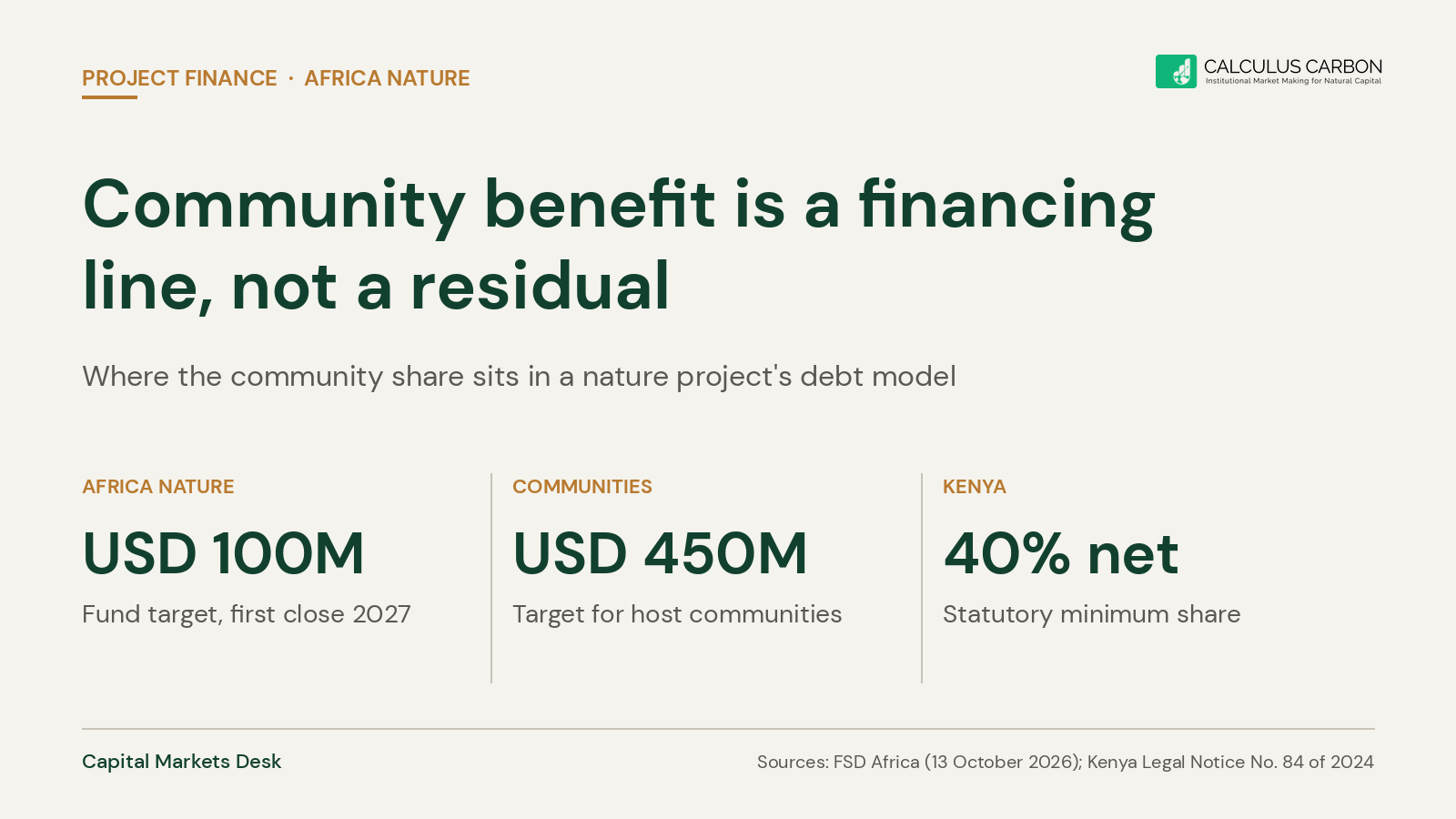
Finance Earth, FSD Africa and FSD Africa Investments launched a USD 100M Africa nature fund last week that will invest only in projects sharing a substantial part of gross carbon value with host communities. The release puts the community target at around USD 450M. For anyone lending to those projects, one point follows: community benefit is a financing line, not a residual.
The Read
Finance Earth, FSD Africa and FSD Africa Investments announced the Africa Nature Impact Fund on 13 October 2026 at the Carbon Markets Africa Summit in Kigali. The fund targets USD 100M for early-stage nature and nature-based carbon projects, with a first close of USD 20M sought in 2027 and a cornerstone commitment of GBP 5M from FSD Africa Investments.1 It will invest only in projects whose benefit-sharing arrangements direct a substantial share of gross carbon value to host communities, with a target of around USD 450M for local communities.1 Our read is that the commitment is welcome and that it changes the debt model in a specific way: community benefit is a financing line, not a residual.
Is A Community Share Paid Before Or After The Lender?
In most nature projects it is paid before. A project loan is repaid from the cash a project generates after its operating costs, and the lender sizes the loan against that cash.5 A community share that is defined as a percentage of carbon revenue leaves the project before any of that cash reaches the debt service account. The correct treatment is as an operating cost. A model that treats it as a residual, paid once the lender is served, makes the project look able to carry far more debt than it can.
The release does not give a project-level percentage, a calculation base or a payment schedule, and we do not infer one.1 Those three terms are exactly what a lender will ask for first, because each of them moves the cash available for debt service.
Does The Calculation Base Change The Debt Capacity?
It does, and Kenya shows the mechanics in statute. Kenya's Climate Change (Carbon Markets) Regulations, 2024 require land-based carbon projects on public and community land to pay an annual social contribution of at least 40 per cent of the previous year's aggregate earnings, less the cost of doing business.2 The contribution is written into a community development agreement, and private projects on private land are exempt.2
Three features matter to a lender. The base is net of costs, not gross. The payment looks back to the previous year, so it lags the revenue it is drawn from. And the phrase cost of doing business is where the negotiation sits: if interest and principal count as a cost, the community share falls after debt service; if they do not, it competes with the lender for the same cash. A loan agreement for a Kenyan land-based project needs that definition settled in the community development agreement before financial close, not after the first payment falls due.
Zimbabwe takes a different route. Its 2025 carbon trading regulations issue 30 per cent of total credit volume directly to a national account as a share of proceeds, with a further 2 per cent to a national buffer account and 1 per cent retired towards the national climate target.4 That share is taken in credits at issuance, ahead of every cash line in the project, so the lender's model starts from 67 per cent of issued volume rather than 100 per cent.
Can The Same Project Carry Very Different Amounts Of Debt?
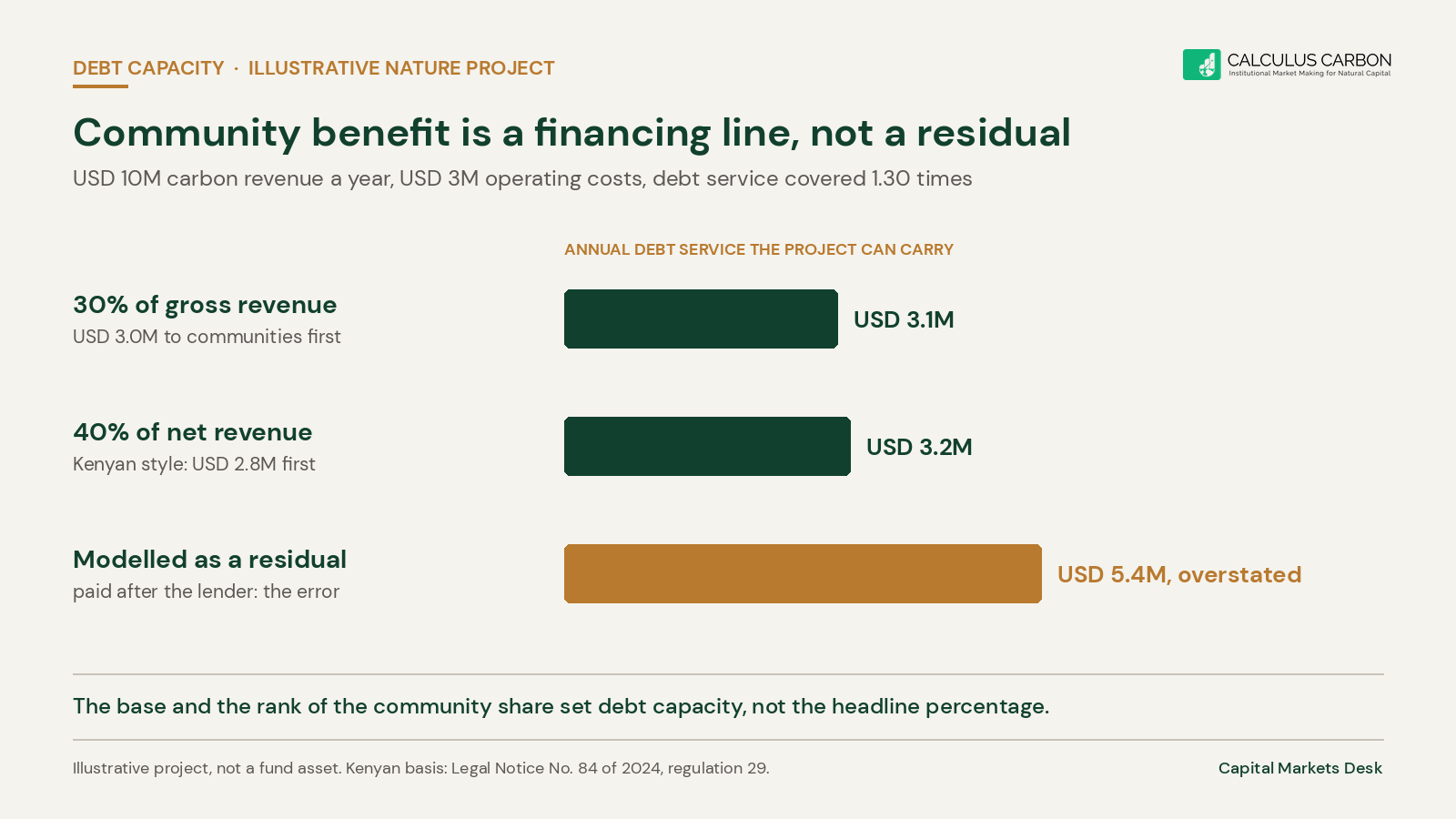
It can, and a simple illustration shows the scale. The example is a nature project with USD 10M of annual carbon revenue and USD 3M of operating costs, and a lender that requires cash flow to cover debt service 1.30 times. With a community share of 30 per cent of gross revenue, USD 3M goes to communities, USD 4M is left for debt service and the project can carry about USD 3.1M of annual debt service. With a share of 40 per cent of revenue net of operating costs, in the Kenyan style, USD 2.8M goes to communities, USD 4.2M is left and capacity rises to about USD 3.2M.
The error case is the one to avoid. If the community share is modelled as a residual paid after the lender, the model shows USD 7M of cash for debt service and capacity of about USD 5.4M, roughly 70 per cent more than the project can support. The figures are illustrative, not drawn from any fund project. The mechanism is general: the base and the rank of the community share decide debt capacity more than the headline percentage does.
Should A Lender Worry About Undefined Revenue Terms?
It should. The Climate Action Platform for Africa's benefit-sharing study, funded by FSD Africa and published in August 2024, found that terms such as gross revenue, net profit or carbon credit sales are often used without clear definitions, and that the amount communities actually receive can be unclear once expenses, taxes and other contributions are deducted.3 One investor quoted in the study described projects channelling 60 to 75 per cent of benefits to communities as high value, and the study notes that the Plan Vivo standard requires 60 per cent of carbon revenue to be paid to communities.3
For a lender, an undefined base is a covenant problem. A debt service cover ratio is only as reliable as the definition of the cash in its numerator. If the community agreement and the loan agreement define revenue differently, the project can be in compliance with one and in breach of the other in the same year.
Does A Review Clause Clash With A Fifteen-Year Loan?
It can. The same study recommends benefit-sharing terms that are reconsidered at a set cadence, for example every five years, and when significant circumstances change, such as drought, flood or a major shift in carbon markets.3 It also notes that community land-based projects typically run for 30 to 40 years.3 Those are sound principles for communities. They also mean the community share can move during the life of a loan.
The structural answer is to give the review a range. A floor protects communities, a cap protects the debt service cover ratio, and the review is barred from taking the ratio below the covenant level while debt is outstanding. The study's alternatives point the same way: a fixed amount per tonne gives clarity and predictability, and profit sharing lets communities share in upside without competing with debt service in a weak year.3
Can Upfront Community Payments Be Financed?
They can, but not from debt. The study lists cash incentives paid to farmers before carbon revenue arrives as a best practice, and recommends budgeting community engagement, governance and compensation for income foregone as core project costs.3 Those payments fall in the riskiest years, before a credit has been issued, and they belong in the development budget funded by grants, equity or catalytic capital.
That is where a fund built in stages fits. Africa Nature is designed to fund project preparation, commercial piloting and implementation, bridging projects from pre-revenue to long-term contracted revenue.1 If its capital pays for the early community costs and fixes the benefit-sharing terms before a lender arrives, the project reaches its first loan with the hardest line in its model already defined.
The Read For Institutional Capital
The USD 450M community target is a strong signal that benefit-sharing is becoming a condition of finance in African nature projects, not an option. For lenders and allocators, the useful test is narrow. The four questions are the calculation base, the payment timing, the rank against debt service and the review mechanics, and the community share belongs in the model as an operating cost from the first year. A project that can answer those four points in writing is a project a lender can size. A project that cannot will be sized on the most conservative reading, or not at all.
Community benefit is a financing line, not a residual, and its base and rank set what a nature project can borrow.
This piece pairs with Neelesh Agrawal's LinkedIn post for W43 on the Africa Nature Impact Fund.
Sources
- [1] FSD Africa, First-of-its-kind Africa Nature Impact Fund Targets USD 100m For Nature-Based Solutions in Africa, 13 October 2026. fsdafrica.org
- [2] Kenya, The Climate Change (Carbon Markets) Regulations, 2024, Legal Notice No. 84 of 2024, regulation 29. kenyalaw.org
- [3] Climate Action Platform for Africa, Unlocking Local Value: Rethinking Benefit Sharing in African Carbon Projects, funded by FSD Africa, August 2024. fsdafrica.org
- [4] Zimbabwe, Statutory Instrument 48 of 2025, Carbon Trading (General) Regulations, 2025. esgnetworkzimbabwe.co.zw
- [5] World Bank PPP Resource Center, Project Finance: Key Concepts. ppp.worldbank.org