
Project Finance · Carbon Removal · Delivery Risk · 21 October 2026
Contracted Is Not Delivered: How Delivery Insurance Changes What A Lender Will Lend Against A Carbon Removal Offtake
Two carbon removal developers closed debt in September 2026 against long-term purchase contracts, and both brought a carbon insurer into the structure. The reason is simple: a lender sizes debt on the tonnes a project will deliver, not the tonnes it has sold. Insurance changes how much of the contract a lender can count.
The Read
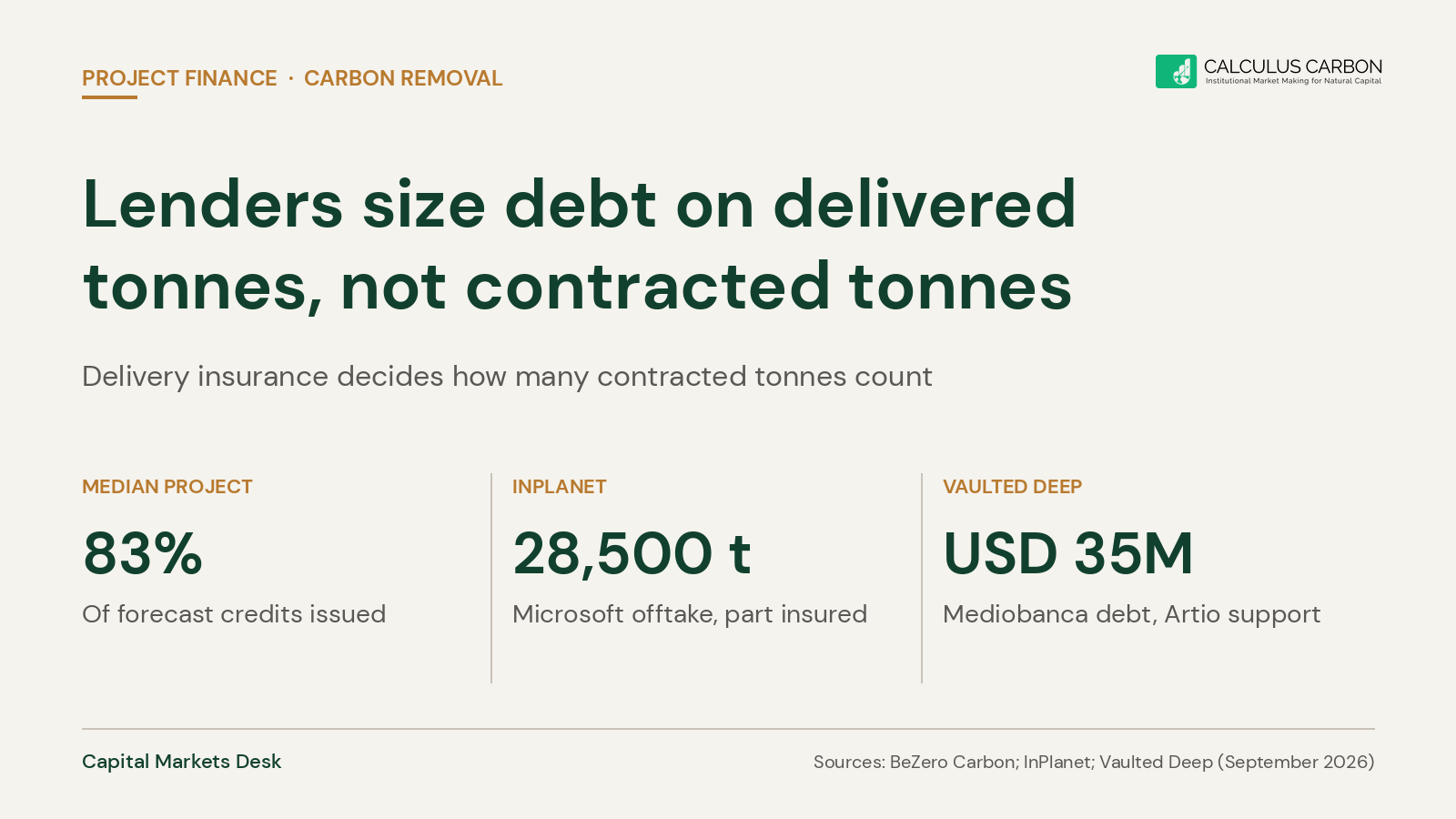
In carbon removal project finance, a contract for tonnes is not the same as tonnes delivered, and a lender sizes debt on the second. BeZero Carbon's tracking of 1,756 carbon projects shows that the median project issues only 83 per cent of its forecast credits, and that 35 per cent have under-delivered by 30 per cent or more.1 Two financings in September 2026, InPlanet's facility from Idemitsu Americas Holdings and Vaulted Deep's USD 35M facility from Mediobanca, both brought a carbon insurer into the structure.2,5 The point that connects them is narrow: a lender sizes debt on delivered tonnes, not contracted tonnes, and delivery insurance changes how many of the contracted tonnes it can count.
Is A Signed Offtake Not Enough For A Lender?
A signed offtake removes price risk and buyer risk. It does not remove delivery risk. Carbon removal buyers pay on delivery of verified tonnes, so the revenue a lender relies on arrives only if the project produces and verifies what it promised. Vaulted Deep's chief executive put the lender's view plainly in September 2026: the bank has to believe the company can deliver, because it is only paid on delivery.7
In project finance, debt is repaid from the cash the project generates, with recourse limited mainly to the project's own assets and contracts.8 A lender therefore applies a delivery assumption to every offtake before sizing a loan. If the project's own record is thin, that assumption falls back towards market evidence, and the market evidence is sobering. Only one fifth of the projects BeZero tracks have issued within plus or minus 10 per cent of forecast.1
Does The Delivery Gap Look Different In The Early Years?
It does, and the early years are when debt is drawn. In an illustrative reforestation case, BeZero identified delivery risk of 20 to 50 per cent in the first five years, driven by planting delays, falling to 5 to 20 per cent over ten years and close to zero over a 40-year crediting period.1 Reforestation projects typically issue around 75 per cent of forecast credits in their first five vintages, with long-term performance broadly in line with the original estimates.1
That pattern matters because loan repayment schedules are front-loaded relative to a project's life. A project that is likely to deliver in full over decades can still miss the first three vintages that a five-year loan depends on. The lender's concern is not whether the tonnes arrive eventually, but whether they arrive on the dates that debt service falls due.
Can Delivery Insurance Make Contracted Tonnes Count?
It can, for the tonnes it covers. Carbon delivery insurance pays out when a project fails to deliver insured tonnes for specified reasons. For a lender, an insured tonne can be counted close to its contracted value, because a shortfall is replaced by an insurance claim rather than lost. An uninsured tonne is counted at whatever delivery rate the lender's stress case assumes.
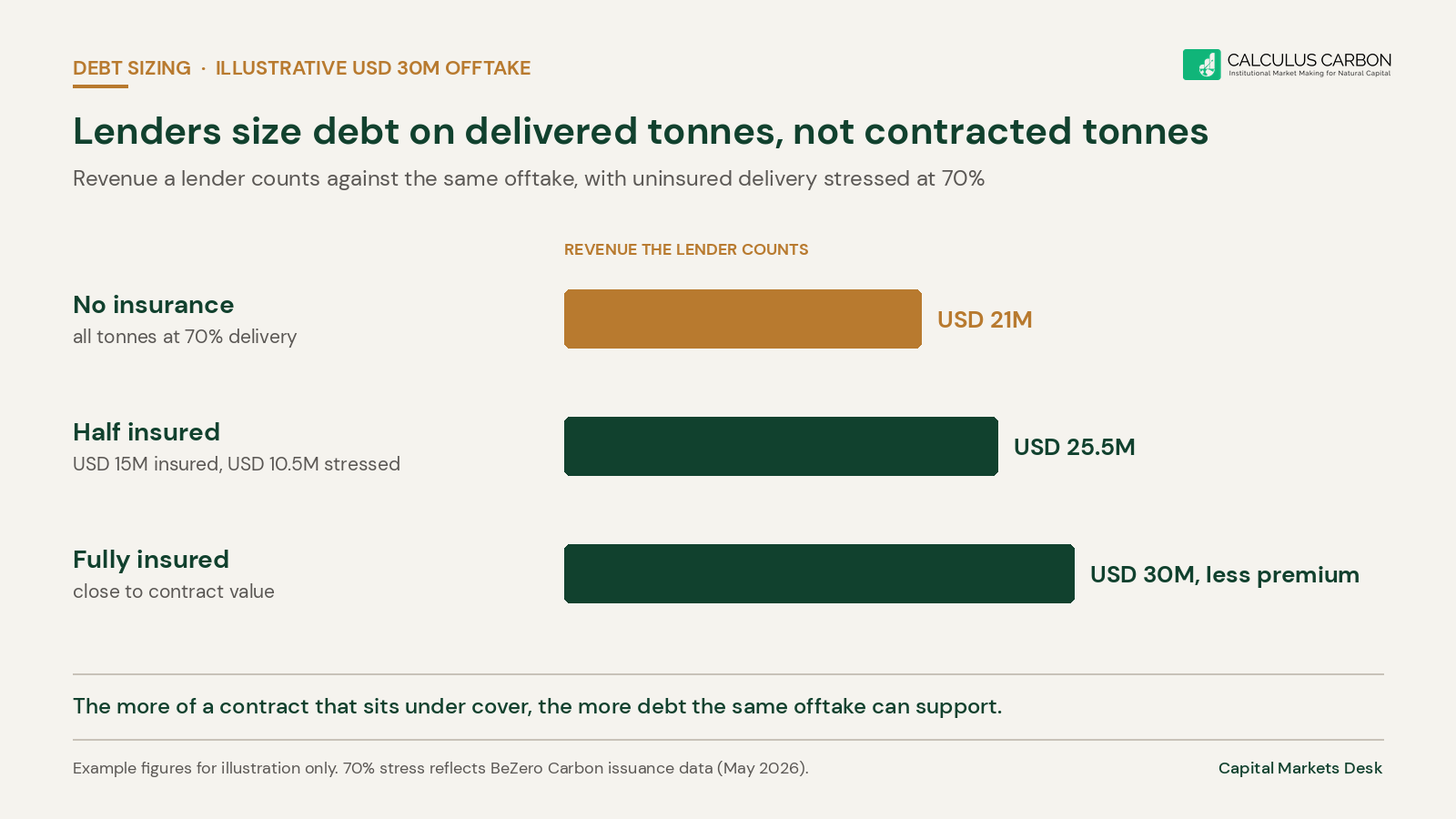
The effect on borrowing capacity is direct. An illustrative offtake worth USD 30M shows the scale, with the lender stressing uninsured delivery at 70 per cent, in line with the one in three projects that fall short by 30 per cent or more.1 Uninsured, the lender counts USD 21M of revenue. With half the contract insured, it counts USD 15M on the insured half and USD 10.5M on the rest, a total of USD 25.5M. Fully insured, the count approaches USD 30M, less the insurance premium. The figures are illustrative, not drawn from either transaction, but the mechanism is general: the more of a contract that sits under cover, the more debt the same offtake can support.
Is InPlanet The First Template For This Structure?
It is one of the first in enhanced rock weathering, a method that spreads crushed silicate rock on farmland to speed up the natural process by which rock absorbs carbon dioxide. InPlanet delivered the first independently verified credits from the method in December 2024, under Isometric's Enhanced Weathering Protocol, and those credits later received an A rating from BeZero.3 In December 2025 Microsoft agreed to buy more than 28,500 tonnes of removals from InPlanet's work on Brazilian farmland, for delivery between 2026 and 2028.4
On 17 September 2026, InPlanet and Idemitsu Americas Holdings, a subsidiary of the Japanese energy group Idemitsu Kosan, closed what InPlanet described as one of the first non-recourse project financings in the sector.2,3 The facility funds delivery of the contracted tonnes, with downside protection backed by the Microsoft agreement, and includes carbon delivery insurance from CFC covering specified project delivery risks for a defined portion of the delivery.2 Howden acted as broker. The facility size was not disclosed, and the structure is designed so that additional lenders can participate on the same basis.2
Each element answers a different lender question. The track record answers whether the method works. The Microsoft contract answers who pays and at what price. The insurance answers what happens to the insured portion if a vintage falls short, which is the question the first two cannot.
Does Vaulted Deep Show The Same Pattern?
It does, on a larger and more diversified base. Vaulted Deep, which injects organic waste deep underground, announced a USD 35M debt facility from Mediobanca on 21 September 2026, arranged by CFP Energy.5 The facility is supported by waste service agreements and contracted carbon removal revenue, including offtakes with Frontier buyers, and carbon insurer Artio supported the transaction by helping to de-risk the investment.5 Vaulted delivered more than 20,000 tonnes to Frontier buyers in the first half of 2026, more than its total for 2025.5
CFP Energy's head of voluntary carbon described what it took for the lender to get comfortable: a developer with a proven record, creditworthy offtakers removing market risk, and an insurer covering the residual project risk that institutional lenders expect.6 The same three layers appear in both deals. Vaulted adds a fourth, waste disposal fees that do not depend on carbon credits at all.
Should A Lender Still Worry About The Uninsured Remainder?
It should, for three reasons. The first is scope. InPlanet's cover applies to specified delivery risks for a defined portion of the tonnes, not to every cause of shortfall.2 A lender has to read the policy wording, map each exclusion against the project's real risks and price whatever falls outside.
The second is timing. With Microsoft deliveries due across 2026 to 2028, a missed vintage leaves little time to recover inside the contract window.4 A claim also has to be paid, in cash or replacement tonnes, before the date the lender needs the money, so the claims process belongs in the debt service reserve analysis. The third is the insurer itself. Once insured tonnes are counted at contract value, the insurer's credit standing becomes part of the lender's credit risk.
Is There A Checklist For Reading A Delivery Policy As A Lender?
There is, and it is short. The Capital Markets Desk reads a carbon delivery policy against five points, each of which decides whether an insured tonne can really be counted at contract value.
The first is the trigger: the policy should define a shortfall by reference to the same delivery schedule and verification standard as the offtake, so that a missed delivery under the contract is also a loss under the policy. The second is the covered perils: the list of causes the insurer will pay for, set against the project's own risk register, with any gap priced as uninsured. The third is the form of payout: cash lets the project pay debt service directly, while replacement tonnes keep the buyer whole but may not reach the lender in time. The fourth is the claims timeline: the period from a missed vintage to payment, which should sit inside the debt service reserve so that a claim in progress does not become a payment default. The fifth is security: the lender should be named as loss payee, with the policy assigned as part of the security package, so that claim proceeds flow into the accounts the lender controls.
A policy that clears all five points turns covered tonnes into something close to contracted cash. A policy that clears only some of them still has value, but the lender will count the insured tonnes at a discount that reflects the gaps.
Does The Premium Pay For Itself?
In most structures the comparison is between the premium and the extra debt the cover allows. In the illustration above, insuring half the contract lifts the revenue a lender counts from USD 21M to USD 25.5M, an increase of about 21 per cent, before the cost of the premium. If the extra debt displaces equity that would otherwise have to fund the same construction or delivery work, the saving in cost of capital can exceed the premium by a wide margin.
The comparison changes as a developer builds its own record. Vaulted Deep's delivery of more than 20,000 tonnes in six months gives its lender evidence that a newer method cannot yet offer.5 Over time, a long record of on-schedule delivery should let a lender count more uninsured tonnes at a higher rate, and the share of a contract that needs cover should fall. Insurance, in that sense, is a bridge to a track record rather than a permanent feature of the capital stack.
The Read For Institutional Capital
A carbon removal offtake is a promise to pay for tonnes that have not yet been delivered. Lenders size debt on the delivery they expect, and market evidence puts the median project at 83 per cent of forecast. Delivery insurance moves the covered portion of a contract close to full value, and both September 2026 financings used it alongside a track record and a creditworthy buyer. The useful question for any offtake-backed loan is how many of the contracted tonnes are insured, against which risks, and what the lender assumes for the rest.
A lender sizes debt on delivered tonnes, not contracted tonnes, and delivery insurance decides how many of the contracted tonnes it can count.
This piece pairs with the Calculus Carbon LinkedIn company post for W43, drafted by Saurabh Anand (short-form companion post, 18 October 2026).
Sources
- [1] BeZero Carbon, The catalyst for carbon offtakes: delivery risk, rated by experts, 18 May 2026. bezerocarbon.com
- [2] InPlanet, InPlanet and Idemitsu Americas Holdings Close Non-Recourse Debt Facility, 17 September 2026. inplanet.earth
- [3] Idemitsu Kosan, Idemitsu closes debt facility with InPlanet, a CO2 removal company, 17 September 2026. idemitsu.com
- [4] InPlanet, InPlanet secures agreement to deliver 28,500 enhanced rock weathering credits to Microsoft, 17 December 2025. inplanet.earth
- [5] Vaulted Deep, Vaulted Deep Secures USD 35 Million in Debt Financing to Expand Nationwide, PR Newswire, 21 September 2026. prnewswire.com
- [6] The Carbon Removal Scoop, From Equity to Debt: How CDR Gets Bankable, with Julia Reichelstein and Tyler Manchester, 2026. music.amazon.com
- [7] Axios, A really big proof point for carbon removal, 21 September 2026. finance.yahoo.com
- [8] World Bank PPP Resource Center, Project Finance: Key Concepts. ppp.worldbank.org