
Project Finance · Nature Offtakes · 26 October 2026
The Contract Is the Collateral: What Nature Finance Should Borrow from the Renewables Power Purchase Agreement
The next phase of nature finance will come from project finance raised against long-term contracted offtakes. Renewables made the same transition two decades ago, and the lesson is in the contract: a lender finances the power purchase agreement, not the wind farm. A carbon offtake earns the same treatment only when it carries the same four terms.
The Read
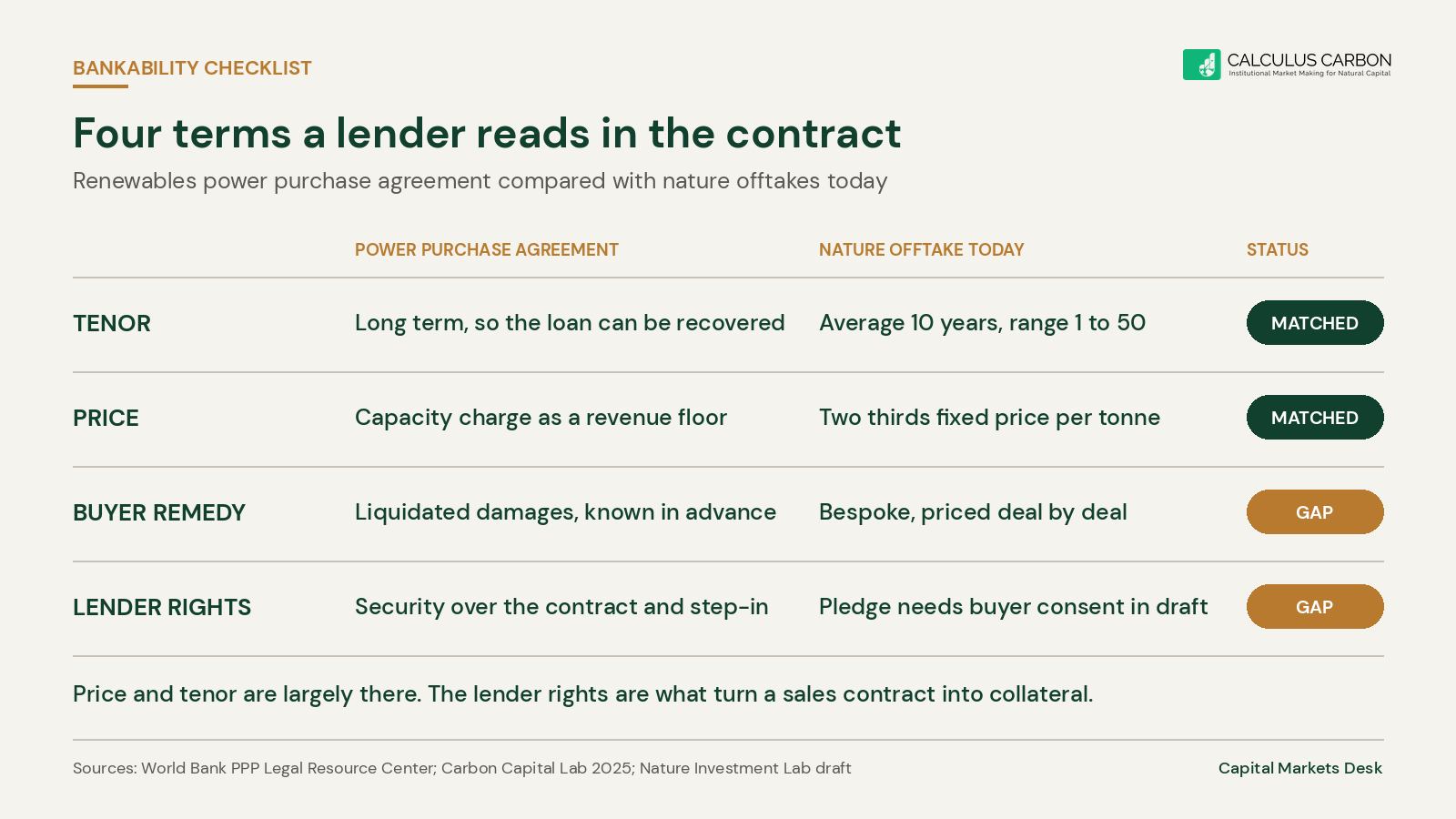
The next phase of nature finance will come from project finance raised against long-term contracted offtakes. At the Corporate Investments into Forestry & Biodiversity conference in London on 13 and 14 October 2026, our panel was titled Carbon Markets Bounce Back Through Offtakes.1,2 The argument we made there is the one we develop here. Renewables did not attract bank debt because wind and sun became less uncertain. They attracted bank debt because the power purchase agreement, the long-term contract under which a buyer agrees to purchase a plant's output, moved price risk to the buyer and left the developer with delivery risk alone. A carbon offtake can do the same job, but only if it carries the same four terms: a tenor at least as long as the loan, a fixed or floored price, a buyer whose credit a lender accepts, and the right for the lender to take the contract as security.
How Rare Is Project Debt in Nature Today?
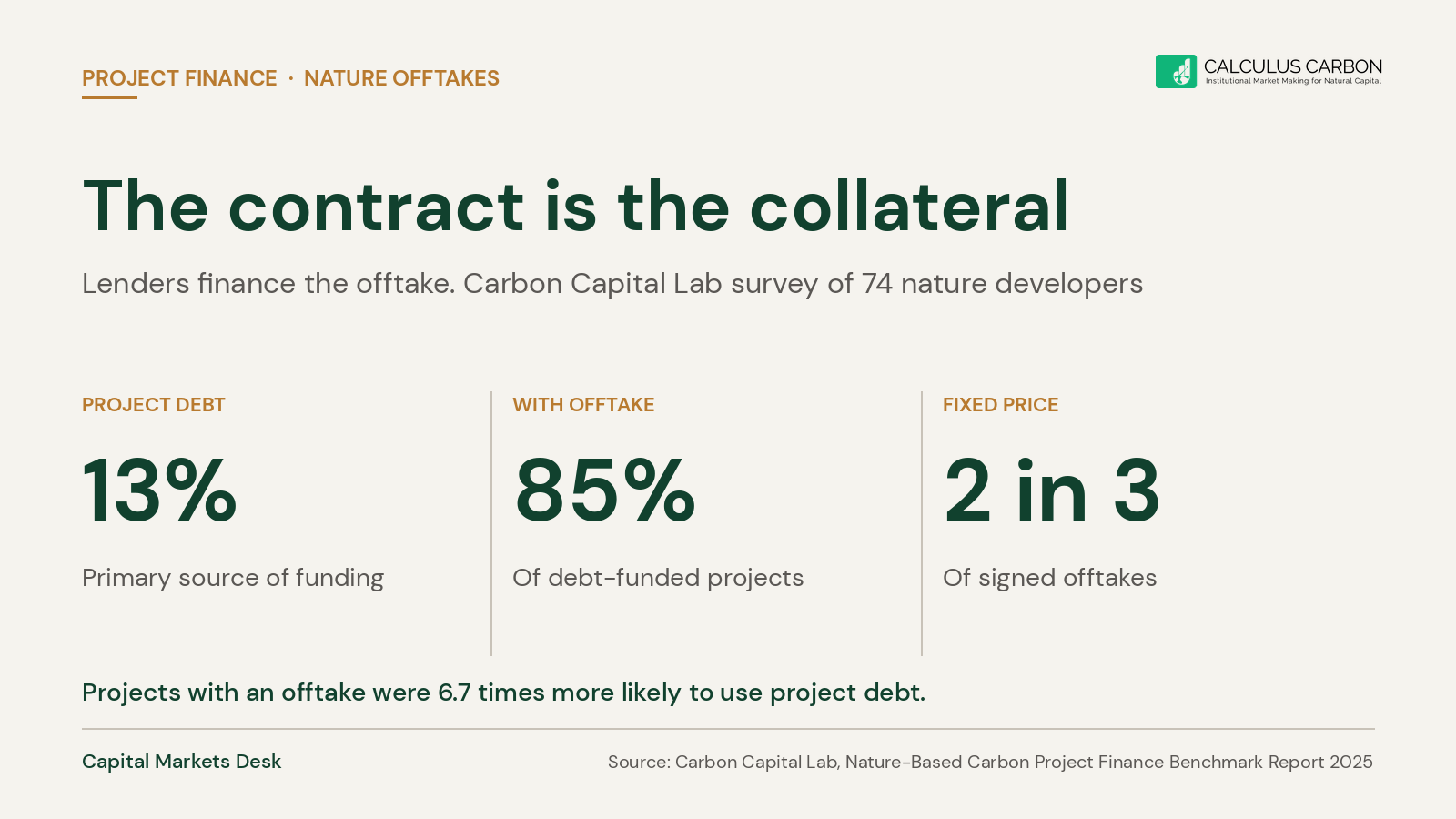
It is rare, and the data say the offtake is the reason it happens at all. Carbon Capital Lab surveyed 74 nature-based project developers between May and September 2025.3 Nearly one in three projects was funded from the developer's own balance sheet, 26 per cent from project-level equity and only 13 per cent from project-level debt as the primary source.3 Grants accounted for just 9 per cent.3
The more useful number sits underneath. Of the projects funded with debt, 85 per cent had a signed offtake or one in late-stage negotiation, and projects with an offtake were 6.7 times more likely to use project debt.3 Lenders are already telling the market what they need. The constraint is not appetite for nature assets but the scarcity of contracts a credit committee can lend against.
What Does a Lender Actually Finance in a Wind Farm?
A lender finances the contract. The World Bank's PPP Legal Resource Center describes the power purchase agreement as the document that usually provides the primary revenue stream underwriting the project.4 Its pricing mechanism is the primary tool for allocating revenue and market risk, and it sits at the centre of the lenders' bankability assessment.4
Three features do the work. The agreement runs for a long term because lenders require it to, so that the investment can be recovered.4 A capacity charge is payable whether or not the buyer takes the electricity, and it is designed as a revenue floor covering fixed costs, including capital and financing costs.4 Underperformance is handled through liquidated damages, a pre-agreed compensation amount, so the buyer's remedy is known in advance rather than open-ended.4
The fourth feature sits outside the agreement itself. Project lenders take security over the project agreements and over the company's receivables, its contracted revenue stream, and they sign direct agreements with the counterparties.5 Those direct agreements give the lender notice before any termination, cure periods and the right to step in, which means taking over the project company's position to put the project back on track.5 In plain terms, if the developer stumbles, the contract survives and the bank can hand it to someone who can perform.
Which of Those Terms Do Nature Offtakes Already Have?
Nature offtakes already have more of the template than the market assumes. Among the 23 developers who shared signed offtake structures, two thirds were priced at a fixed price per tonne.3 Delivery windows ran from 1 to 50 years, with an average of 10 years, and offtake prices for reforestation, improved forest management and soil carbon sat above spot prices.3 A fixed price over a ten-year window is, in structure, close to the price leg of a power purchase agreement.
The gap is in the terms a lender reads after the price. The same report concludes that offtakes remain bespoke for nature-based carbon credits.3 Bespoke means every lender has to price the contract from first principles: what happens on a delivery shortfall, who bears a reversal, what the buyer's remedy is, and whether the bank can step in. Every one of those questions adds legal cost and time to a deal, and the survey respondents ranked the cost of becoming investment-ready and long diligence timelines as their top obstacle.3
Is Anyone Standardising the Contract?
Brazil is attempting it. The Nature Investment Lab, an initiative backed by Banco do Brasil, Instituto Itaúsa, Instituto Clima e Sociedade and GFANZ, presented a draft model offtake contract during Climate Week in New York in September 2026, after consulting 25 institutions including Itaú BBA and Petrobras.7 The draft is due to go to public consultation and to feature at COP31 in November 2026, with the aim of finishing the work by the end of the year.7 In April 2026 the lab had commissioned legal advice to consolidate a version 2.0, on the stated grounds that non-standard offtake contracts raise transaction costs and legal uncertainty and make long-term finance harder to access.8
The earlier public draft shows exactly where the work is. Its pricing section already offers three options: a fixed price, an indexed market price, and a floor and ceiling structure in which the price tracks a benchmark but cannot fall below an agreed minimum.6 That floor option is the carbon equivalent of a capacity charge. The assignment clause, however, states that neither party may pledge its rights under the agreement without the other's prior written consent, and the draft states that the buyer's prepayment creates no security interest in the project.6 The New York draft, according to Estadão's coverage, adds clauses on guarantees, receivables and financiers.7 That addition is the single most important change for a lender, because it turns a sales contract into a document a bank can take as collateral.
Does a Pledgeable Offtake Remove the Carbon Price Question?
It removes most of it. Under a fixed or floored price, a lender no longer needs a view on where carbon trades in ten years. The questions narrow to two: will the buyer pay, and will the project deliver the tonnes. Buyer payment is a credit question that banks answer every day, and delivery is the developer's operating risk, which can be supported with buffers, insurance and step-in rights.
A worked example shows the effect on structure. On an illustrative reforestation project with an offtake for 100,000 credits a year at a fixed USD 25, contracted revenue is USD 2.5M a year. A lender sizing against that contract can set a debt service cover ratio on the contracted line and lend over the delivery window. Without the fixed price, the same lender must haircut revenue to a downside carbon price, and debt capacity falls with it. The figures are illustrative, but the mechanism is the one renewables lenders have used for two decades.
Delivery risk does not disappear, and a lender will still diligence it with care. The questions become operational: survival rates of planted trees, the size of the buffer pool, the verification schedule, and the remedy the buyer holds if a vintage arrives short. Each of those can be sized and covenanted, which is the point. A risk that can be measured and allocated in a contract is a risk a bank can price, while an open view on future carbon prices is one most credit committees will decline to take.
The Read for Institutional Capital
For developers, the takeaway is concrete. An offtake should be negotiated as a financing document from the first draft, with four clauses checked before price is settled: tenor at least as long as the intended loan, a fixed price or a floor, a buyer remedy capped and defined in advance, and an express right to assign the contract and its receivables to lenders, backed by a direct agreement with step-in rights.
For banks and natural capital funds, the market is moving towards them. The Carbon Capital Lab survey estimates that current funding for nature-based removals meets about half of expected 2030 demand, with the largest concentration of projects in Latin America and the Caribbean.3 That gap will not be closed by balance sheets and grants. At Calculus Carbon, the project finance we raise for developers starts with the offtake, and the first thing we read in it is the assignment clause.
Renewables proved the point once: lenders do not finance the asset, they finance the contract, so the nature offtake has to be written for the lender who will read it.
Calculus Carbon is an investment bank raising project finance for nature and carbon developers with offtakes. This note is for information only and is not investment advice.
Sources
- [1] CE Events & Media, Corporate Investments into Forestry & Biodiversity (CIFB) London, 13 to 14 October 2026, Hilton London Canary Wharf, programme including the session Carbon Markets Bounce Back. ce-em.com
- [2] CE Events & Media, speaker profile, Neelesh Agrawal, session Carbon Markets Bounce Back Through Offtakes, CIFB October 2026. ce-em.com
- [3] Carbon Capital Lab, Nature-Based Carbon Project Finance Benchmark Report 2025, survey of 74 nature-based project developers, May to September 2025, published December 2025. carboncapitallab.com
- [4] World Bank PPP Legal Resource Center, Power Purchase Agreements (PPAs) and Energy Purchase Agreements (EPAs). ppp.worldbank.org
- [5] World Bank PPP Legal Resource Center, Key Issues in Developing Project Financed Transactions: lender protection, step-in, direct agreements and taking security. ppp.worldbank.org
- [6] Nature Investment Lab, Carbon Credit Offtake Agreement, model template, preliminary version subject to change (versão preliminar sujeita a alterações). natureinvestmentlab.org
- [7] Estadão content via HNT, NIL elabora modelo de contrato de financiamento para apoiar projetos de redução de emissões, October 2026. hnt.com.br
- [8] Nature Investment Lab, Terms of Reference 01/26, specialised legal consultancy to consolidate and validate the standard offtake contract (version 2.0), April 2026. natureinvestmentlab.org