
Project Finance · Agroforestry · 27 October 2026
From a Guarantor to a Cocoa Buyer: How Belterra’s Second BNDES Loan Was Built Around a Contracted Crop
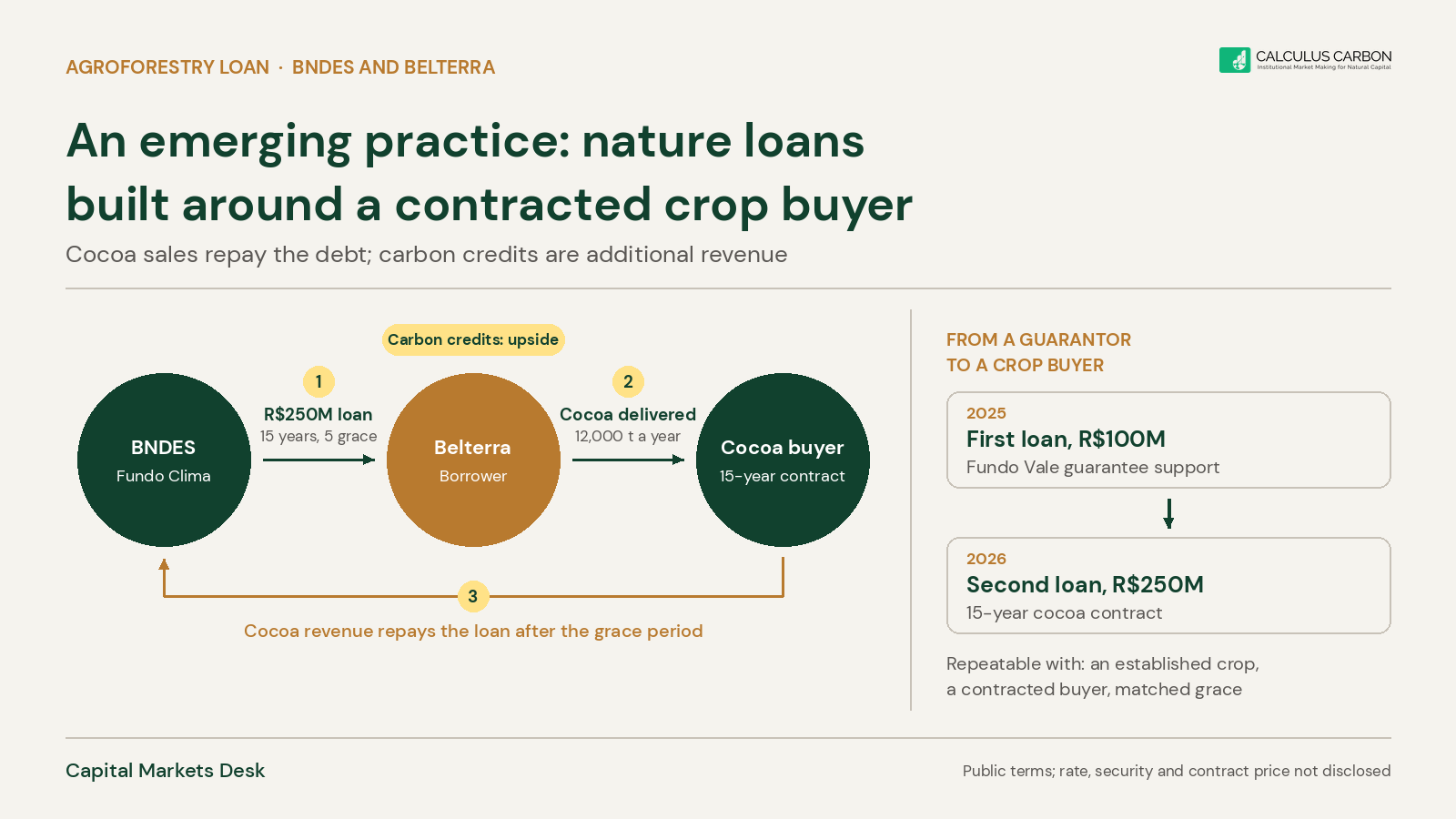
In nature-based project finance, an emerging and increasingly used practice is to build the loan around a contracted crop buyer, with carbon credits treated as additional revenue rather than the source of repayment. Belterra's R$250M loan from Brazil's development bank, approved on 19 October 2026, is a clear recent example.
The Read
In nature-based project finance, an emerging and increasingly used practice is to build the loan around a contracted crop buyer, with carbon credits treated as additional revenue rather than the source of repayment. On 19 October 2026, Brazil's national development bank, BNDES, approved a R$250M loan (about USD 47M) to Belterra for 4,000 hectares of cocoa agroforestry in the Amazon, with a 15-year term and a five-year grace period.1,3 The project carries a 15-year contract with a global cocoa and chocolate company to buy its cocoa.1 A year earlier, Belterra's first, smaller BNDES loan went ahead only after Fundo Vale put R$20M into guarantee mechanisms.4 The move from the first structure to the second is the subject of this note.
Is This a Carbon Project or a Cocoa Project?
It is a cocoa project that also generates carbon credits, and the distinction drives the financing. Agroforestry means planting trees and crops together on the same land. Belterra converts degraded cattle pasture into plots where cocoa grows under the shade of native species such as açaí, Brazil nut and ipê, alongside short-cycle crops such as banana and cassava.1 BNDES describes cocoa as the project's main commercial activity and expects output to exceed 12,000 tonnes a year once the plots are established.1
Carbon credits are tradeable certificates, each representing one tonne of carbon dioxide removed from the atmosphere or kept out of it, which companies buy to count against their climate targets. BNDES estimates that the new project will remove about 337,000 tonnes of carbon dioxide equivalent by 2031, and Belterra intends to certify the restored areas to generate credits.1 The company expects around 85 per cent of its future revenue to come from cocoa and other crops and around 15 per cent from carbon credits.9 For a lender, that ratio places the main repayment source in a commodity with an established global market, and carbon in the position of upside.
Does the First Loan Show the Underlying Problem?
It does. In October 2025, BNDES approved R$100M from the Fundo Clima towards a R$135M programme to restore 2,750 hectares of degraded pasture in Pará, Bahia, Mato Grosso and Rondônia.4,5 The Fundo Clima is Brazil's national climate fund, linked to the Ministry of the Environment and Climate Change and operated by BNDES.1 It was the Fundo Clima's first agroforestry operation,5 and Fundo Vale, the sustainability investment arm of the mining company Vale, contributed R$20M to structure guarantee mechanisms that made the operation with BNDES possible.4 Trade press described Fundo Vale as a guarantor of the operation.6
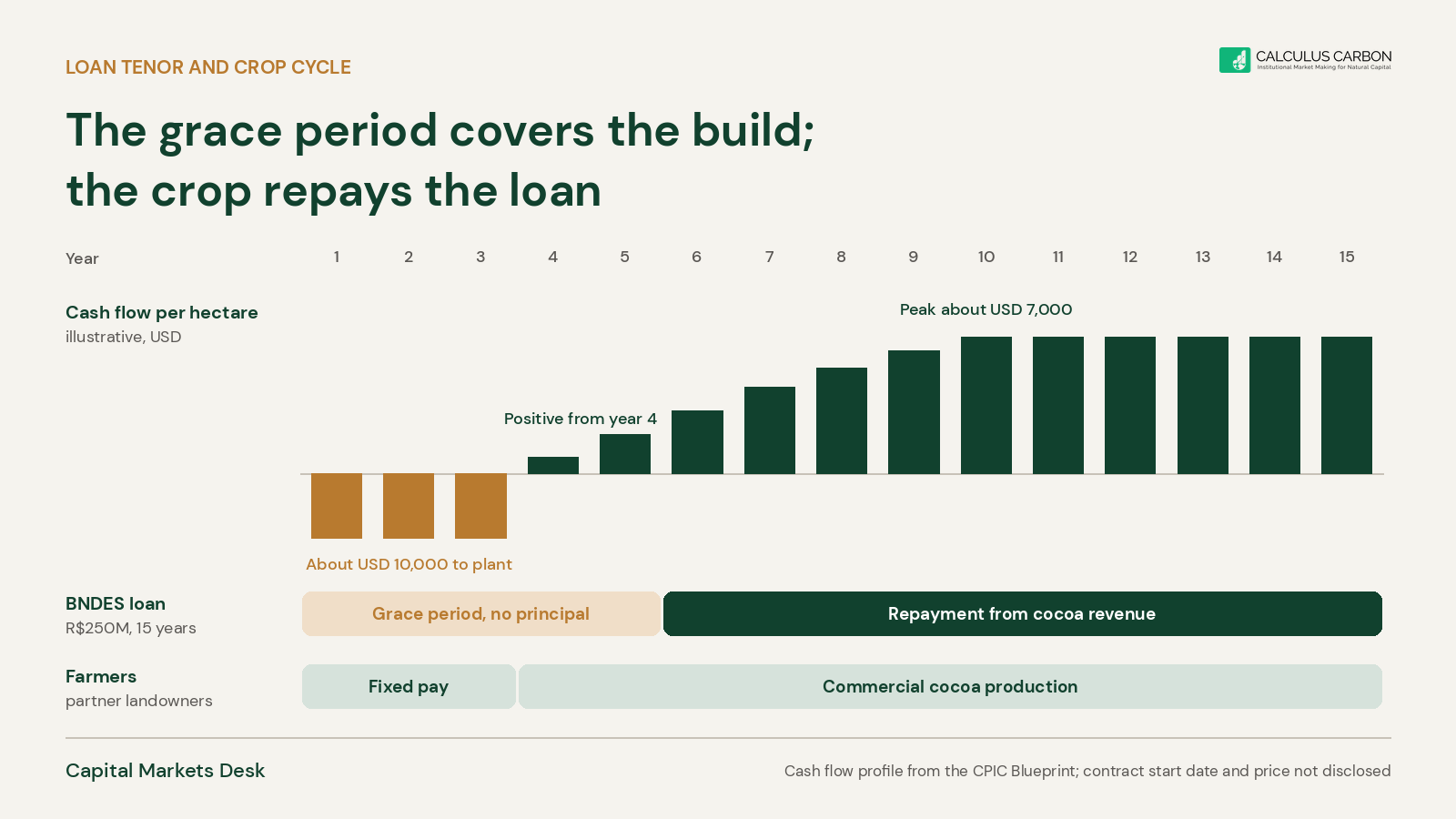
The need for a guarantee follows from the economics of the asset. The CPIC Blueprint on Belterra's model puts upfront spending at around USD 10,000 per hectare over the first three years, with positive cash flow starting only in the fourth year and peaking at around USD 7,000 per hectare by the tenth.10 Belterra does not own the land. It partners with farmers through leases or rural partnerships, pays for seedlings, inputs, technical assistance and labour, and, under the partnership model, pays farmers a fixed amount for the first three years before commercial cocoa production begins.1 A lender to that structure faces three years of spending with no crop revenue and no land to take as security. Catalytic capital, meaning money from foundations or corporate funds willing to take more risk or a lower return to make a deal happen, closed the gap on the first loan.
Can a Crop Contract Do the Work a Guarantee Did?
In part, and the second loan suggests how. An offtake is a long-term contract in which a buyer commits to purchase a project's output. BNDES states that Belterra holds such a contract with a global company in the cocoa and chocolate chain, with an initial term of 15 years, and that the agreement provides predictability of sales and reduces the exposure of farmers and the company to market swings.1 Earlier coverage reports that Cargill supports Belterra's commercial strategy through long-term cocoa purchase agreements, although BNDES does not name the counterparty to the 15-year contract.7,1
For a lender, a creditworthy buyer under a long contract converts a future harvest from a market bet into a receivable with a known counterparty. It does not remove agricultural risk: the trees still have to establish, yields still have to arrive, and price terms matter. It does remove the question of whether the cocoa can be sold. The second loan is 2.5 times the size of the first, covers about 83 per cent of the project's stated R$302M investment, and is held by a dedicated project company, Restaura Amazônia SPE S.A.1 A dedicated project company is the standard project finance device for ring-fencing the assets, contracts and cash flows that repay a loan.
The disclosures stop short of the full picture, and precision matters here. BNDES has not published the interest rate, the security package or whether any guarantee supports the second loan. The cocoa contract's price formula, volumes and start date are also undisclosed.1,2 The accurate reading is that the second loan arrives with a contracted buyer that the first did not have, and that its tenor was set to fit the crop. It is not yet possible to say that the offtake replaced the guarantee.
Is the Loan Tenor Matched to the Crop?
It is, by design. BNDES states that the 15-year term, including five years of grace, is compatible with the time agroforestry systems need to be established and to mature.1 A grace period is a window in which the borrower pays no principal. Set against the CPIC cash flow profile, five years of grace covers the three-year build in which farmers receive fixed payments and the early harvest years in which cash flow turns positive, leaving ten years of repayment while the plots approach peak output.1,10
The 15-year initial term of the cocoa contract mirrors the 15-year loan term. Because the contract's start date is undisclosed, the exact overlap between the purchase commitment and the repayment years cannot be confirmed from public sources. The design intent is nonetheless visible: the debt is shaped around the crop's cash flow curve, and the buyer contract is long enough to cover most or all of the repayment period.
Does Carbon Still Have a Role in the Structure?
It does, as a second revenue line rather than the foundation. Belterra describes carbon credits as a complementary source of revenue, contingent on project validation, certification of removals and market conditions.1 In 2025, the company reported a carbon removal project under validation with Verra, the largest registry for voluntary carbon credits,5 and in May 2026 it named Vale Carbono, Fundo Vale and Amazon among partners working on carbon contracts and project development.7
The CPIC Blueprint goes further, describing the generation of high-integrity carbon credits as a guarantee for financing within Belterra's blended structure, with credits expected from the second year at an average of 136 tonnes per hectare over a 14-year cycle.10 That is the useful position for carbon in a crop-led structure. Credits that arrive early can support debt service or credit enhancement during the years before cocoa reaches full output, while the loan's base case does not depend on them. If credit prices disappoint, the project still has its cocoa buyer; if they hold, the lender's cover improves.
Does the Equity Round Matter to the Lender?
It matters because project lenders want a sponsor with capital at risk beneath them. In May 2026, Belterra raised R$75M (about USD 13.3M) from Bold.t, MOV, Rise Ventures and Ecosia.8,9 The company has said it will grow through special purpose companies designed to attract different investor profiles, and the Restaura Amazônia vehicle that holds the new loan fits that plan.9,1 BNDES has not published how the R$52M gap between the loan and the total investment is funded.1
Belterra has used layered structures before. The CPIC Blueprint describes a blended vehicle in which philanthropic capital sits in a subordinated tranche, concessional and commercial lenders sit above it with repayment periods of up to ten years, and a Rural Receivables Certificate, a Brazilian security backed by agricultural receivables, opens the deal to mainstream investors.10 The progression from that structure to a 15-year development bank loan with a contracted buyer shows the capital stack lengthening and simplifying as the operating record and the commercial contracts accumulate.
Should Other Nature Projects Expect the Same Route?
Some can, provided three conditions hold. The first is an established commodity with a deep global market and creditworthy buyers. Cocoa qualifies; a niche forest product with a thin market does not. The second is a long-term purchase contract with one of those buyers, covering most of the repayment period. The third is a development lender or concessional fund willing to offer a tenor and grace period matched to the crop's establishment period.
Projects that rely mainly on carbon revenue face a different test. Their repayment source depends on validation, certification of removals and credit prices, which BNDES itself names as conditions for any carbon income at Belterra.1 Those projects tend to need pre-purchase agreements, insurance or first-loss capital to reach the same position. For projects built around a commodity, the Belterra sequence offers a practical order of work: secure catalytic support for the first loan, build an operating record, sign the crop buyer, and then refinance or expand on longer and larger terms.
The Read for Institutional Capital
In nature-based project finance, an emerging and increasingly used practice is to build the loan around a contracted crop buyer, with carbon credits treated as additional revenue rather than the source of repayment. Belterra's second BNDES loan is 2.5 times the first, carries a tenor matched to the crop, and sits alongside a 15-year cocoa purchase contract, while its rate and security remain undisclosed. For an allocator, the question to ask of an agroforestry project is who buys the crop, for how long, and whether the loan's grace period covers the years before the first harvest.
Nature-based projects built around an established commodity can borrow on the strength of a contracted buyer, once catalytic capital has carried them through the first loan.
Sources
- [1] BNDES, BNDES aprova R$ 250 milhões do Fundo Clima para Belterra recuperar 4 mil hectares na Amazônia, Agência BNDES de Notícias, 19 October 2026. agenciadenoticias.bndes.gov.br
- [2] Valor International, Brazil's development bank approves R$250m for Belterra investment, 19 October 2026. valorinternational.globo.com
- [3] Carbon Pulse, Brazilian agroforestry developer secures R$250 mln for Amazon restoration, 21 October 2026. carbon-pulse.com
- [4] Fundo Vale, Belterra expands agroforestry systems with R$100 million in financing from Brazilian Climate Fund, October 2025. fundovale.org
- [5] ESG Inside, BNDES aprova financiamento de R$ 100 milhões do Fundo Clima para expansão de sistemas agroflorestais da Belterra, 10 October 2025. esginside.com.br
- [6] AgFeed, Belterra consegue R$ 100 milhões com BNDES para financiar agroflorestas na Amazônia, October 2025. agfeed.com.br
- [7] E&MAQ, Belterra Agroflorestas avança em consolidação com aporte inédito no segmento e expansão de modelo agroflorestal, 17 May 2026. eaemaq.com.br
- [8] LAVCA, Bold.t, MOV, Rise, Ecosia Invest BRL75m (~USD13.3m) in Belterra, 21 May 2026. lavca.org
- [9] Mercado do Cacau, Com aporte de R$ 75 milhões, startup aposta no cacau agroflorestal e mira protagonismo global para o Brasil, 13 May 2026. mercadodocacau.com.br
- [10] Convergence and partners, CPIC Blueprint, Transforming degraded land into productive forests through blended finance. cpicfinance.com