
Project Finance · Biochar · 2 November 2026
Placer County’s USD 6M Biochar Loan: Construction Debt Drawn Against Paid Invoices, With the Parent Standing Behind It
A practical route for a first-of-site biochar plant is construction debt drawn against paid invoices, with the parent funding overruns and pledging assets beyond the site. Placer County's USD 6M loan to Sierra Nevada Biochar, approved on 20 October 2026, is a clear recent example of that structure.
The Read
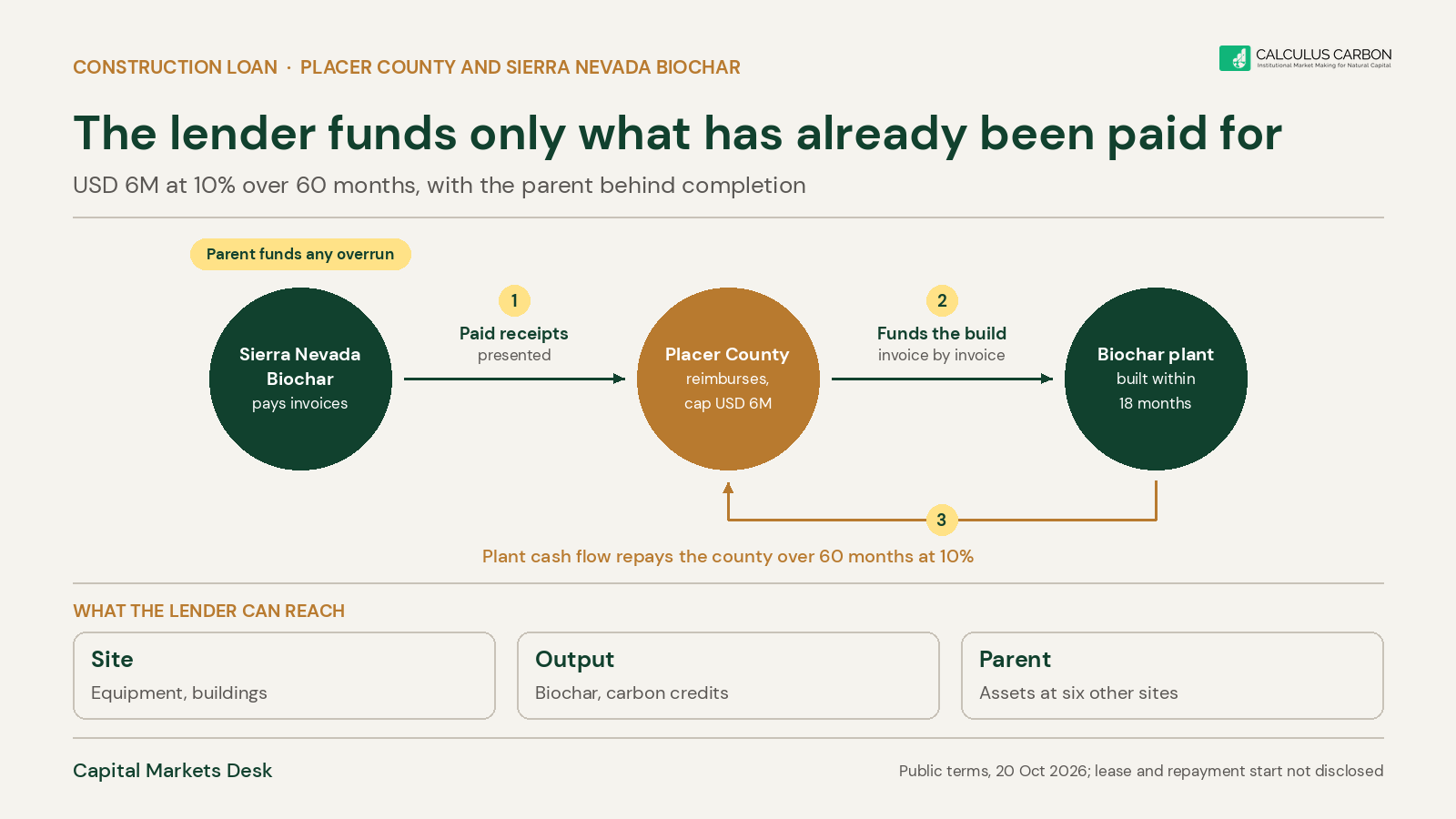
A practical route for a first-of-site biochar plant is construction debt drawn against paid invoices, with the parent funding overruns and pledging assets beyond the site. On 20 October 2026, the Placer County Board of Supervisors in California authorised a loan of up to USD 6M to Sierra Nevada Biochar LLC for a biochar facility at the county's Eastern Regional Landfill near Lake Tahoe.1 The loan carries a 10% annual rate, is repaid in principal and interest over 60 months, and is released only once the county receives paid receipts.1 The parent company, Biochar Now LLC, is responsible for any funding the project needs beyond the USD 6M.1,2 Each of those three terms addresses a specific construction risk, and together they indicate how a single small plant can borrow before it has an operating record at the site.
Is This Project Finance or a Loan to the Sponsor?
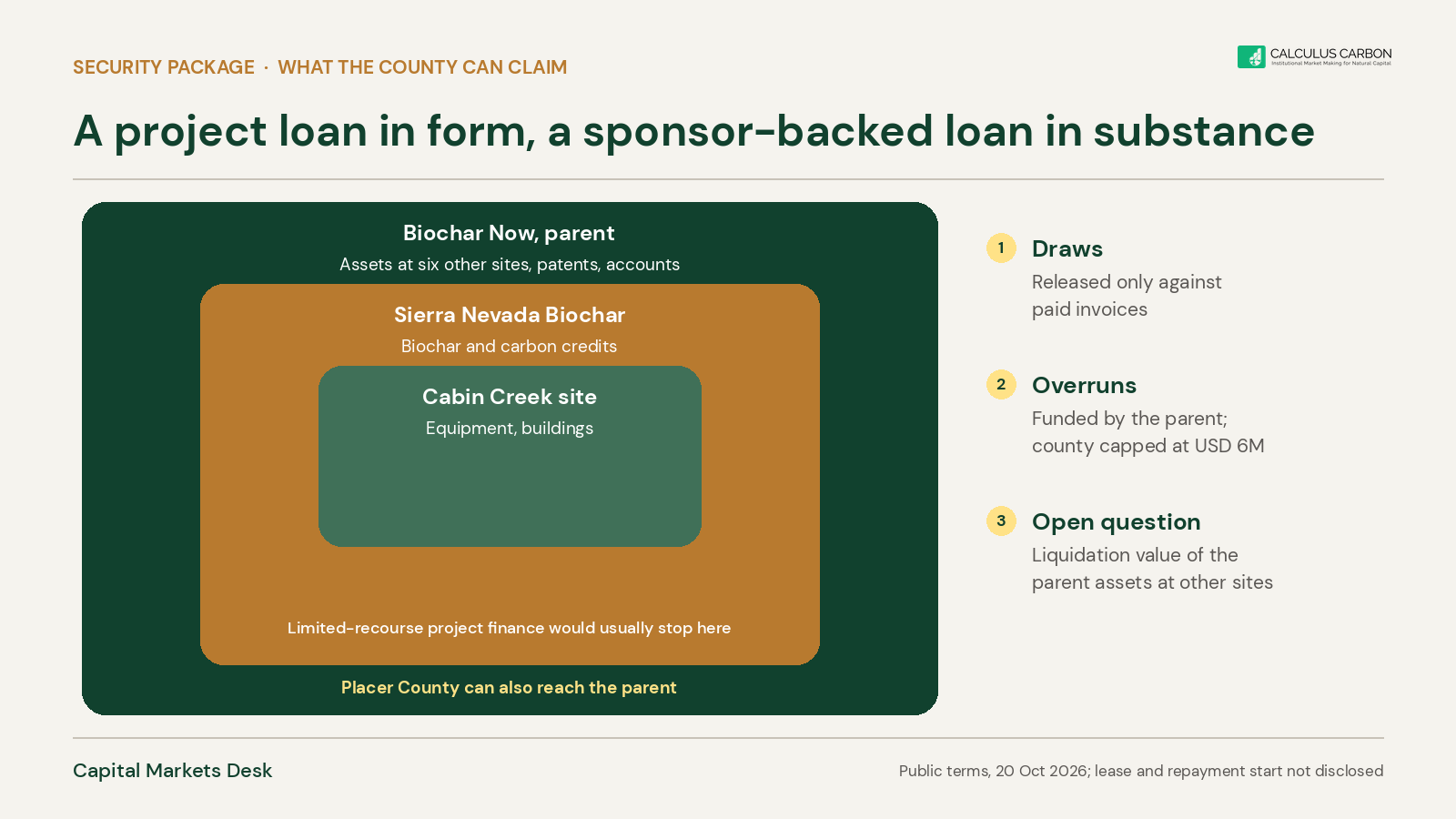
It sits between the two, and the distinction matters for anyone sizing similar debt. Project finance in its strict form is lending repaid from one asset's cash flows, with the lender's claim limited to that asset and its contracts. The borrower here is a site-level company, Sierra Nevada Biochar, which follows the project finance convention of ring-fencing one plant in one entity.1 The security package, however, reaches past that entity.
According to the county's deputy public works director, the collateral includes the equipment and buildings at the facility, its biochar and carbon credits, and assets belonging to Biochar Now at six other locations.2 The county would also hold a claim against parent assets including patents and financial accounts.2 Recourse to a parent's balance sheet is the defining feature of corporate lending rather than limited-recourse project finance. We read the structure as a project loan in form and a sponsor-backed loan in substance, which is the usual position for a first plant at a new site.
Does Drawing Against Paid Invoices Change the Lender's Risk?
It changes the order in which money moves, and that order is the lender's main protection during construction. The county's staff report states that the loan is disbursed only after the company has paid invoices for materials, construction and equipment fabrication.2 This is a reimbursement draw: the borrower spends first, presents evidence of payment, and the lender then releases the matching amount.
Two consequences follow. The lender never funds in advance of physical progress, so a stalled build leaves the county with less money out than a lump-sum advance would. The borrower, in turn, has to carry working capital between paying a supplier and being reimbursed, which places a liquidity test on the sponsor from the first invoice. Commercial construction lenders achieve a similar effect with independent engineer certificates before each drawdown; the receipts test is a simpler version suited to a USD 6M facility.
Who Carries the Cost Overrun Risk?
The parent does, by undertaking. The county states that Biochar Now is responsible for any additional funding needed beyond the USD 6M county investment, and that the county is not required to provide more.1,2 In project finance terms this is a cost overrun undertaking, a commitment by the sponsor to fund any shortfall between the budget and the actual cost of completion.
Its value depends on the sponsor's capacity, which is why the county reviewed the parent's financial records, sales receipts and ongoing sales agreements before approving the loan.2 Construction is expected to begin in spring 2027, with substantial completion required within 18 months of the start.2 A completion deadline, a capped lender commitment and an overrun undertaking together place almost all completion risk with the sponsor, leaving the lender mainly with the risk that the sponsor itself fails.
The tenor deserves the same attention. Repayment over 60 months is short when set against an 18-month construction window, and neither the county nor the press coverage states whether amortisation begins at first drawdown or at completion.1,2 That timing determines how much of the plant's early operating cash flow goes to debt service, and it is the term we would confirm first in the loan agreement.
Is the Lender Also the Feedstock Supplier and Landlord?
It is, and the overlap shapes the credit in both directions. Biochar is a charcoal-like material made by heating biomass without burning it; it is used as a soil and water treatment product and can store carbon for long periods, which is what generates carbon removal credits. The plant will convert woody debris from forest thinning that the landfill already receives, of which 20,000 to 25,000 bone-dry tons are available each year and currently travel round trips of about 200 miles to other facilities.2
Under the proposed agreements, the company would buy at least 5,000 tons a year from the county at USD 60 per ton, adjusted for moisture, and pay USD 15,000 a month in rent and 10% of the facility's net profits.2 Feedstock security, meaning a contracted and nearby source of raw material, is the risk that most often delays biochar plants, and here the lender controls it. The same position concentrates exposure: the county's loan repayments, feedstock revenue, rent and profit share all depend on one plant operating.
The ground lease is not yet in place. The board left it out of the 20 October vote and will consider it at a future meeting.1 A construction lender would normally treat site rights as a condition precedent, meaning a requirement to be satisfied before the first drawdown, and the sequencing of the lease and the first reimbursement has not been disclosed.
Did the Terms Change Between 2024 and 2026?
They did, and the direction is instructive. The 2024 staff report proposed a five-year USD 6M convertible loan at 11%, an equity stake or equivalent 10% profit share for the county, shared profit on carbon credit sales initiated by the county, and a ground lease at USD 12,000 a month.4,3 The 2026 approval describes a loan and promissory note at 10% over 60 months, with disbursement against paid receipts and an explicit overrun obligation on the parent.1
The rate moved down by one percentage point, the rent proposal moved up to USD 15,000 a month, and the protections around disbursement and overruns became explicit.2,4 A lender that accepts a lower coupon in exchange for tighter draw and completion terms is pricing construction risk through structure rather than through rate. That trade is usually available only where the lender has a reason to see the asset built, which the county states in terms of wildfire fuel reduction and lower forest health costs.1
Which Parts of the Structure Can Other Biochar Plants Reproduce?
Most of the mechanics, provided the sponsor can support them. Reimbursement draws, a capped lender commitment, a completion deadline and a parent overrun undertaking are standard construction finance tools and do not depend on a public lender. A private credit fund or a regional bank can apply the same terms to a single kiln site of similar size.
The harder conditions to reproduce are on the sponsor side. The parent must have assets elsewhere to pledge, operating sales to evidence, and the liquidity to pay invoices before reimbursement. Developers without an existing operating base will tend to need equity or a guarantor to fill that role. The carbon credits in the collateral package also deserve caution: neither the county nor the press coverage discloses a carbon credit offtake for this plant, so their recovery value to the lender is uncertain.
The Sacramento Bee noted that it remains unclear whether the pledged assets would cover the loan if the company defaults.2 That is the correct open question, and it is the one any lender reproducing the structure should test first, by valuing the parent's assets at the other six sites on a liquidation basis.
The Read for Institutional Capital
A practical route for a first-of-site biochar plant is construction debt drawn against paid invoices, with the parent funding overruns and pledging assets beyond the site. Placer County's USD 6M loan combines a 10% rate, 60-month repayment, reimbursement draws and recourse to Biochar Now's other locations, while the ground lease and repayment start date remain to be settled.1,2 For an allocator considering a single biochar plant, the questions to ask are when each drawdown is released, who funds the overrun, and what the lender can reach if the site fails.
Small biochar plants can raise construction debt before they have a record at the site, provided the lender funds only what has been paid for and the parent stands behind completion.
This note is for information only and is not investment advice.
Sources
- [1] Placer County, Placer County advances Cabin Creek Biomass Facility through new partnership agreements, news release, 20 October 2026. placer.ca.gov
- [2] Sacramento Bee, Placer County puts up $6M loan for wildfire debris project. What are the risks?, 21 October 2026. sacbee.com
- [3] Placer County, Placer County nears deal to bring biochar production company to North Lake Tahoe, news release, 19 September 2024. placer.ca.gov
- [4] Placer County Public Works, Cabin Creek Biomass at Eastern Regional Landfill, Negotiate Agreement between Biochar Now, LLC and Placer County, staff report to the Board of Supervisors, 10 September 2024. placer.ca.gov