
Carbon Removal Project Finance · Terradot and HASI
Two Offtake Books, One Loan: How Terradot Reached an Institutional Debt Ticket
Terradot's USD 34M senior secured term loan from HASI followed its purchase of Eion's assets, which put two fixed-price Frontier offtakes worth USD 59.9M under one owner. The deal suggests one way a carbon removal developer can reach the ticket size institutional lenders look for.
The Read
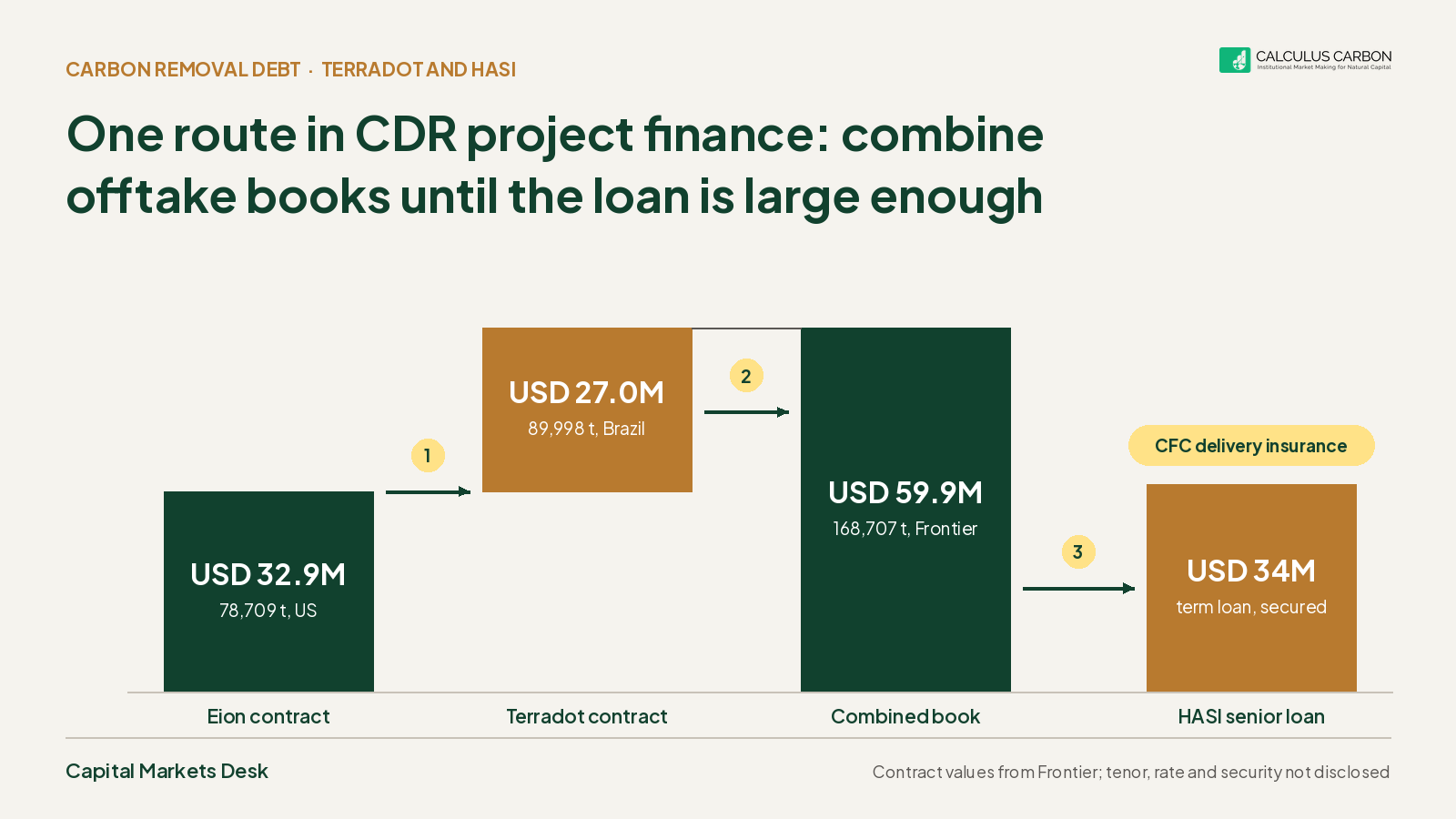
An interesting practice in project finance within carbon removal, and one which could serve as a model for future transactions, is to combine separately signed purchase contracts under one owner so that the contract book reaches the size an institutional lender is prepared to finance. Terradot's USD 34M senior secured term loan from HASI, closed on 27 October 2026, is the clearest recent case.1 Eight months earlier Terradot bought the assets of Eion, a smaller competitor, and with them a second fixed-price contract from Frontier, the carbon removal buying coalition. The two Frontier contracts together come to 168,707 tonnes and USD 59.9M.3,4 This note sets out how the deal was built, how it compares with other carbon removal debt raised in 2026, and what another developer would need in order to repeat it.
Is Ticket Size the Obstacle Between Carbon Removal and Institutional Debt?
Carbon dioxide removal (CDR) is the business of taking carbon dioxide out of the atmosphere and storing it durably. Most CDR projects sell their output through offtakes, long-term contracts in which a buyer agrees to purchase a fixed volume of removal credits at an agreed price as they are delivered. Those contracts are now being used to raise debt, but most of the loans disclosed in 2026 are small, and most come from lenders with a reason to be there beyond the loan itself.
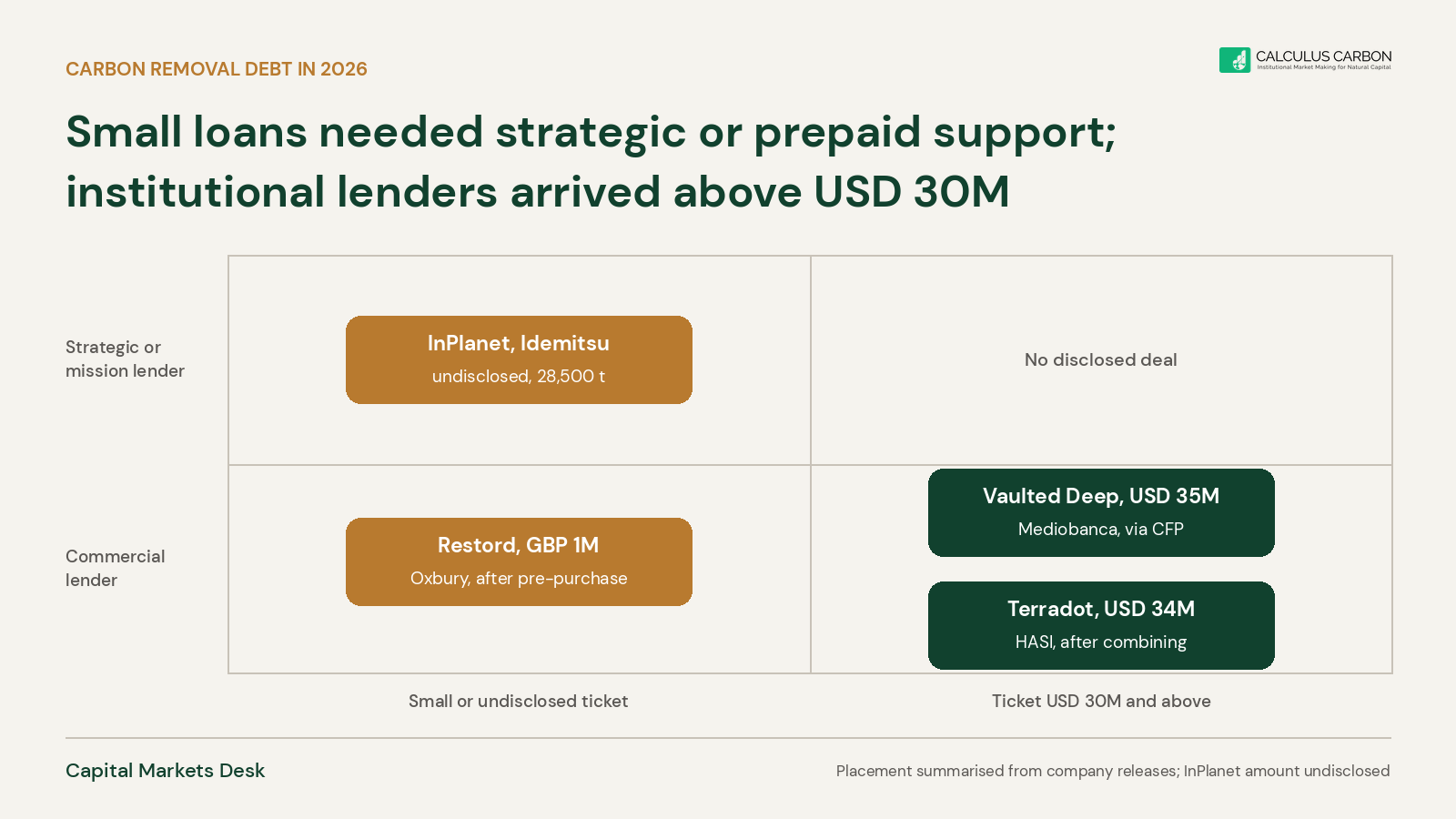
Restord, a UK biochar company, closed a GBP 1M loan from Oxbury Bank, a specialist agricultural lender, in March 2026.9 The loan followed a forward purchase of about GBP 165,000 of carbon removal by Terraset, which uses philanthropic capital to pre-purchase credits, and it was structured against the pyrolysis equipment with a manufacturer buyback option as further protection.8 InPlanet, which spreads crushed rock on Brazilian farmland, closed a non-recourse facility in September 2026 with Idemitsu Americas Holdings to fund delivery of more than 28,500 tonnes contracted with Microsoft; the amount was not disclosed, and Idemitsu described the deal as part of its own strategy to expand in carbon markets.10 Terraton, a biochar developer, secured USD 1.5M of debt from HSBC Ventures in October 2026.13
Each of these loans brought a project forward. None of them is the ticket size that a pension fund, an infrastructure debt fund or a sovereign investor normally underwrites. Eion's chief executive, Anastasia Pavlovic Hans, made the point directly when Eion sold to Terradot in February 2026: she said sovereign wealth funds and similar investors preferred to put USD 50M to USD 200M into projects, which left Eion too small for them.5 TechCrunch reported her conclusion more bluntly: Eion was simply too small.6
Does Combining Two Offtake Books Change What a Lender Sees?
Both companies use enhanced rock weathering (ERW), in which crushed rock is spread on farmland, reacts with carbon dioxide dissolved in rainwater and stores it for thousands of years.1 Eion spread olivine on farms in the US South and Midwest;16 Terradot spreads basalt in Brazil.6
Frontier, whose members include Google, Salesforce, JPMorgan, Shopify and Stripe,1 had signed a separate fixed-price contract with each company. The contract now called Terradot Delta, originally signed with Eion, covers 78,709 tonnes for USD 32.9M, delivering from 2027 to 2030. Terradot's own Brazilian contract, Terradot Carcará, covers 89,998 tonnes for USD 27.0M, delivering from 2025 to 2029.3,4 Frontier's portfolio page records that Terradot is now responsible for delivering the Eion contract.4 Together the two contracts are worth USD 59.9M for 168,707 tonnes, an average of roughly USD 355 a tonne.
Neither contract was small to begin with, and the combination did more than add the two numbers together. Terradot's announcement of the deal said the enlarged portfolio spread delivery across different soils, supply chains and growing seasons in two hemispheres, and its chief financial officer said a larger, diversified portfolio with an operating record improves bankability and access to long-term capital.7 For a lender, two contracts with the same creditworthy buyer, delivered by one operator under one measurement system, behave more like a portfolio than like two separate credits. Weather, rock supply or farmer uptake can go wrong in one country without the same thing happening in the other.
The two Frontier contracts are not the whole book. Terradot said at the time that its existing contracts, including those with Google and Frontier, exceeded 300,000 tonnes, and that the combined company would hold more than 400,000 tonnes under contract.5,7
Is the USD 34M Loan the Same Thing as the USD 59.9M Contract Book?
It is not, and the two figures should be kept apart. The USD 59.9M is revenue that Frontier buyers pay only as verified tonnes are delivered over several years. The USD 34M is capital lent up front so that Terradot can do the work that produces those tonnes. Dividing one by the other gives a ratio of about 57 per cent, but that is an illustration, not a disclosed advance rate: the release does not say which contracts form the security package, or whether other contracts in the wider book support the loan.1
The disclosed terms are limited. The loan is a senior secured term loan, meaning HASI ranks first for repayment and holds security over the borrower's assets, for Terradot's ERW projects in the US and Brazil.1 Those projects are supported by fixed-price, multi-year Frontier offtakes, and the investment carries carbon delivery insurance from CFC, arranged through Marsh, which pays out if specified delivery risks cause tonnes to fall short.1,2 The tenor, interest rate, insured share of delivery and repayment profile have not been disclosed. Terradot plans to spread 1 million tonnes of rock across 60,000 hectares in 2026 and 2027; that figure is rock deployed, not carbon removed.1
The lender matters as much as the size. HASI is a listed investor with more than USD 17 billion in managed assets, mostly in solar, storage and wind portfolios backed by long-term contracts with investment-grade buyers.14,15 Its co-chief investment officer, Annmarie Reynolds, said Terradot combined contracted demand, rigorous field data, a repeatable deployment model and a thoughtful approach to risk.1 Terradot's chief financial officer, Julia Sekula, put the lender's view more simply: lenders only back what they can predict.1 An infrastructure lender of this kind is underwriting a contracted cash flow, not taking a strategic position in carbon removal.
Does the Precedent Hold Across Other Recent Carbon Removal Debt?
The closest comparable is Vaulted Deep, which buries organic waste deep underground. In September 2026 it closed a USD 35M debt facility from Mediobanca, arranged by CFP Energy and supported by its waste service agreements and contracted carbon removal revenue, including offtakes with Frontier buyers; Artio, a carbon insurance firm, helped de-risk the deal.11 Speaking about that facility, CFP Energy's head of voluntary carbon described what it took to get comfortable: a developer with a proven record, high-credit buyers removing market risk, and an insurer covering the residual project risk that institutional lenders expect.12 Vaulted Deep reached its size with several contracts on one balance sheet, but without a merger.
Two other deals show the same aggregation logic arrived at by different routes. InPlanet and Idemitsu structured their facility so that additional lenders can participate on the same basis, and they intend to use it as a template across new projects and new buyers.10 Terraton is developing a USD 25M pooled vehicle to finance about 20 more biochar facilities; because every facility uses the same design, equipment and reporting, the fund can underwrite them as a portfolio across operators and countries.13 Pooling contracts to reach a financeable size is therefore a recurring aim. Buying a competitor's contracts and then borrowing against the combined book is, on public information, a single case, which is why it is better described as an interesting model than as an established practice.
Can Other Developers Copy the Logic Without a Merger?
Four conditions made the Terradot case work, and each can be tested on another deal. The first is a common buyer: both contracts were with Frontier at fixed prices, so the lender had one counterparty type to assess. The second is a common method. Both books were ERW, measured by one operator, so the lender could rely on a single measurement, reporting and verification process, the audit chain that confirms how much carbon was actually removed. The third is diversification that is real rather than nominal, with two rock types in two countries and different delivery windows. The fourth is insurance over delivery, which narrows the gap between contracted tonnes and the tonnes a lender expects to see.
A merger is one way to meet those conditions, not the only one. Developers using the same method can pool contracts in a shared vehicle, as Terraton is attempting, or sign onto a common-terms facility that admits further lenders, as InPlanet has set up. A buyer coalition such as Frontier, which already contracts with many developers, is also well placed to make contract terms standard enough to be pooled.
The logic has limits. Contracts with different buyers, prices and termination rights are hard to combine, and assigning a contract to a new owner usually needs the buyer's agreement. Pooling across methods with very different measurement risk, such as biochar and rock weathering, asks the lender to understand both. A merger also concentrates delivery in one sponsor, so the lender's exposure to that operator rises even as its exposure to any single field falls.
Should Lenders Read a Larger Book as Lower Risk or Simply Larger Risk?
Both readings have some truth. Combining the books reduces the chance that a single region, harvest or rock supply problem stops repayment, and it lets the lender spread the fixed cost of diligence over a larger loan. It does not remove the core uncertainty in ERW, which is measuring how much carbon the rock has actually captured; Frontier's own project pages describe several methods Terradot uses to estimate this.3 The delivery insurance covers specified risks, and its scope in this deal has not been published.1
A lender should therefore treat aggregation as a way to reach a financeable size with a more predictable cash flow, provided the underlying contracts, measurement and insurance would each stand up on their own. Size achieved by stacking weak contracts would simply produce a larger weak loan.
The Read for Institutional Capital
Carbon removal debt has so far come mainly from lenders with a strategic or philanthropic reason to participate, at tickets well below what infrastructure lenders usually underwrite. Terradot's loan from HASI shows that a developer can bring an institutional lender in by first putting two strong, fixed-price contracts with the same buyer under one owner, then adding delivery insurance. The structure is a single case today, but its logic of a common buyer, a common method and real diversification can be copied through pooled vehicles or common-terms facilities as well as through mergers. Allocators should judge such loans on the quality of each contract in the pool, not on the headline size of the combined book.
A combined book of sound, same-buyer contracts gave an infrastructure lender a cash flow it could predict, and that is a route other carbon removal developers can follow with or without a merger.
This note is for information only and is not investment advice.
Sources
- [1] Business Wire, “Terradot and HASI Close $34M Investment for Carbon Removal Projects”, 27 October 2026. businesswire.com
- [2] Carbon Herald, “Terradot Secures Debt Financing For Its ERW Projects, Locking In $34M From HASI”, 28 October 2026. carbonherald.com
- [3] Frontier, “Terradot Carcará” portfolio page. frontierclimate.com
- [4] Frontier, “Terradot Delta” (originally contracted with Eion) portfolio page. frontierclimate.com
- [5] Axios, “Terradot-Eion deal signals a step in CO2 removal consolidation”, 6 February 2026. axios.com
- [6] TechCrunch, “Google- and Microsoft-backed Terradot acquires carbon-removal competitor”, 6 February 2026. techcrunch.com
- [7] Terradot press release via Yahoo Finance, “Terradot Acquires Eion to Form Leading Global Enhanced Rock Weathering Carbon Removal Platform”, 6 February 2026. finance.yahoo.com
- [8] Terraset, “Taking biochar to the bank”, 30 June 2026. terraset.substack.com
- [9] Green Finance Institute, “Scaling Carbon Dioxide Removals” (CDR Catalyst and the Restord transaction). greenfinanceinstitute.com
- [10] InPlanet, “InPlanet and Idemitsu Americas Holdings Close Non-Recourse Debt Facility”, 17 September 2026. inplanet.earth
- [11] CFP Energy, “Vaulted Deep Secures $35 Million in Debt Financing with CFP Energy to Expand Nationwide”, 21 September 2026. cfp.energy
- [12] The Carbon Removal Scoop, episode 104, “From Equity to Debt: How CDR Gets Bankable”, 12 October 2026. shows.acast.com
- [13] Terraton press release via Yahoo Finance, “Terraton Issues First Carbon Removal Credits”, 20 October 2026. finance.yahoo.com
- [14] HASI, “Invenergy and HASI Expand Partnership to Support 2.7 GW Portfolio”, October 2026. investors.hasi.com
- [15] HASI, “Our Investments”. hasi.com
- [16] DatacenterDynamics, “Frontier to buy $33m in carbon credits from enhanced rock weathering firm Eion”, 2025. datacenterdynamics.com