
Project Finance · Biochar · 9 November 2026
One Route in CDR Project Finance: Build the Biochar Plant Inside the Feedstock Business, With Carbon Credits on Top
An emerging practice in project finance within carbon removal is to build the plant inside a business that already controls the feedstock, so that product sales and public incentives carry the base case and carbon credits sit on top. Robinson Carbon's USD 16.3M Louisiana biochar facility, announced on 4 November 2026, is the most recent example.
The Read
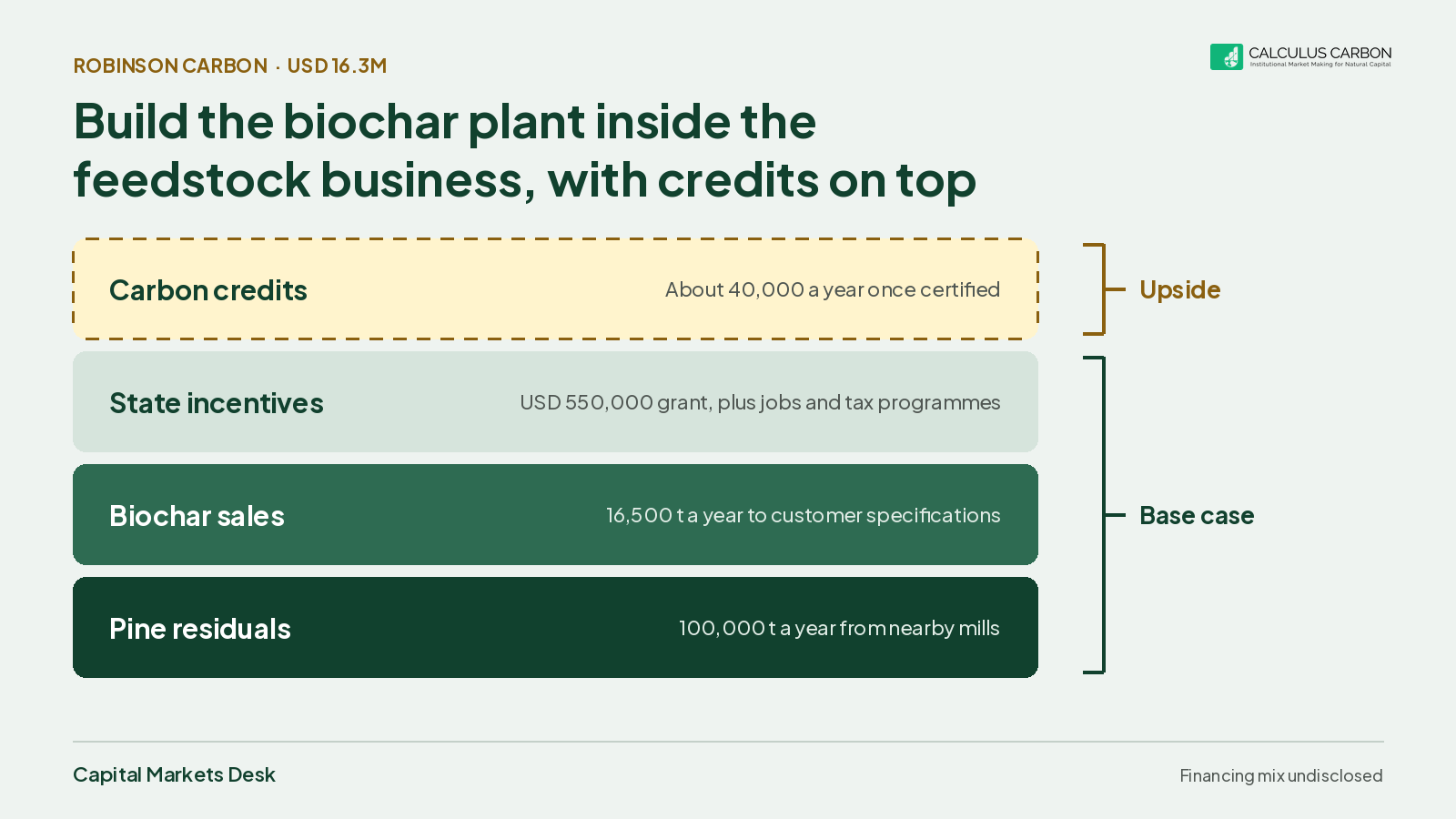
An emerging practice in project finance within carbon removal is to build the plant inside a business that already controls the feedstock, so that product sales and public incentives carry the base case and carbon credits sit on top. On 4 November 2026, Robinson Carbon, the carbon products arm of the New Orleans firm Robinson Lumber Company, announced a USD 16.3M investment in a biochar facility at England Airpark in Rapides Parish, Louisiana.1 The plant will run two rotary drum pyrolysis reactors, converting about 100,000 tonnes of Southern Yellow Pine residuals a year into 16,500 tonnes of biochar.1 Once certified under the Puro Standard, it is expected to generate about 40,000 carbon removal certificates a year.1 Construction is due to start in November 2026, with production expected in the second quarter of 2027.1
Is This a Project Financing at All?
Not in the strict sense, and the distinction is the point of the deal. Project finance in its strict form means lending repaid from one asset's cash flows, with the lender's claim limited to that asset. Neither the state's release nor the press coverage states whether the USD 16.3M comes from equity, debt or the parent's own funds.1,2 The only disclosed outside capital is a USD 550,000 performance-based grant from the state of Louisiana for site and infrastructure improvements, alongside expected participation in the state's High Impact Jobs and Industrial Tax Exemption programmes.1
Robinson Lumber is a fifth-generation family business founded in 1893, which owns manufacturing and concentration yards, buys directly from sawmills and sells into more than 70 countries.1 We read the plant as a new product line inside an operating company rather than a stand-alone project company. That framing matters for any lender later asked to refinance it, because the credit question becomes the strength of the sponsor and its supply chain, not the price of carbon removal.
In practice, a plant of this kind is often built with sponsor equity and corporate borrowing, then refinanced with asset-level debt once it has run for a year or two. At that point a lender would look for a feedstock supply agreement with a minimum tonnage, offtake contracts for the biochar, an operating record showing that the reactors reach their design throughput, and a debt service reserve sized to several months of payments. Each of those items can be built from an existing business more quickly than from a standing start.
Does Owning the Feedstock Business Change the Credit?
It does, because feedstock is the risk that most often stalls a biochar plant. Biochar is a charcoal-like material made by heating biomass without burning it; it is sold as a soil and remediation product and can store carbon for long periods, which is what generates carbon removal credits. A plant that cannot secure a steady, nearby and cheap supply of biomass cannot run at the throughput its model assumes.
Robinson Carbon plans to source residuals from nearby mills, and its parent already buys directly from sawmills.1 According to the company, the plant creates a new market for sawmill waste that used to go to paper mills across Louisiana.2 The supply contracts themselves, and the price paid per tonne of residuals, have not been disclosed.2 A lender would still ask for them, but the sponsor's existing purchasing relationships reduce the risk that the plant is built and then waits for material.
Should Carbon Credits Sit in the Base Case?
On the disclosed facts, they should sit on top of it. The 40,000 certificates a year depend on certification under the Puro Standard, which has not yet been granted, and no buyer or price for those certificates has been disclosed.1,2 The company told NOLA.com that it holds a contract with an international carbon credit registry, without naming it, and that the credits could be worth millions of dollars.2
The physical product is better defined. The plant is designed to make biochar to customer specifications for agricultural, horticultural and pollution remediation uses.1 At the stated volumes, each tonne of biochar would carry roughly 2.4 certificates, so credit revenue can be material even at modest prices. A prudent debt case would nonetheless size repayment on product sales and treat credit revenue as an upside that becomes bankable only once certification and a contracted buyer are in place.
Can Public Incentives Do Part of the Work?
They can, but on this plant they are small relative to capital cost. The USD 550,000 grant is about 3.4% of the USD 16.3M budget, and the values of the jobs and property tax incentives have not been published.1,2 Performance-based grants of this kind are paid against delivery of agreed commitments, which suits a sponsor that is confident in its build schedule and hiring plan.
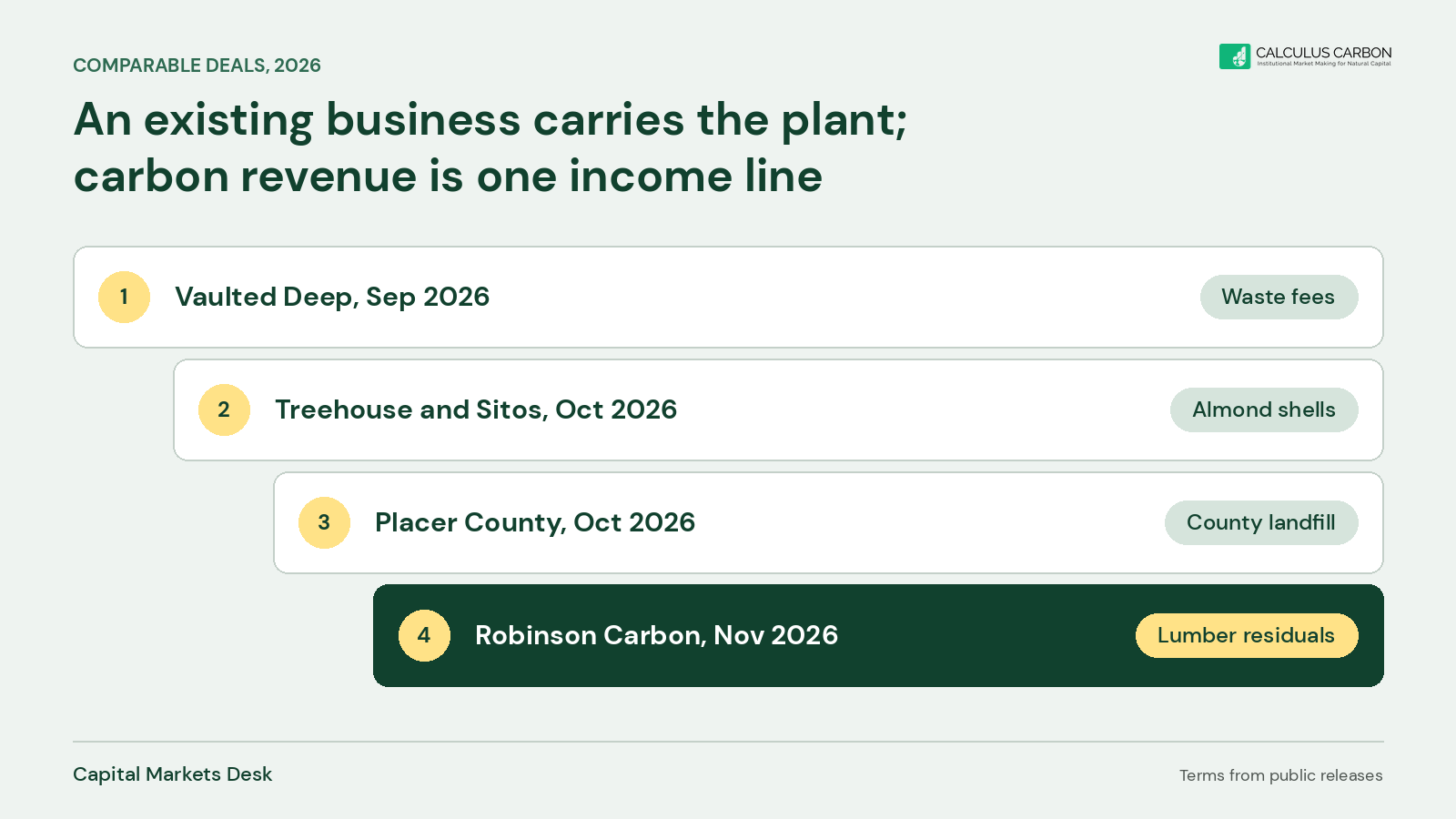
Incentives matter more where they enter the capital stack directly. The Treehouse California Almonds and Sitos Group plant in Delano, California, announced in October 2024 at USD 9M, was funded by Sitos shareholders with New Markets Tax Credits intended as the eventual long-term funding.3 That plant opened in October 2026, converting almond shells from Treehouse's own hulling and shelling operations.4
Is the Practice Recurring or a One-Off?
It is recurring, which is why we describe it as an emerging practice rather than a single interesting structure. Before settling on the wording, we looked for comparable transactions in the past few months in which an established feedstock or waste business, or the owner of the waste stream, rather than a stand-alone carbon developer, carries the plant.
Three stand out. In Delano, the feedstock comes from the almond processor's own operations.3,4 In Placer County, California, the county approved on 20 October 2026 a loan of up to USD 6M to Sierra Nevada Biochar for a plant at the county's own Eastern Regional Landfill, so that the owner of the site and its waste stream also became the lender.5 In September 2026, Vaulted Deep, a waste management and carbon removal company, secured a USD 35M debt facility supported by its waste servicing agreements as well as its carbon removal contracts.6
The common thread is that carbon revenue is one income line among several, attached to a business that would continue to handle the material if the credit market weakened. Lenders and public funders appear more willing to commit where that is true.
Should Lenders Treat the Model as Repeatable?
Provided three conditions hold, the logic travels well. The sponsor needs a durable feedstock position, through ownership or long purchasing relationships. The plant needs a physical product with identifiable buyers, so that debt service does not depend on credit prices. The credit stream needs a clear path to certification and sale, so that it can later be contracted and added to the debt case.
The limits are equally clear. Developers without an operating business behind them cannot borrow on this basis, and most stand-alone carbon removal companies fall into that group. For Robinson Carbon specifically, the open items are the financing mix, the residual supply terms, the biochar sales contracts and the timing of certification, none of which has been disclosed.1,2
The Read for Institutional Capital
An emerging practice in project finance within carbon removal is to build the plant inside a business that already controls the feedstock, so that product sales and public incentives carry the base case and carbon credits sit on top. Robinson Carbon's USD 16.3M plant, with 100,000 tonnes of residuals in, 16,500 tonnes of biochar out and about 40,000 certificates expected once certified, follows that pattern, alongside Delano, Placer County and Vaulted Deep.1,3,5,6 For an allocator assessing a biochar plant, the questions to ask are who owns the feedstock, who buys the physical product, and whether the debt still works if the credits are never sold.
A biochar plant anchored in an established feedstock business can be financed on its product and its sponsor, leaving carbon revenue as the upside that later debt can draw on.
This note is for information only and is not investment advice.
Sources
- [1] Louisiana Economic Development, Robinson Carbon Takes Biochar Production to Industrial Scale in Central Louisiana, news release, 4 November 2026. opportunitylouisiana.gov
- [2] NOLA.com, New Orleans company, Robinson Carbon, to invest $16M in biochar facility in central Louisiana, 4 November 2026. nola.com
- [3] Treehouse California Almonds, Treehouse California Almonds Partners with Sitos Group to Launch $9 Million Dollar State-of-the-Art Slow Pyrolysis Biochar Facility, news release, 28 October 2024. treehousealmonds.com
- [4] carbon.fyi, Treehouse California Almonds and Sitos Group open Delano biochar facility, 22 October 2026. carbon.fyi
- [5] Placer County, Placer County advances Cabin Creek Biomass Facility through new partnership agreements, news release, 20 October 2026. placer.ca.gov
- [6] Waste Dive, Vaulted Deep gets $35M debt deal to expand injection well technology, 22 September 2026. wastedive.com